
Imagine explaining a simple instruction to a colleague, only to find that they have misunderstood it several times. In a moment of frustration, someone might say, “Are you dense?” Although the speaker may intend to express disbelief or impatience, the words can sound insulting and make the other person feel embarrassed or disrespected.
The phrase “Are you dense?” is an informal, often sarcastic question used to suggest that someone is being slow to understand something. Here, dense refers to difficulty understanding information rather than physical thickness. Depending on the situation, the phrase can communicate frustration, disbelief, irritation, or teasing between people who know each other well.
However, word choice matters in modern communication. A sarcastic remark that seems harmless among close friends can sound hostile in a workplace, classroom, email, or online discussion. Choosing an alternative such as “Does that make sense?” or “Am I explaining this clearly?” can communicate the same underlying concern without insulting anyone.
What Does “Are You Dense?” Mean?
“Are you dense?” is an informal expression used to question whether someone is having difficulty understanding something that the speaker considers obvious. It often conveys frustration, impatience, disbelief, or sarcasm rather than a genuine request for information. People may use it during arguments, casual conversations, or moments of misunderstanding, but it can sound insulting because it questions another person’s ability to understand.
Origin & History of “Are You Dense?”
The expression comes from the adjective dense, which entered English through French from Latin densus, meaning thick, crowded, or closely packed. Historically, the word described physical substances or groups of things that were tightly concentrated.
Over time, English speakers began using dense figuratively to describe something difficult to understand or a person perceived as slow to grasp an idea. This figurative meaning developed alongside similar expressions that compare mental understanding with qualities such as sharpness, clarity, or speed.
The question “Are you dense?” emerged from this figurative use. Instead of asking directly why someone has misunderstood an explanation, the speaker uses a rhetorical question that implies the listener should have understood already.
Today, the phrase appears in everyday speech, films, television, online discussions, and fictional dialogue. It can be used humorously among close friends, but it is also associated with arguments, condescension, and verbal put-downs.
The important distinction is that “Are you dense?” expresses the speaker’s judgment about another person’s understanding; it does not establish that the person lacks intelligence. Someone may misunderstand an instruction because it was unclear, they missed information, or they have a different perspective.
When Should You Use “Are You Dense?”
The phrase is most appropriate when the speaker deliberately wants a sharp, confrontational, or sarcastic effect and understands the possible consequences. It is rarely the best choice when the goal is to explain information or resolve a misunderstanding.
In Casual Conversations
Among close friends who regularly exchange sarcastic jokes, the phrase might be used as exaggerated teasing. Even then, the relationship and the listener’s comfort matter.
For example, two friends joking about an obvious plot twist might use the expression playfully. The same words could feel hurtful if one friend is already embarrassed or upset.
In Professional Settings
In most workplaces, it is better to avoid the phrase. If a colleague repeatedly misses a key instruction, focus on the specific misunderstanding rather than questioning their intelligence.
For example, say, “Let’s review the deadline and responsibilities once more,” instead of “Are you dense?”
This keeps the conversation focused on the task and makes it easier to correct the problem.
In Writing and Presentations
The phrase may appear in fictional dialogue, character-driven storytelling, comedy, or an analysis of rude expressions. It can help establish a character’s impatience or an antagonistic relationship.
In instructional writing, presentations, and professional documents, however, it is usually counterproductive. Clear explanations and neutral questions help readers engage with the material without feeling judged.
In Digital Communication
Text messages, Slack, WhatsApp, and social media lack many of the vocal cues that distinguish joking from genuine anger. A remark intended as playful may be read as an attack.
If the objective is to resolve a misunderstanding, use a direct but neutral question such as, “Which part should I clarify?” This invites a response instead of provoking defensiveness.
When Should You Avoid “Are You Dense?”
There are several situations where using this expression can damage communication or create unnecessary conflict.
- Formal workplace situations: It may undermine your professionalism and damage working relationships.
- Academic environments: Students and teachers benefit more from patient explanations than from comments that shame someone for misunderstanding a topic.
- Legal or official communication: Insulting language can distract from the facts and make a written record appear unnecessarily hostile.
- Sensitive conversations: People dealing with stress, embarrassment, or personal difficulties may experience the phrase as especially hurtful.
- Cross-cultural communication: English speakers from different backgrounds may interpret sarcasm and teasing differently.
- Public discussions: Using the expression in a comment or group chat can humiliate someone in front of others.
- Repeated misunderstandings: If a person continues to struggle, the explanation, instructions, or circumstances may need to be reviewed rather than blaming the listener.
A useful rule is to address the misunderstanding, not the person’s intelligence. This approach helps maintain respect while still allowing you to be clear, firm, and honest.
“Are You Dense?” vs. Similar Expressions: Key Differences
Several English expressions communicate confusion, impatience, or disbelief, but they do not all carry the same emotional weight.
| Phrase | Meaning Difference | Tone Difference | Best Use Scenario |
| Are you dense? | Questions someone’s ability to understand | Insulting, sarcastic, confrontational | Fictional dialogue or deliberately sharp banter |
| Are you following me? | Checks whether someone understands or can keep up | Neutral or mildly impatient | Meetings, lessons, explanations |
| Did that go over your head? | Suggests someone missed a point, joke, or implication | Casual, teasing, potentially condescending | Informal conversations when teasing is welcome |
| Does that make sense? | Checks whether an explanation is understandable | Neutral and generally polite | Teaching, presentations, workplace discussions |
| What’s not clicking? | Asks what part someone is struggling to understand | Casual, sometimes impatient | Informal troubleshooting or familiar conversations |
| Are we on the same page? | Checks whether people share the same understanding | Collaborative and professional | Team discussions, project updates, planning |
The central difference is whether the expression criticizes the person or checks the understanding. The first approach can create conflict; the second makes it easier to identify and resolve the problem.
Common Mistakes & Misuse of “Are You Dense?”
Even fluent English speakers can misjudge this expression because its impact depends on context, relationships, and delivery.
Overusing the Phrase
Using “Are you dense?” whenever someone disagrees or asks a question can make the speaker appear impatient and dismissive. A person who asks for clarification may understand the issue perfectly well but simply have a different interpretation.
Using It in the Wrong Context
The expression is particularly unsuitable in formal emails, client meetings, interviews, classrooms, and sensitive discussions. A neutral clarification is more effective when accuracy and cooperation matter.
Confusing Disagreement With Lack of Understanding
Someone who rejects an idea is not necessarily failing to understand it. Saying “Are you dense?” can shut down a legitimate discussion by suggesting that disagreement is evidence of low intelligence.
A better response is, “I understand your point, but I see the evidence differently.”
Assuming Sarcasm Will Be Understood
Friends may recognize a sarcastic tone during a face-to-face conversation. In a text message, the same words can look genuinely hostile because facial expressions and vocal cues are absent.
Overlooking Cultural Differences
Not every English-speaking community treats teasing and blunt criticism in the same way. What one person considers friendly banter may be perceived as disrespectful by another.
Ignoring Unclear Instructions
When the same misunderstanding happens repeatedly, the speaker should consider whether the instructions are incomplete or confusing. Repeating an insult will not make an unclear explanation more useful.
Psychological Reason People Prefer “Are You Dense?”
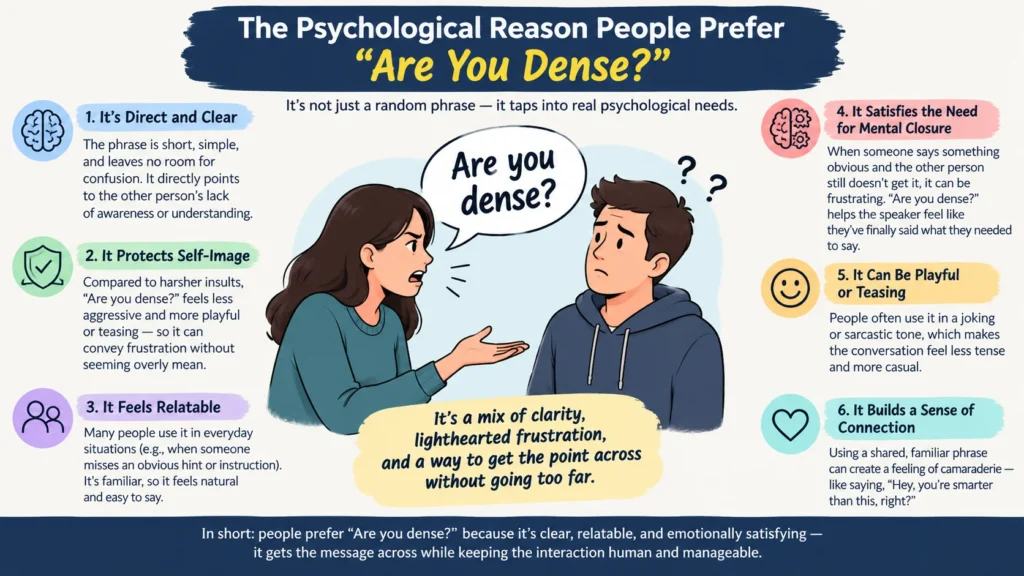
People may use sharp expressions such as “Are you dense?” because these words provide a quick way to communicate frustration. However, understanding the reasons behind the phrase does not mean that insulting someone is justified.
Cognitive Load Reduction
When people feel stressed, they may favor short, familiar expressions instead of carefully explaining what went wrong. A brief rhetorical question communicates irritation immediately, but it leaves the underlying misunderstanding unresolved.
Trust and Authority Signals
Some speakers use blunt language to establish authority or signal that they consider an issue obvious. In certain competitive environments, they may believe that sounding forceful will make others respond quickly.
However, confidence and respect are not mutually exclusive. A clear statement of expectations often demonstrates more effective leadership than a personal insult.
Attention Economy
Modern communication often rewards brief, emotionally striking messages. Sharp expressions can attract attention in online discussions because they provoke reactions, but attention does not necessarily produce understanding or agreement.
Modern Communication Habits
Fast-paced messaging, short comments, and frequent notifications can encourage people to respond before considering how their words will be received. When frustration rises, a person may type a sarcastic remark that they would reconsider in a face-to-face conversation.
Pausing briefly and identifying the actual problem can help prevent unnecessary conflict.
Emotional Self-Protection
Occasionally, a speaker uses ridicule to avoid admitting that they have failed to explain something clearly. Blaming the listener can feel easier than reconsidering their own communication.
A more productive approach is to ask, “Which part should I explain differently?” This question keeps attention on solving the problem rather than assigning blame.
US vs UK Usage of “Are You Dense?”
“Are you dense?” is understood in both American and British English. The word dense has the same basic figurative meaning in both varieties: someone is perceived as slow to understand something.
| Feature | American English | British English |
| Meaning | Suggests that someone is slow to understand | Suggests that someone is slow to understand |
| General tone | Often blunt, sarcastic, or insulting | Often blunt, sarcastic, or insulting |
| Informal use | May appear in teasing, arguments, and entertainment | May appear in teasing, arguments, and entertainment |
| Professional suitability | Generally inappropriate | Generally inappropriate |
| Common neutral alternative | “Does that make sense?” | “Is that clear?” or “Does that make sense?” |
These are broad tendencies, not strict regional rules. Individuals vary considerably in their use of sarcasm, and context often matters more than nationality.
In both countries, “Are you dense?” can sound hostile when used to criticize someone’s understanding. British speakers may also use other blunt expressions, such as “Are you being deliberately obtuse?”, while American speakers might say “Are you not getting it?” Neither is automatically polite.
For international communication, neutral questions are usually the safest choice because they reduce the risk of misinterpreting humor or regional conversational habits.
“Are You Dense?” in Digital & Modern Communication
Digital communication makes tone especially important because short messages are often read without the context available in a face-to-face conversation.
Emails
In professional email, “Are you dense?” can make a disagreement look personal and unnecessarily aggressive. Even if the writer is frustrated by a repeated error, the message may damage their credibility.
Instead, identify the issue clearly:
“Please refer to the revised instructions attached below. The delivery date is Thursday, not Friday.”
Slack and WhatsApp
Team messages and private chats encourage quick responses. This can make sarcastic comments seem more natural, but written words can also be saved, forwarded, or read by people outside the original conversation.
Use “Can we revisit this step?” or “I think we may have a misunderstanding” when you want to resolve a problem without escalating it.
Social Media
On social media, the phrase may be used to mock another user’s opinion or express disbelief. Because public replies reach a wider audience, such comments can encourage arguments rather than thoughtful discussion.
A stronger response focuses on evidence: “That conclusion doesn’t follow from the figures in the report. Here’s the relevant section.”
AI-Generated Summaries and Responses
AI writing assistants can help replace confrontational wording with clear, neutral language. However, an automated rewrite should preserve the intended meaning rather than simply making every sentence sound polite.
For example:
- Original: “Are you dense? I said the meeting starts at nine.”
- Neutral rewrite: “Just to clarify, the meeting starts at nine.”
- Collaborative rewrite: “The meeting starts at nine. Let me know if you’d like me to resend the calendar invitation.”
The best version depends on the goal: correcting a mistake, reminding someone of an instruction, or maintaining a cooperative relationship.
Linguistic & Communication Insight
Understanding “Are you dense?” requires looking beyond its dictionary meaning. The phrase is a useful example of how everyday English communicates emotion, social position, and expectations through word choice.
Emotional Weight and Subtext
Literally, the question asks whether someone is dense. In ordinary conversation, however, it usually carries an implied judgment: You should understand this by now.
That implied message can be more damaging than the words themselves. The listener may feel embarrassed, dismissed, or pressured to agree, even when the original misunderstanding was reasonable.
The phrase can also express disbelief rather than a genuine concern about comprehension. A speaker might use it when someone ignores an instruction, rejects an obvious conclusion, or repeatedly makes the same mistake. These situations have different causes, even though the same expression may be used for all of them.
Direct vs. Indirect Phrasing
Direct language is not necessarily rude. The important distinction is whether the speaker addresses the issue or attacks the person.
Compare these examples:
- Personal criticism: “Are you dense?”
- Direct clarification: “You have misunderstood the instruction.”
- Collaborative clarification: “Let’s review the instruction together.”
- Supportive clarification: “Which part would you like me to explain again?”
The first expression adds a judgment about the listener. The other three focus on the misunderstanding, with different levels of directness and support.
Professional Communication Perspective

In a workplace, the phrase may signal impatience or a lack of respect for colleagues. It can discourage employees from asking questions, reporting mistakes, or challenging assumptions.
Effective professional communication does not require avoiding every difficult statement. A manager can be firm about deadlines, expectations, and repeated errors while remaining respectful.
For example, “This is the third time the report has been submitted without the required figures. Please check the template before sending the next version” is direct, specific, and actionable. It identifies the problem without making an unsupported judgment about intelligence.
Why Experienced Communicators Choose Alternatives
Experienced communicators often choose alternative wording for practical reasons:
- To reduce defensiveness: A neutral question makes it easier for the listener to admit confusion.
- To encourage collaboration: Shared language such as “Let’s review this together” frames the problem as something to solve.
- To preserve authority: Clear expectations and evidence demonstrate competence without relying on insults.
- To improve accuracy: Asking what someone understood can reveal exactly where the misunderstanding occurred.
- To protect relationships: Respectful correction allows people to move forward without unnecessary embarrassment.
Social Signaling and Trust
Word choice influences how others perceive the speaker. “Are you dense?” may signal impatience, superiority, or hostility, even if the speaker believes they are simply being honest.
By contrast, a question such as “Are we on the same page?” can signal that shared understanding matters. This does not guarantee a positive response, but it creates a more constructive opportunity for discussion.
Tone and Context Guidance
Before using a sharp expression, consider three questions:
- What am I trying to achieve? If the goal is to correct a misunderstanding, a neutral question will usually work better.
- What is my relationship with the listener? Familiarity can make teasing more acceptable, but it does not guarantee that the other person will enjoy it.
- Where will these words appear? A sarcastic remark in private conversation may carry different consequences when sent in an email or posted publicly.
The central communication principle is simple: be direct about the problem without making unnecessary judgments about the person.
Comparison Table of 10 Best Alternatives
The best alternative depends on your intention, audience, and setting. This table compares ten useful options, from professional clarification to casual expressions, so you can choose wording that communicates your point without creating unnecessary tension.
| Phrase | Meaning | Best Use | Worst Use | Tone | US vs UK Usage |
| Could you clarify what you understood? | Checks someone’s interpretation | Workplace discussions | Urgent situations needing immediate direction | Professional | Natural in both |
| Is anything unclear? | Checks for confusion | Presentations and training | When a specific issue needs addressing | Neutral | Natural in both |
| Would you like me to explain that differently? | Offers a clearer explanation | Teaching and support | When the real issue is disagreement | Supportive | Natural in both |
| Are we on the same page? | Checks shared understanding | Team meetings and planning | Detailed technical troubleshooting | Collaborative | Common in both |
| Does that make sense? | Checks comprehension | Everyday explanations | Pressuring someone to agree | Neutral | Natural in both |
| Let me put it another way | Introduces a different explanation | Complex discussions | When the facts, not the wording, are disputed | Helpful | Natural in both |
| Where did I lose you? | Identifies where understanding broke down | Informal teaching and mentoring | Sensitive formal conversations | Conversational | Common in the US; understood in the UK |
| Am I explaining this clearly? | Checks the clarity of the explanation | Presentations and management | Confirming task completion | Respectful | Natural in both |
| Did you miss the memo? | Suggests someone missed an update | Friendly informal conversations | When someone was never informed | Sarcastic | Understood in both |
| What’s not clicking? | Asks what remains confusing | Casual troubleshooting | Formal or sensitive discussions | Informal | Understood in both |
Conclusion
“Are you dense?” is an informal English expression used to suggest that someone is having difficulty understanding something obvious. It often conveys frustration, disbelief, or sarcasm and can sound insulting when directed at another person. Although it may be used playfully among close friends, its meaning depends heavily on the relationship, situation, and tone.
Choosing the right alternative helps you communicate more clearly without creating unnecessary tension. Expressions such as “Does that make sense?” “Are we on the same page?” and “Could you clarify what you understood?” are useful when your goal is to resolve confusion or encourage better understanding. In professional settings, respectful and specific language is generally more effective than personal criticism.
FAQs
What does “Are You Dense?” mean?
“Are you dense?” is an informal expression that suggests someone is slow to understand something. It is usually used to express frustration, disbelief, or sarcasm when a person seems not to understand an idea or instruction. Because it can sound insulting, it is generally better to use a neutral question when seeking clarification.
Is “Are You Dense?” an insult?
Yes, “Are you dense?” is commonly perceived as an insult because it questions someone’s ability to understand. However, close friends may sometimes use it jokingly. Its impact depends on tone, context, and the relationship between speakers. In professional or sensitive situations, it is safer to choose a respectful alternative.
Is “Are You Dense?” rude or impolite?
The phrase is generally considered rude, especially when spoken seriously or during an argument. It can make someone feel embarrassed or disrespected. Although it may be intended as humor, the listener may interpret it differently. A phrase such as “Would you like me to explain that differently?” is more considerate.
What is a polite alternative to “Are You Dense?”
Polite alternatives include “Does that make sense?”“Is anything unclear?”, “Could you clarify what you understood? “Would you like me to explain that differently?” These expressions focus on understanding rather than intelligence. They are especially useful in workplaces, classrooms, customer service, and conversations where maintaining respect matters.
What are professional ways to say “Are You Dense?”
Professional alternatives include “Are we on the same page?” “Let me clarify that point,” and “Could you explain how you interpreted the instructions?” These phrases help identify misunderstandings without blaming colleagues. They are appropriate for meetings, emails, presentations, and project discussions where clarity and cooperation are important.
What is the difference between “Are You Dense?” and “Are You Following Me?”
“Are you dense?” questions someone’s ability to understand and often sounds insulting. “Are you following me?” checks whether someone can keep up with an explanation. The second expression is generally more neutral, although it can sound impatient depending on delivery. In formal settings, “Is everything clear so far?” may be preferable.
Is “Are You Dense?” formal or informal?
“Are you dense?” is an informal expression and is usually unsuitable for formal communication. It may appear in casual arguments, sarcastic conversations, comedy, or fictional dialogue. In workplaces, academic writing, and official correspondence, neutral alternatives are more appropriate because they communicate the issue without introducing unnecessary hostility.
What does “Dense” mean when describing a person?
When describing a person, “dense” is a figurative adjective suggesting that someone is slow to understand an idea or recognize a point. It does not establish anything about the person’s actual intelligence. The word can be insulting when directed at someone, so context and tone are important when interpreting it.
Is “Are You Dense?” commonly used in American and British English?
Yes, “Are you dense?” is understood in both American and British English. In both varieties, it can convey impatience, sarcasm, or criticism. Regional conversational habits may influence how teasing is interpreted, but the expression is generally considered blunt. Neutral alternatives such as “Does that make sense?” work in both countries.
How can I respond when someone says “Are You Dense?” to me?
You can respond calmly by saying, “I understand your point, but there’s no need to make it personal,” or “Could you explain what you think I’ve misunderstood?” If the comment was intended as a joke, you can clarify whether you are comfortable with that humor. A calm response helps redirect the conversation toward the actual issue.