
Imagine coming home after work and noticing that your desk drawer is open, your notebook has been moved, or someone has read messages on your phone without asking. You feel uncomfortable because your personal belongings and private information deserve respect. In that moment, you might say, “You went through my stuff.”
The phrase “You went through my stuff” means that someone searched, examined, or looked through your personal belongings or private information, often without your permission. It is commonly used in conversations involving friends, partners, family members, roommates, and colleagues. Depending on the situation, it can express surprise, frustration, disappointment, or concern about personal boundaries.
Although the phrase is natural in everyday English, it may sound accusatory in professional or sensitive situations. Choosing a suitable alternative can help you explain your concerns without creating unnecessary conflict. For example, “I noticed you looked through my things” sounds less confrontational, while “You invaded my privacy” communicates a stronger emotional reaction.
What Does “You Went Through My Stuff” Mean?
“You went through my stuff” means that someone searched, examined, or looked through another person’s personal belongings, documents, messages, or files. The phrase often suggests that the action was unwanted or performed without permission. It commonly appears in conversations about privacy, trust, personal boundaries, shared living spaces, and access to private information.
Origin & History of “You Went Through My Stuff”
The expression does not have one specific, documented origin as a fixed phrase. Instead, it developed naturally from familiar English words that have long been used to describe searching and examining belongings.
The expression “go through” has several meanings. It can refer to examining documents, searching through a collection of objects, experiencing a difficult situation, or completing a process. When someone says, “I went through the papers,” the listener generally understands that the papers were examined.
The word “stuff” is an informal term for possessions, materials, or things. It is useful in everyday English because it allows people to refer to several belongings without naming each item individually.
When these words are combined in the past tense, “you went through my stuff” describes an action that has already happened. In a disagreement, the phrase often communicates that the speaker believes someone has crossed a personal boundary.
How the Meaning Has Evolved
Traditionally, the phrase could refer to someone searching through a handbag, bedroom drawer, desk, or personal letters. With the growth of digital technology, its meaning has expanded to include private messages, personal photographs, computer files, and online accounts.
Today, privacy concerns frequently involve both physical and digital belongings. Someone might say, “You went through my stuff on the laptop,” even when the information involved is stored electronically rather than in a physical object.
The underlying meaning remains consistent: someone examined something the speaker considers personal, and the speaker believes that action was inappropriate or unwanted.
When Should You Avoid “You Went Through My Stuff”?
Although the phrase is useful, it may be unsuitable when precision, neutrality, or professional formality is important.
Formal and Legal Situations
The word “stuff” is vague. In an official complaint or formal report, identify the actual belongings or information involved.
For example:
- “You accessed my personal documents without authorization.”
- “My private correspondence was viewed without my consent.”
- “My personal belongings were searched while I was absent.”
Only use descriptions that accurately reflect what happened. Finding an open drawer does not automatically prove that someone searched it.
Sensitive Relationships
When speaking with a partner, family member, or close friend, the phrase may sound like an accusation before the other person has had a chance to explain.
A softer approach might be:
“I noticed some things had been moved. Did you need something from my drawer?”
This opens the conversation while giving the other person an opportunity to clarify the situation.
When the Other Person Had Permission
If someone had permission to borrow your laptop or search for a document, saying they went through your stuff may give the wrong impression.
Explain the specific boundary instead. For example, someone might have permission to use a shared computer but not to read personal messages stored on it.
Is “You Went Through My Stuff” Professional, Polite, or Casual?
The phrase is primarily casual, direct, and potentially confrontational. Its meaning is clear, but its tone depends on the relationship, circumstances, and manner of delivery.
| Feature | Explanation |
| Formality | Informal because “stuff” is a broad, conversational word. |
| Clarity | High in familiar situations where the belongings are understood. |
| Politeness | Context-dependent; it can be reasonable or accusatory. |
| Emotional intensity | Moderate to high when the speaker feels their privacy was violated. |
| Professional suitability | Limited in formal communication unless the phrase is being quoted. |
| Directness | High because it identifies the listener’s action. |
The phrase can be appropriate when someone clearly crosses a boundary. Being direct is not automatically rude. However, if you are uncertain what happened, asking a question may produce a better result than making an accusation.
For a professional conversation, try “I noticed that my personal documents were accessed.” For a personal relationship, “I wasn’t comfortable with you looking through my things” may sound more natural and emotionally honest.
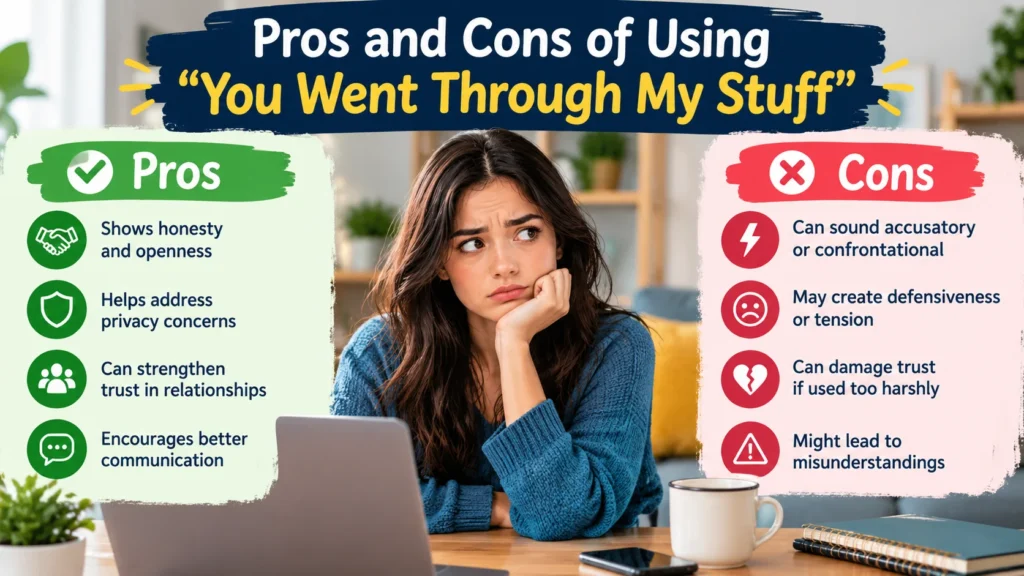
Pros and Cons of Using “You Went Through My Stuff”
Advantages
Clarity: The phrase quickly communicates that someone examined personal belongings or information.
Efficiency: It conveys a concern in a few words, which makes it useful in everyday conversation.
Accessibility: Its simple vocabulary makes it easy for English learners to understand and use.
Emotional honesty: It allows someone to express discomfort rather than ignoring a boundary concern.
Boundary-setting: It can begin a conversation about permission, privacy, and mutual respect.
Potential Drawbacks
Vagueness: The word “stuff” does not identify whether the person searched a bag, opened a drawer, or read private messages.
Tone mismatch: The phrase can sound hostile when the speaker intended to ask a simple question.
Assumptions about intent: It may imply deliberate snooping even when the other person’s reason is unknown.
Limited professional precision: Formal complaints and workplace reports usually require more specific language.
The best approach is to match your words to your goal. Ask a question when you need clarification, state a boundary when you need to prevent future problems, and use precise descriptions when the matter is serious.
Real-Life Examples of “You Went Through My Stuff” by Context
“Hi Jordan, I noticed that some of my documents had been moved from my desk yesterday. Did you need to look for something? In the future, please check with me before accessing my personal belongings.”
This example is professional because it describes the concern and requests a practical change without assuming intent.
Meetings
“Before we finish, I want to clarify something. My notebook was opened while I was away, and I wasn’t comfortable with that. Please ask me before looking through my notes next time.”
The speaker raises the issue directly while explaining the expected behavior.
Presentations
“Someone might say, ‘You went through my stuff,’ after discovering that a roommate searched their desk. The expression communicates a privacy concern, but the next step should be a discussion about permission and boundaries.”
Here, the phrase illustrates everyday language in a broader discussion about personal privacy.
Conversations
“Hey, you went through my stuff looking for the headphones? You could’ve just asked me. They’re on the shelf next to the TV.”
This is a natural, informal response that communicates mild frustration without making the disagreement unnecessarily serious.
Social Media
“Borrowing someone’s charger doesn’t mean you have permission to read their messages. Respecting people’s privacy should be normal.”
This example addresses the underlying principle without publicly accusing a particular person.
“Psychological Reason People Prefer “You Went Through My Stuff”
People often choose familiar expressions because they make difficult situations easier to explain.
Cognitive Load Reduction
When someone feels upset, a short phrase can be easier to produce than a carefully qualified explanation. “You went through my stuff” identifies the problem quickly, although it may leave important details unclear.
Trust and Authority Signals
Personal belongings often represent independence and control over personal information. A direct statement can communicate self-respect and a desire for appropriate boundaries.
However, assertiveness does not require hostility. A calm statement may be more effective than an insult.
Modern Communication Habits
Text messages and online conversations encourage short, familiar expressions. The phrase works well in these settings, but brief messages leave less room for nuance.
When a situation is sensitive, adding a question or explaining the boundary can reduce misunderstanding.
US vs UK Usage of “You Went Through My Stuff”
The expression is understandable in both American and British English. Its basic meaning does not change significantly between the two varieties.
In the United States, “You went through my stuff” and “You were snooping through my stuff” are natural informal expressions.
In the United Kingdom, “You went through my things” and “You were snooping around in my room” are also natural choices.
These examples are not strict regional rules. Speakers in both countries use the original phrase, and its emotional impact depends more on context than nationality.
Meaning, Usage & Examples for Each Alternative
You Accessed My Personal Belongings
Meaning: You handled or accessed items that belong to me.
Why This Phrase Works: It replaces the vague word “stuff” with more specific, professional language.
Real-World Usage Insight: It describes access without automatically assuming why the person handled the belongings.
Best Use: Workplace conversations and formal discussions.
Avoid When: A relaxed conversation would sound unnatural with formal wording.
Tone: Professional and neutral.
US vs UK Usage: Natural in both varieties.
Example (Email / Message / Meeting): “I noticed that my personal belongings had been moved from the cabinet. Please check with me before accessing them again.”
You Searched Through My Things
Meaning: You searched my belongings to find or examine something.
Why This Phrase Works: It describes the action without necessarily suggesting bad intentions.
Real-World Usage Insight: It is useful when the physical search is the central issue.
Best Use: Conversations about bags, desks, drawers, or personal storage.
Avoid When: The concern involves digital information rather than physical belongings.
Tone: Direct and serious.
US vs UK Usage: Understandable in both varieties.
Example (Email / Message / Meeting): “It looks like you searched through my things while looking for the travel folder. Next time, could you ask me first?”
You Examined My Personal Items
Meaning: You inspected objects that belong to me.
Why This Phrase Works: It focuses on the act of examination rather than implying secrecy.
Real-World Usage Insight: It is useful when you want a measured description of what happened.
Best Use: Formal discussions and factual written accounts.
Avoid When: You want to express strong emotion in casual conversation.
Tone: Formal and descriptive.
US vs UK Usage: Suitable in both varieties.
Example (Email / Message / Meeting): “I noticed that you examined my personal items while I was out. Was there something you needed?”
You Looked Through My Private Files
Meaning: You opened or reviewed personal documents or digital files.
Why This Phrase Works: It identifies the information involved and clarifies the privacy concern.
Real-World Usage Insight: Specific wording is especially helpful when the issue involves electronic documents.
Best Use: Shared computers, personal laptops, and cloud folders.
Avoid When: You do not know whether the files were actually opened.
Tone: Serious and precise.
US vs UK Usage: Natural in both varieties.
Example (Email / Message / Meeting): “I found my personal documents open on the shared laptop. Please don’t look through my private files without asking.”
You Accessed My Personal Information
Meaning: You obtained or viewed information relating to me.
Why This Phrase Works: It is more precise than “stuff” when discussing digital privacy.
Real-World Usage Insight: Access does not automatically mean information was copied or misused, so describe the known facts carefully.
Best Use: Workplace communications and personal-data concerns.
Avoid When: The issue involves only physical objects.
Tone: Professional and serious.
US vs UK Usage: Common in both varieties.
Example (Email / Message / Meeting): “I noticed that my personal information was visible on the shared screen. Can we review who has access to that folder?”
I Noticed You Looked Through My Things
Meaning: You observed someone examining your belongings.
Why This Phrase Works: It introduces the concern as an observation rather than an immediate accusation.
Real-World Usage Insight: It leaves room for the other person to explain what happened.
Best Use: Conversations with friends, partners, or roommates.
Avoid When: You need an immediate instruction to stop an ongoing action.
Tone: Calm and conversational.
US vs UK Usage: Natural in both varieties.
Example (Email / Message / Meeting): “I noticed you looked through my things when you borrowed the suitcase. Could you ask before opening the smaller compartments next time?”
I Would Have Preferred You to Ask First
Meaning: You wanted the person to request permission beforehand.
Why This Phrase Works: It communicates a boundary without making a broad judgment about intent.
Real-World Usage Insight: It is useful when maintaining a relationship is important.
Best Use: Family, friendships, and shared living spaces.
Avoid When: A repeated or serious violation requires a firmer response.
Tone: Polite and diplomatic.
US vs UK Usage: Appropriate in both varieties.
Example (Email / Message / Meeting): “I know you were looking for the spare keys, but I would have preferred you to ask first before opening my desk.”
Please Respect My Personal Space
Meaning: You are asking someone to respect your physical or personal boundaries.
Why This Phrase Works: It focuses on the boundary rather than only the past action.
Real-World Usage Insight: Because “personal space” can mean physical distance, explain your concern if you specifically mean belongings or information.
Best Use: Personal relationships and recurring boundary concerns.
Avoid When: You need to document a specific incident formally.
Tone: Firm and respectful.
US vs UK Usage: Natural in both varieties.
Example (Email / Message / Meeting): “I’m happy to share the desk, but please respect my personal space and ask before opening my drawers.”
You Were Poking Around in My Room
Meaning: You were looking around a room or examining things without a clear invitation.
Why This Phrase Works: It describes casual exploration without sounding as severe as “invaded my privacy.”
Real-World Usage Insight: It usually refers to exploring a space rather than accessing digital information.
Best Use: Informal conversations about bedrooms, offices, or storage areas.
Avoid When: The concern involves sensitive information or a serious breach of privacy.
Tone: Casual and mildly disapproving.
US vs UK Usage: Natural in both varieties.
Example (Email / Message / Meeting): “I came back and found the closet open. Were you poking around in my room looking for the blankets?”
You Were Nosing Through My Belongings
Meaning: You were looking through my belongings out of curiosity or in an unwelcome way.
Why This Phrase Works: It conveys disapproval of someone’s nosiness.
Real-World Usage Insight: The phrase can sound humorous among close friends but judgmental during a serious disagreement.
Best Use: Informal conversations about intrusive curiosity.
Avoid When: Communicating in formal business settings.
Tone: Informal and disapproving.
US vs UK Usage: Understandable in both varieties.
Example (Email / Message / Meeting): “I left my journal on the table. Please don’t go nosing through my belongings.”
You Invaded My Privacy
Meaning: You crossed a boundary involving personal belongings, information, or private communications.
Why This Phrase Works: It focuses on the perceived harm rather than just the physical action.
Real-World Usage Insight: It communicates a deeper loss of trust, especially when someone reads private messages or repeatedly ignores boundaries.
Best Use: Serious relationship discussions and recurring privacy concerns.
Avoid When: The facts are uncertain, and a neutral question is more appropriate.
Tone: Strong and emotionally serious.
US vs UK Usage: Common in both varieties.
Example (Email / Message / Meeting): “Reading my private messages without asking felt like you invaded my privacy. I’d rather we talk directly if something is bothering you.”
Please Check With Me Before Accessing My Things

Meaning: You want someone to obtain permission before handling your belongings.
Why This Phrase Works: It gives the listener a clear action to follow in the future.
Real-World Usage Insight: Forward-looking requests help prevent repeated misunderstandings.
Best Use: Shared homes, workplaces, and ongoing boundary-setting.
Avoid When: A serious incident needs to be documented before discussing future arrangements.
Tone: Polite and assertive.
US vs UK Usage: Natural in both varieties.
Example (Email / Message / Meeting): “I’m fine with you borrowing things from my desk, but please check with me before accessing my personal documents.”
I’d Like Us to Respect Each Other’s Privacy
Meaning: You want both people to maintain appropriate boundaries around belongings and information.
Why This Phrase Works: It frames privacy as a shared expectation rather than a one-sided accusation.
Real-World Usage Insight: It is helpful when a relationship needs clearer mutual rules about devices, messages, or personal spaces.
Best Use: Relationships, shared homes, and collaborative workplace discussions.
Avoid When: An immediate intervention is necessary.
Tone: Collaborative and constructive.
US vs UK Usage: Appropriate in both varieties.
Example (Email / Message / Meeting): “Since we’re sharing the apartment, I’d like us to respect each other’s privacy. Let’s ask before opening personal drawers or using each other’s devices.”
Let’s Agree on Some Boundaries Around Personal Belongings
Meaning: You want to establish clear, mutually understood rules for accessing belongings.
Why This Phrase Works: It shifts the discussion from blame toward a practical agreement.
Real-World Usage Insight: It is useful when misunderstandings arise because people have different expectations about shared spaces.
Best Use: Conversations with roommates, partners, family members, or colleagues.
Avoid When: Someone is deliberately ignoring an already established boundary and a stronger response is required.
Tone: Collaborative and solution-oriented.
US vs UK Usage: Natural in both varieties.
Example (Email / Message / Meeting): “We’ve had a couple of misunderstandings about the desk, so let’s agree on some boundaries around personal belongings. I’ll ask before borrowing your things, and I’d appreciate the same courtesy.”
Comparison Table of 10 Best Alternatives
The following comparison helps you choose an expression based on your communication goal, the seriousness of the situation, and your relationship with the listener.
| Phrase | Meaning | Best Use | Worst Use | Tone | US vs UK Usage |
| You accessed my personal belongings. | You handled or accessed personal items. | Professional conversations. | Casual jokes among close friends. | Neutral, professional | Natural in both. |
| You searched through my things. | You searched belongings for something. | Describing a physical search. | When no search occurred. | Direct, serious | Natural in both. |
| You looked through my private files. | You examined personal documents or digital files. | Digital privacy concerns. | When access is unconfirmed. | Precise, serious | Natural in both. |
| I noticed you looked through my things. | You observed someone examining belongings. | Raising a concern calmly. | Urgent situations requiring immediate action. | Conversational | Natural in both. |
| I would have preferred you to ask first. | You wanted permission requested beforehand. | Preserving relationships. | Repeated violations requiring firm action. | Polite, diplomatic | Natural in both. |
| Please respect my personal space. | You want personal boundaries respected. | Shared spaces and recurring concerns. | Formal incident documentation. | Firm, respectful | Natural in both. |
| You were snooping through my stuff. | You suspect secretive searching. | Suspected deliberate snooping. | Uncertain or highly sensitive situations. | Accusatory | Natural in both. |
| You invaded my privacy. | You believe a personal boundary was crossed. | Serious trust concerns. | Minor misunderstandings without clear evidence. | Strong, serious | Natural in both. |
| Please check with me before accessing my things. | You want permission requested in the future. | Establishing a clear boundary. | Situations requiring an immediate stop. | Polite, assertive | Natural in both. |
| I’d like us to respect each other’s privacy. | You want mutual privacy expectations. | Relationships and shared homes. | Situations requiring immediate intervention. | Collaborative | Natural in both. |
Conclusion
“You went through my stuff” is a natural English expression used when someone believes another person has searched their belongings or accessed private information without permission. Although its meaning is straightforward, its emotional impact can range from mild annoyance to a serious concern about trust.
The best alternative depends on your goal. “You searched through my things” describes the action, “You invaded my privacy” emphasizes the impact, and “Please check with me before accessing my things” establishes a practical boundary for the future.
In professional settings, specific wording about personal documents or files is usually more effective than the vague word “stuff.” In personal conversations, a direct but calm statement can help you explain your discomfort without escalating a disagreement.
FAQs
What does “You went through my stuff” mean?
It means someone searched, examined, or looked through your personal belongings or private information. The phrase often suggests that the action was unwanted or performed without permission. It is commonly used when discussing privacy concerns involving friends, family members, partners, roommates, or colleagues.
What is another way to say “You went through my stuff”?
You can say “You searched through my things,” “You looked through my belongings,” or “You accessed my personal files.” For a softer approach, try “I noticed you looked through my things.” The best alternative depends on whether you want to sound neutral, polite, professional, or confrontational.
Is “You went through my stuff” rude?
It can sound rude or accusatory, but it is not automatically impolite. The phrase is direct and may be appropriate when someone has crossed a personal boundary. If you want to reduce confrontation, ask what happened or explain that you would prefer the person to request permission in the future.
Is “You went through my stuff” professional?
The expression is understandable but informal. In a workplace email or formal discussion, “You accessed my personal documents without permission” is more precise. If you are uncertain about the facts, “I noticed that my documents had been moved” is a more neutral starting point.
What is a polite way to tell someone not to touch your belongings?
You can say, “Please ask me before using my things,” or “I’d appreciate it if you respected my personal space.” These expressions communicate your expectations without unnecessarily blaming the other person. If the behavior continues, state the boundary more firmly and explain what you need to change.
What is the difference between snooping and going through someone’s stuff?
“Going through someone’s stuff” describes searching or examining their belongings. “Snooping” adds the suggestion that the person was acting secretly or intrusively, often out of curiosity. Because snooping implies a motive, it can sound more accusatory than the original expression.
How do you respond when someone goes through your things?
Explain what you noticed, describe how it affected you, and state what you expect in the future. For example, “I noticed that my drawer had been opened. Please ask me before looking through my belongings.” If the situation is unclear, ask a question before assuming why it happened.
Can “You went through my stuff” refer to digital privacy?
Yes. The phrase can refer to someone opening private messages, browsing personal photographs, searching computer files, or examining information stored on a shared device. In professional or technical contexts, more precise wording, such as “You accessed my personal files,” can make the concern easier to understand.
What is a stronger alternative to “You went through my stuff”?
“You invaded my privacy” is a stronger alternative because it emphasizes the perceived boundary violation rather than merely describing the action. “You were snooping through my things” also sounds more accusatory because it suggests deliberate, intrusive searching. Choose stronger language when it accurately reflects the situation.
How can I explain a privacy boundary without starting an argument?
Focus on the behavior and the change you want rather than attacking the person’s character. For example, say, “I understand you may have been looking for something, but please ask before opening my personal drawers.” This approach communicates your expectations clearly while leaving room for a constructive conversation.