
Imagine your friend is about to perform on stage for the first time. They have practiced for weeks, memorized their lines, and prepared carefully, but they are still nervous. Just before the performance, you smile and say, “Break a leg!” Although the words sound unusual, your friend understands that you are wishing them success.
The expression “break a leg” means “good luck” or “I hope you do well.” It is a common English idiom traditionally associated with theater, acting, and live performances. Today, people also use it before presentations, job interviews, exams, competitions, and other important events.
Learning this expression can help English learners, students, professionals, and content writers communicate more naturally. However, the best phrase depends on the situation. “Break a leg” sounds friendly and energetic, while “Wishing you success” sounds more professional. Other alternatives, such as “You’ve got this” and “All the best,” provide different ways to express encouragement.
This guide explores the meaning, history, tone, and everyday use of “break a leg.” It also explains 20 alternative expressions, provides realistic examples, and helps you choose the right words for professional and casual communication.
What Does “Break a Leg” Mean?
“Break a leg” is an English idiom used to wish someone good luck or success before an important event. It is especially common before theatrical performances, auditions, presentations, speeches, and competitions. Although the words literally refer to breaking a leg, the expression has a figurative meaning and is generally understood as a friendly way to encourage someone.
For example, if your coworker is preparing to present a new project, you might say, “Break a leg at the presentation today!” This communicates that you hope the presentation goes well.
The phrase is particularly useful when you want to express support without writing a lengthy message. It can also create a sense of excitement before an event.
Origin & History of “Break a Leg”
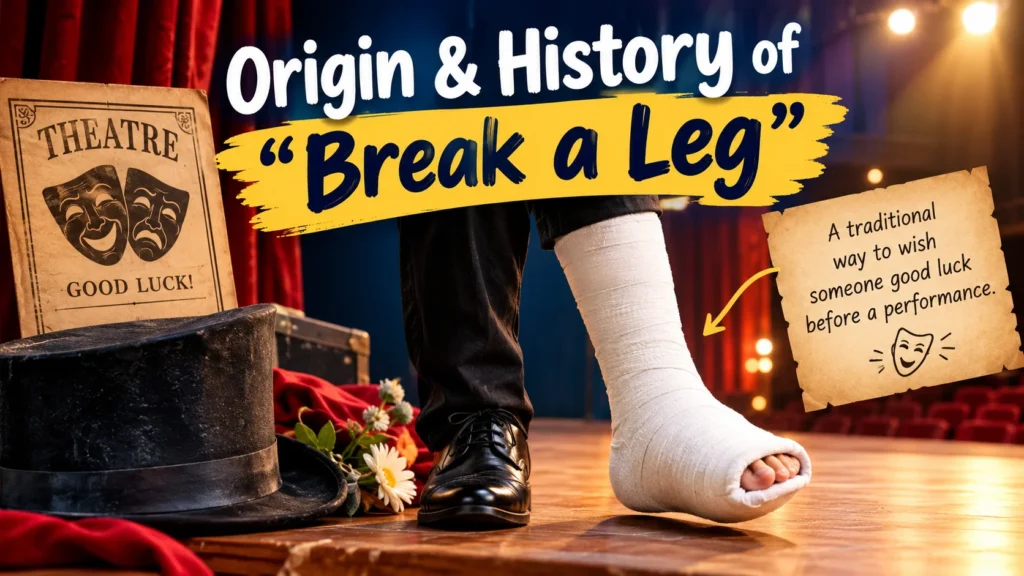
The exact origin of “break a leg” remains uncertain, but the phrase has a strong connection with theater traditions and superstitions surrounding good luck.
The theatrical tradition
Actors and performers have traditionally used unusual expressions to wish each other success before going onstage. In theater culture, directly saying “good luck” has sometimes been considered tempting fate. “Break a leg” became a familiar alternative that communicates encouragement without using the conventional wording.
The expression is now widely recognized beyond the performing arts, but its theatrical associations remain an important part of its identity.
Theories about its origin
Several explanations have been suggested for the phrase.
- Theater superstition: One theory connects the expression with the tradition of avoiding direct wishes for good luck before a performance.
- Bowing after a performance: Another explanation suggests a connection with bending the knee while bowing to an audience. However, this theory is not conclusively established.
- Stage traditions: Some explanations associate the expression with movement around the stage or crossing theatrical boundaries, but reliable evidence does not establish a single definitive origin.
These explanations are popular, but the precise historical development of the idiom remains uncertain.
How the meaning developed
Over time, “break a leg” became a general expression of encouragement in English. It moved beyond theater and began appearing in everyday conversations, workplace messages, educational settings, and online communication.
Today, you might hear it before a university examination, a job interview, a conference presentation, or a singing competition.
Its meaning has remained relatively stable: it is a wish for success, not a literal reference to injury.
Synonyms & Alternatives by Tone
Different alternatives to “break a leg” communicate different levels of enthusiasm, confidence, and professionalism.
Professional & Neutral Alternatives
- Wishing you success
- Best of luck
- I wish you all the best
- Wishing you the very best
- I hope everything goes well
- Good luck with your presentation
- Wishing you a successful outcome
- I hope it goes smoothly
Polite & Supportive Alternatives
- All the best
- I’m wishing you well
- I hope it goes really well
- Sending you my best wishes
- I hope everything works out
- I’m rooting for you
Encouraging & Reassuring Alternatives
- You’ve got this
- Believe in yourself
- You’re going to do great
- Trust your preparation
- Go show them what you can do
- Give it your best
- You’ve worked hard for this
- Have confidence in yourself
Casual, Playful & Idiomatic Alternatives
- Knock ’em dead
- Go smash it
- Nail it
- Go get ’em
- Hit it out of the park
- Make it count
- Blow them away
- Go rock it
These expressions are not identical in tone. “Good luck” is straightforward, “You’ve got this” offers reassurance, and “Knock ’em dead” adds playful enthusiasm.
When Should You Use “Break a Leg”?
The phrase works best when someone is preparing for an event that requires preparation, confidence, or a public performance.
Before a performance
This is the most traditional use of the expression. Actors, musicians, dancers, and other performers may hear it before going onstage.
Example: “Your opening night is finally here. Break a leg!”
Before a presentation
You can use the phrase when a colleague is preparing to present a project or speak at a conference.
Example: “Break a leg at the client presentation. Your slides look excellent.”
Before a job interview
The expression can encourage a friend or colleague who is nervous about an interview.
Example: “Your interview starts at ten, right? Break a leg!”
For an unfamiliar professional contact, “Wishing you the best with your interview” may sound more appropriate.
Before an exam or competition
Friends and classmates may use the expression before an important test, debate, or competition.
Example: “You’ve studied hard all month. Break a leg on the exam tomorrow!”
In digital communication
“Break a leg” also works in informal emails, text messages, workplace chats, and social media comments.
Example: “Good luck with the conference tomorrow. Break a leg, and let me know how it goes!”
When Should You Avoid “Break a Leg”?
Although the expression is widely understood, it is not ideal for every situation.
Highly formal communication
A formal letter or message to an unfamiliar client may require a more professional expression.
Instead of “Break a leg at the board meeting,” write, “I wish you every success at the board meeting.”
Sensitive situations
Avoid playful idioms when someone is dealing with grief, a serious medical concern, or a personal crisis. “I’m thinking of you and hoping everything goes well” may communicate greater empathy.
When the audience may misunderstand
People learning English may initially interpret the words literally. When clarity is important, “Good luck” is a safer option.
When the phrase could sound sarcastic
Tone and facial expression can change how an idiom is understood. If you say “Break a leg” sarcastically, the listener may question whether you genuinely want them to succeed.
The key is to match your words to the audience, relationship, and situation.
Is “Break a Leg” Professional, Polite, or Casual?
“Break a leg” is generally informal, friendly, and encouraging. It is not inherently rude or unprofessional, but it is less formal than expressions such as “Wishing you success.”
| Factor | Explanation |
| Formality | Informal to moderately informal |
| Politeness | Usually polite |
| Emotional tone | Friendly and enthusiastic |
| Workplace suitability | Good for friendly teams and creative industries |
| Cultural familiarity | Widely recognized among English speakers |
| Potential misunderstanding | Possible for people unfamiliar with idioms |
In a friendly workplace, “Break a leg in the presentation!” may sound completely natural. In a formal business email, “I hope your presentation goes well” may be a better choice.
The phrase can also be appropriate in academic settings when used in conversation, although it is generally unnecessary in formal academic writing.
Pros and Cons of Using “Break a Leg”
Understanding the advantages and disadvantages of this expression helps you use it effectively.
Advantages
- Clear social intention: Most familiar English speakers understand that it expresses encouragement.
- Short and memorable: It communicates a positive message in just three words.
- Friendly tone: It can make a conversation feel warm and energetic.
- Versatile usage: It works before performances, interviews, speeches, and other challenges.
- Cultural familiarity: It is especially recognizable in theater and entertainment settings.
Disadvantages
- Informal wording: It may not suit highly formal communication.
- Possible confusion: Someone unfamiliar with the idiom might misunderstand its literal wording.
- Context sensitivity: It may sound insensitive in serious or emotionally difficult situations.
- Potential repetition: Using it constantly can make encouragement feel automatic.
- Limited detail: It does not explain why you believe the person will succeed.
For example, “Break a leg!” is a perfectly reasonable message before a presentation. However, “You’ve prepared carefully, and your explanation is clear. I hope the presentation goes well” provides more personalized encouragement.
Real-Life Examples of “Break a Leg” by Context
Subject: Today’s presentation
Hi Maya,
I reviewed the final slides, and everything looks ready. Break a leg at the client presentation this afternoon! I hope it goes really well.
Best,
Jordan
Meeting
“Before you head into the meeting, break a leg. You’ve prepared answers to the difficult questions, so take your time and trust your work.”
Presentation
“Break a leg at the conference tomorrow. Your opening is strong, and the audience will appreciate your practical examples.”
Casual conversation
Friend A: “I’m performing in front of a live audience tonight, and I’m nervous.”
Friend B: “You’ve practiced for weeks. Break a leg!”
Social media
A friend announces their first solo performance.
A natural comment would be: “Break a leg! You’ve worked so hard for this, and I can’t wait to see you perform.”
Workplace chat
“Your product demo starts in five minutes. The test run looked great, so break a leg!”
These examples show that the phrase is most effective when the speaker wants to encourage someone rather than provide detailed instructions or serious advice.
“Break a Leg” vs. Similar Expressions
Several English phrases communicate good wishes, but their tone and emphasis differ.
| Phrase | Meaning Difference | Tone Difference | Best Use Scenario |
| Good luck | A straightforward wish for success | Neutral and friendly | Exams, interviews, competitions |
| All the best | Expresses general goodwill | Warm and polite | Emails, farewells, professional messages |
| Knock ’em dead | Encourages someone to impress an audience | Playful and energetic | Theater, speeches, performances |
| You’ve got this | Emphasizes confidence in someone’s abilities | Reassuring and motivational | Interviews, exams, challenging tasks |
| Best of luck | Wishes someone a favorable outcome | Polite and neutral | Professional messages and competitions |
| Nail it | Encourages excellent execution | Confident and casual | Presentations, demonstrations, interviews |
Use “good luck” when you want a familiar, direct expression. Choose “all the best” when you want a polite, warm message. “You’ve got this” works when someone needs reassurance, while “knock ’em dead” is especially suitable for energetic performance-related encouragement.
Common Mistakes & Misuse of “Break a Leg”
Taking it literally
The phrase is figurative. When someone says it before an audition, they are wishing you success rather than suggesting that you should get injured.
Using it in the wrong context
A playful idiom may not suit someone dealing with a serious personal challenge. Consider whether the person needs encouragement, practical help, or emotional support.
Assuming it is always professional
Although the phrase is acceptable in many workplaces, formal communication may benefit from a more neutral alternative.
Using it sarcastically
A mocking tone can change the message from encouragement to criticism. If you genuinely want to support someone, make your intention clear.
Overusing the expression
Repeating the same phrase in every conversation can make it feel impersonal. A specific message that acknowledges someone’s effort may have a stronger effect.
Psychological Reason People Prefer “Break a Leg”
Short expressions of encouragement are useful because they communicate social support without requiring a long conversation.
Reducing communication effort
Before an important event, people may be busy or nervous. “Break a leg” quickly acknowledges the occasion and allows the recipient to respond naturally.
Communicating confidence
The expression can suggest that the speaker recognizes the importance of the event and wants the recipient to feel supported.
Compare “Good luck” with “You’ve got this.” The first wishes someone a positive outcome, while the second expresses confidence in their ability.
Creating a sense of connection
Shared expressions can make people feel part of a community. In theater, “break a leg” reflects familiarity with a tradition that many performers recognize.
Fitting modern communication
Short messages are common in workplace chats and text conversations. “Break a leg!” is memorable and convenient, but a more personalized message may be better when someone needs meaningful reassurance.
The phrase communicates goodwill, but it cannot guarantee a successful outcome. Its value lies in the social support it expresses.
US vs UK Usage of “Break a Leg”
“Break a leg” is familiar in both American and British English. Its core meaning remains the same, although individual preferences can vary.
| Feature | American English | British English |
| Basic meaning | Wishing someone success | Wishing someone success |
| Theater usage | Common | Common |
| Workplace usage | Often informal and friendly | Often informal and friendly |
| Alternative expressions | Good luck, best of luck | All the best, good luck |
| Overall tone | Encouraging and casual | Encouraging and casual |
In the United States, someone might say, “Break a leg at your first live show tonight!” In the United Kingdom, someone might say, “Break a leg with the performance tonight!”
There is no major difference in the expression’s meaning between the two countries. Context, personal preference, and familiarity with theater culture generally matter more than nationality.
“Break a Leg” in Digital & Modern Communication
Emails
In a friendly professional email, you might write, “Break a leg at the presentation tomorrow. Your preparation looks excellent.”
For a formal client, “Wishing you a successful presentation” may be more suitable.
Slack and workplace chat
A short message can encourage a teammate before a demonstration or meeting.
Example: “The demo is ready—break a leg! The test run went smoothly.”
WhatsApp and text messages
Friends and family often use the expression before interviews, exams, and performances.
Example: “Today’s the day! Break a leg at the audition. Let me know how it goes!”
Social media
The phrase is common in comments on posts announcing a performance, competition, or important milestone.
Example: “Break a leg! Can’t wait to see your first performance.”
AI writing tools
AI writing assistants may suggest “break a leg” for informal messages and dialogue. However, the final wording should match the audience and context. “Wishing you success” may be preferable in a formal business email, while “Break a leg!” may sound natural in a message to a friend.
Linguistic & Communication Insight
The expression demonstrates how English speakers communicate social intentions through shared language and context.
Emotional weight and subtext
Beyond wishing someone success, “break a leg” can communicate enthusiasm, familiarity, and recognition of the effort someone has invested.
A colleague saying it before opening night may be expressing support and excitement, not merely offering a generic good-luck message.
Direct versus indirect phrasing
“Break a leg” uses unusual literal wording to communicate a familiar intention. “I hope your presentation goes well” expresses that intention more directly, while “You’ve prepared thoroughly, and I believe in you” emphasizes confidence in the person’s ability.
Each expression serves a slightly different purpose.
Professional communication perspective
A teammate may appreciate “Break a leg!” because it feels friendly and relaxed. An unfamiliar client may respond better to “I wish you success with the presentation.”
The best option depends on the relationship and the communication setting.
Why professionals choose alternatives
Experienced communicators consider how their words will be received. “You’ve got this” can reassure someone who feels anxious. “I hope everything goes smoothly” may suit an uncertain situation. “Wishing you success” maintains a professional tone.
These alternatives allow speakers to communicate support without creating confusion or sounding overly familiar.
Social signaling
Idioms can signal familiarity with a language community or professional tradition. However, unfamiliar expressions can confuse people who are learning English.
Trustworthy communication depends on choosing language that is understandable, sincere, and appropriate to the audience.
Tone and context guidance
Before using the expression, consider who will receive it, what they are experiencing, and what you want to communicate. Use “break a leg” for friendly encouragement, “you’ve got this” for reassurance, and “wishing you success” for a more professional message.
Trust Your Preparation

Meaning: An encouragement to rely on the work and practice already completed.
Why This Phrase Works: It gives someone a practical reason to feel confident.
Real-World Usage Insight: It is useful when anxiety appears despite thorough preparation.
Best Use: Exams, rehearsals, interviews, and presentations.
Avoid When: Preparation is incomplete and practical guidance is needed.
Tone: Thoughtful and reassuring.
US vs UK Usage: Clear in both varieties of English.
Example (Email / Message / Meeting): “Take a breath, trust your preparation, and explain the material one step at a time.”
Give It Your Best
Meaning: An encouragement to make a strong effort.
Why This Phrase Works: It emphasizes effort without promising a particular outcome.
Real-World Usage Insight: It can encourage people facing competition or a challenging task.
Best Use: Exams, sports, and creative projects.
Avoid When: Specific feedback or instructions are required.
Tone: Supportive and motivational.
US vs UK Usage: Common in both countries.
Example (Email / Message / Meeting): “The competition is tough, but you’ve worked hard. Give it your best.”
Go Smash It
Meaning: An informal expression encouraging someone to perform extremely well.
Why This Phrase Works: It communicates strong enthusiasm in very few words.
Real-World Usage Insight: It is particularly familiar in British informal English and modern online conversations.
Best Use: Friendly messages, presentations, and performances.
Avoid When: The setting requires formal or restrained language.
Tone: Energetic and casual.
US vs UK Usage: Particularly familiar in the UK; understood in the US.
Example (Email / Message / Meeting): “Your first workshop is tomorrow. Go smash it!”
Make It Count
Meaning: An encouragement to use an opportunity effectively.
Why This Phrase Works: It emphasizes purpose and meaningful action.
Real-World Usage Insight: It is useful when someone has an important opportunity to demonstrate their abilities.
Best Use: Competitions, presentations, and major milestones.
Avoid When: The person is already under excessive pressure.
Tone: Motivational and purposeful.
US vs UK Usage: Widely understood in both countries.
Example (Email / Message / Meeting): “You’ve worked hard to get this opportunity. Take your time and make it count.”
Comparison Table of 10 Best Alternatives
The following table summarizes ten useful alternatives to “break a leg.” Use it to compare meaning, tone, and suitability before choosing an expression.
| Phrase | Meaning | Best Use | Worst Use | Tone | US vs UK Usage |
| Good luck | Wishes someone success | Everyday situations | When detailed reassurance is needed | Neutral | Common in both |
| Best of luck | Wishes a favorable outcome | Interviews and exams | Highly emotional situations | Polite | Common in both |
| All the best | Expresses goodwill | Emails and farewells | High-energy encouragement | Warm | Common in both |
| Wishing you success | Wishes achievement | Formal communication | Casual exchanges with close friends | Professional | Common in both |
| I hope it goes well | Hopes for a positive result | Meetings and appointments | Energetic performance settings | Gentle | Common in both |
| You’ve got this | Expresses confidence | Challenging tasks | Very formal emails | Reassuring | Common in both |
| Knock ’em dead | Encourages an impressive performance | Theater and speeches | Sensitive situations | Playful | Recognized in both |
| Nail it | Encourages excellent execution | Presentations and demonstrations | Formal letters | Confident | Common in both |
| I’m rooting for you | Expresses personal support | Important milestones | Highly formal communication | Warm | Familiar in both |
| Give it your best | Encourages effort | Competitions and projects | When detailed instructions are needed | Motivational | Common in both |
Conclusion
“Break a leg” is a popular English idiom that means “good luck” or “I hope you succeed.” Traditionally associated with theater and live performances, it is now commonly used before presentations, interviews, exams, competitions, and other important events. Although its literal wording may sound unusual, the expression conveys encouragement and positive intentions.
Choosing the right alternative depends on your audience and situation. Phrases such as “Good luck,” “All the best,” and “Wishing you success” work well in professional communication, while “You’ve got this,” “Nail it,” and “Knock ’em dead” add confidence and enthusiasm to casual conversations. Understanding these differences helps you communicate naturally and avoid misunderstandings.
FAQs
What does “break a leg” mean?
“Break a leg” means “good luck” or “I hope you succeed.” It is especially common before performances, auditions, speeches, and presentations. Although the literal wording refers to an injury, the expression is intended as encouragement.
Is “break a leg” polite?
Yes, it is generally polite and encouraging when used in the right context. However, it is informal, so “Wishing you success” may be more suitable for formal communication.
Why do people say “break a leg”?
The phrase is associated with theater traditions and superstitions about directly wishing performers good luck. Its exact origin is uncertain, but today it is widely understood as a wish for success.
Can I say “break a leg” at work?
Yes. It is appropriate in friendly workplaces before presentations, demonstrations, and important meetings. For unfamiliar clients or formal correspondence, “Best of luck” may be more appropriate.
What is the best alternative to “break a leg”?
“Good luck” is one of the most versatile alternatives. “All the best” sounds polite, “You’ve got this” offers reassurance, and “Wishing you success” suits professional settings.
Is “break a leg” used in the US and UK?
Yes. It is familiar in both American and British English and has the same basic meaning. Differences generally depend on context and personal preference.
Can I use “break a leg” in an email?
Yes. It works well in informal emails to friends, classmates, and familiar colleagues. In formal emails, “I hope your presentation goes well” may sound more appropriate.
Is “knock ’em dead” the same as “break a leg”?
Both expressions can wish someone success, but “knock ’em dead” emphasizes impressing an audience, while “break a leg” is a conventional wish for good luck.
Can I say “break a leg” before an exam?
Yes, particularly when speaking casually with friends. “Good luck on your exam” is more direct and familiar to people who may not know the idiom.
What should I say instead of “break a leg” professionally?
Use “Wishing you success,” “I wish you all the best,” or “I hope your presentation goes well.” These alternatives communicate support clearly and maintain a professional tone.