
Imagine a colleague helps you finish an important project, a friend offers support when you need it, or a customer takes the time to provide useful feedback. You want to show appreciation without sounding too casual or overly formal. In these situations, the phrase “thank you kindly” can help you express gratitude politely and respectfully.
“Thank you kindly” means expressing appreciation in a courteous, gracious manner. It is suitable for many everyday interactions, professional emails, and situations where you want to acknowledge someone’s help or consideration. However, different situations call for different expressions. “I sincerely appreciate your help” may sound more professional, while “Thanks so much” may feel warmer and more natural in casual conversations.
Understanding alternatives to “thank you kindly” helps you communicate with confidence, avoid repetitive wording, and choose expressions that match your audience. This guide explores 20 alternatives, their meanings, practical examples, and the differences between formal, friendly, and heartfelt expressions of gratitude.
What Does “Thank You Kindly” Mean?
“Thank you kindly” is a polite expression used to show appreciation for someone’s assistance, generosity, time, or consideration. It combines a direct acknowledgment of gratitude with a courteous tone. People use it in personal conversations, professional correspondence, customer interactions, and everyday situations when they want to thank someone respectfully.
Origin & History of “Thank You Kindly”
The phrase combines “thank you,” an established English expression of gratitude, with “kindly,” which means in a kind or considerate manner. The word “thank” comes from Old English þancian, while “kindly” developed from the word “kind,” historically associated with character and benevolent behavior.
As English politeness conventions developed, expressions such as “thank you kindly” became recognizable ways to communicate appreciation and good manners. The phrase has also been associated with traditional letter-writing, hospitality, and courteous conversation.
Today, it remains understandable in both American and British English. Some people perceive it as warm and gracious, while others consider it slightly old-fashioned. Its interpretation depends on the speaker, the relationship, and the surrounding conversation.
Synonyms & Alternatives by Tone
Professional & Neutral Alternatives
- Thank you very much.
- I sincerely appreciate it.
- I appreciate your assistance.
- Many thanks.
- Thank you for your support.
- I appreciate your time.
Polite & Supportive Alternatives
- Thank you so much.
- I truly appreciate your kindness.
- I am very grateful.
- Thank you for being so helpful.
- I appreciate your thoughtfulness.
Encouraging & Reassuring Alternatives
- Your help means a lot to me.
- I really appreciate you taking the time.
- Thank you for going the extra mile.
- I’m grateful you were able to help.
Casual, Playful & Idiomatic Alternatives
- Thanks a million.
- Much appreciated.
- Thanks a bunch.
- Cheers, thanks!
When Should You Use “Thank You Kindly”?
Professional Settings
Use the phrase when acknowledging a colleague’s contribution, a client’s response, or someone’s assistance. For example: “Thank you kindly for sharing the updated report.”
Casual Conversations
It can express appreciation to friends, neighbors, and acquaintances. However, “Thanks so much” may sound more natural among close friends.
Emails and Digital Communication
The phrase works in polite emails and messages when you want to acknowledge a helpful action. For highly formal correspondence, “Thank you for your assistance” may be a better choice.
When It Is Especially Effective
Use “thank you kindly” when you want to sound gracious, respectful, and appreciative without writing a long explanation. For significant favors, mention the specific action to make your gratitude more personal.
When Should You Avoid “Thank You Kindly”?
Avoid using the phrase when its traditional tone does not match the situation.
- Formal legal or academic writing: Prefer direct, precise wording.
- Sensitive conversations: A personal expression such as “I’m truly grateful for your support” may communicate more warmth.
- Tense exchanges: The phrase can sound sarcastic if the surrounding message expresses frustration.
- Repeated acknowledgments: Vary your wording to avoid sounding mechanical.
Is “Thank You Kindly” Professional, Polite, or Casual?
“Thank you kindly” is primarily polite and moderately formal. It can be professional, but it may sound traditional in some modern workplaces.
Its tone depends on context. In a business email, it may communicate courtesy. Among friends, it can sound warm or playfully formal. During an argument, it may be interpreted as sarcastic.
For most professional situations, “Thank you for your help” is a safe alternative because it is direct, clear, and widely accepted.
Pros and Cons of Using “Thank You Kindly”
Advantages
- Politeness: Shows respect and appreciation.
- Efficiency: Communicates gratitude in a few words.
- Warmth: Can make a message feel gracious.
- Versatility: Works in conversations, emails, and everyday interactions.
Potential Drawbacks
- Old-fashioned tone: Some readers may prefer contemporary wording.
- Tone mismatch: It can sound too formal in casual conversations.
- Repetition: Frequent use can make gratitude feel automatic.
- Limited specificity: It does not explain what you appreciate unless the context makes it clear.
Real-Life Examples of “Thank You Kindly” by Context
Email: “Thank you kindly for sending the revised proposal. I’ll review it before Thursday’s meeting.”
Meeting: “Thank you kindly for explaining the new process. That cleared up several questions.”
Presentation: “Thank you kindly for your time and thoughtful feedback today.”
Conversation: “Thank you kindly for helping me carry these boxes upstairs.”
Social media: “Thank you kindly to everyone who sent messages and supported the launch.”
These examples demonstrate how the phrase can express gratitude across different settings. The most natural choice depends on the relationship and the degree of formality.
“Thank You Kindly” vs. Similar Expressions
| Phrase | Meaning Difference | Tone Difference | Best Use Scenario |
| Thank you very much | General appreciation | Neutral and polite | Professional emails |
| I sincerely appreciate it | Emphasizes genuine gratitude | Professional and heartfelt | Meaningful favors |
| Many thanks | Concise appreciation | Courteous and slightly formal | Written correspondence |
| Thanks so much | Warm gratitude | Friendly and conversational | Everyday messages |
| I appreciate your assistance | Specifically acknowledges help | Formal and professional | Business communication |
| Much appreciated | Briefly recognizes a contribution | Concise and relaxed | Workplace chats |
Common Mistakes & Misuse of “Thank You Kindly”
Overuse
Using the same phrase repeatedly can make your communication sound formulaic. Alternate between “Many thanks,” “I appreciate your help,” and “Thanks so much.”
Incorrect Context
A traditional expression may feel unnatural in an informal conversation or insufficiently specific in an important business acknowledgment.
Contradictory Usage
“Thank you kindly for ignoring my request” is likely to sound sarcastic. If you need to address a problem, explain it directly and respectfully.
Cultural Misunderstandings
English speakers may interpret traditional expressions differently. When you are unsure of your audience’s preferences, choose familiar and straightforward wording.
Psychological Reason People Prefer “Thank You Kindly”
Expressions of gratitude make social interactions easier by communicating appreciation without requiring a long explanation. They also signal that someone has noticed another person’s effort.
In professional environments, a sincere thank-you can support cooperation and help people feel that their contributions matter. In digital communication, polite expressions can soften short messages that might otherwise seem abrupt.
However, politeness alone does not establish trust. Genuine appreciation is more convincing when the words match the speaker’s actions.
US vs UK Usage of “Thank You Kindly”
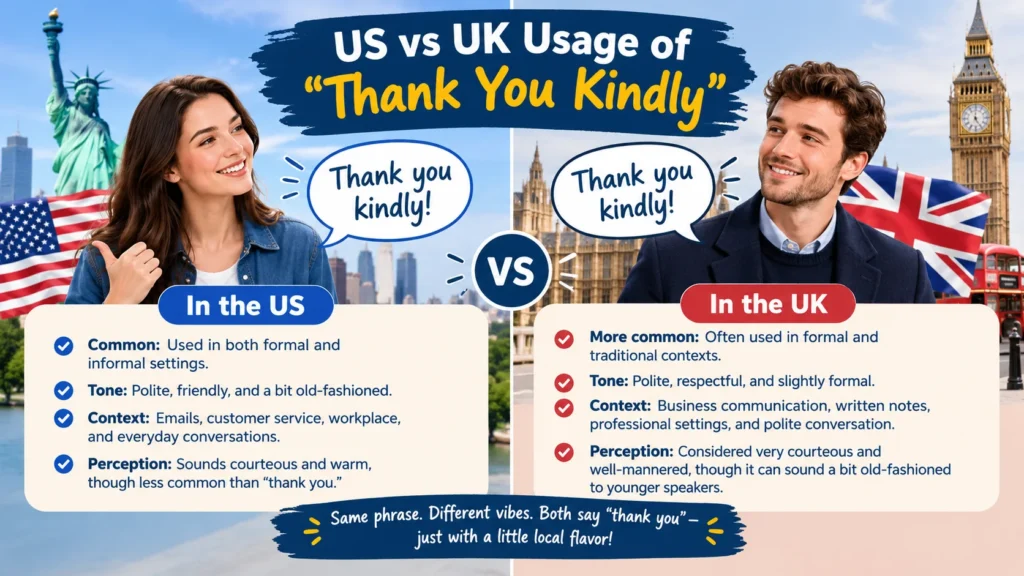
The phrase is understood in both American and British English. In the United States, some speakers associate it with gracious manners or traditional Southern hospitality. In the United Kingdom, it may sound courteous, traditional, or slightly formal.
Common alternatives also vary by personal preference. “Thanks so much” is widely used in both countries, while “many thanks” is particularly familiar in British business correspondence. “Cheers” is a common informal expression of thanks in British English, although it is also used by some American speakers.
These are general tendencies rather than strict rules. Workplace culture, personal style, and the relationship between speakers often matter more than nationality.
“Thank You Kindly” in Digital & Modern Communication
Emails
“Thank you kindly for sending the updated schedule. I’ll share it with the team this afternoon.”
Slack and WhatsApp
“Thanks, I appreciate it!” or “Much appreciated!” may sound more natural in quick team conversations.
Social Media
“Thank you kindly to everyone who supported the launch. Your feedback means a lot.”
AI-Generated Writing
AI-generated messages may use familiar expressions such as “thank you kindly.” Review the wording to ensure it sounds natural and matches your communication style. A specific acknowledgment is often more effective than a generic thank-you.
Linguistic & Communication Insight
“Thank you kindly” communicates more than gratitude. It can also signal respect, warmth, and a preference for traditional politeness. However, its emotional meaning depends on context.
In professional communication, “I appreciate your assistance” emphasizes the helpful action, while “Your help means a lot to me” highlights its personal impact. Experienced communicators choose between these expressions according to their audience and purpose.
A thoughtful thank-you can strengthen relationships because it shows that another person’s effort has been noticed. Nevertheless, overly formal wording may create distance, and a polite phrase can sound sarcastic when the surrounding message is hostile.
The most effective expression of gratitude is clear, appropriate, and genuine. Rather than choosing the longest or most formal phrase, acknowledge what the person did and explain why it mattered when the situation calls for more detail.
Meaning, Usage & Examples for Each Alternative
Thank You Very Much
Meaning: A standard expression of appreciation.
Why This Phrase Works: It is clear, familiar, and appropriate for many situations.
Real-World Usage Insight: It works well when you want to sound polite without being overly formal.
Best Use: Emails, meetings, and everyday conversations.
Avoid When: You need to express particularly deep gratitude in a personal situation.
Tone: Neutral and polite.
US vs UK Usage: Common in both.
Example (Email / Message / Meeting): “Thank you very much for reviewing the report before the deadline.”
I Sincerely Appreciate It
Meaning: A direct statement of genuine gratitude.
Why This Phrase Works: It emphasizes sincerity and appreciation.
Real-World Usage Insight: Useful when a routine thank-you feels insufficient.
Best Use: Professional correspondence and meaningful favors.
Avoid When: A very casual, brief response is more natural.
Tone: Professional and heartfelt.
US vs UK Usage: Natural in both.
Example (Email / Message / Meeting): “I sincerely appreciate it, especially because you rearranged your schedule to help me.”
I Appreciate Your Assistance
Meaning: Acknowledgment of someone’s help.
Why This Phrase Works: It identifies the contribution clearly.
Real-World Usage Insight: Particularly suitable for workplace correspondence.
Best Use: Business emails and customer service.
Avoid When: A close personal relationship calls for warmer wording.
Tone: Formal and respectful.
US vs UK Usage: Common in both.
Example (Email / Message / Meeting): “I appreciate your assistance with the booking changes.”
Many Thanks
Meaning: A concise expression of gratitude.
Why This Phrase Works: It keeps written communication brief and courteous.
Real-World Usage Insight: Particularly useful in routine email exchanges.
Best Use: Emails and professional notes.
Avoid When: A major personal favor requires a more detailed acknowledgment.
Tone: Courteous and concise.
US vs UK Usage: Familiar in both, especially in British business writing.
Example (Email / Message / Meeting): “Many thanks for sending the final document.”
Thank You for Your Support
Meaning: Appreciation for practical or ongoing assistance.
Why This Phrase Works: It recognizes a person’s contribution.
Real-World Usage Insight: Effective when someone has helped throughout a project.
Best Use: Team updates and personal messages.
Avoid When: A minor favor does not require such a broad acknowledgment.
Tone: Warm and professional.
US vs UK Usage: Common in both.
Example (Email / Message / Meeting): “Thank you for your support during the project launch.”
Thank You So Much
Meaning: A warm expression of gratitude.
Why This Phrase Works: It feels friendly and natural.
Real-World Usage Insight: Suitable for both personal and professional relationships.
Best Use: Messages, conversations, and friendly emails.
Avoid When: A highly formal context requires restrained wording.
Tone: Warm and conversational.
US vs UK Usage: Common in both.
Example (Email / Message / Meeting): “Thank you so much for covering my shift yesterday.”
I Truly Appreciate Your Kindness
Meaning: Gratitude for someone’s considerate behavior.
Why This Phrase Works: It recognizes the thought behind the action.
Real-World Usage Insight: Best for thoughtful gestures or meaningful support.
Best Use: Personal notes and heartfelt acknowledgments.
Avoid When: Responding to a routine administrative task.
Tone: Warm and sincere.
US vs UK Usage: Natural in both.
Example (Email / Message / Meeting): “I truly appreciate your kindness in checking on me after the meeting.”
I Am Very Grateful
Meaning: A clear statement of strong appreciation.
Why This Phrase Works: It communicates personal gratitude directly.
Real-World Usage Insight: Useful when someone has provided meaningful help.
Best Use: Personal messages and important acknowledgments.
Avoid When: A short, casual response is sufficient.
Tone: Sincere and thoughtful.
US vs UK Usage: Common in both.
Example (Email / Message / Meeting): “I am very grateful that you explained the process again.”
Thank You for Being So Helpful
Meaning: Appreciation for someone’s cooperation or assistance.
Why This Phrase Works: It recognizes helpful behavior directly.
Real-World Usage Insight: Useful after someone answers questions or provides guidance.
Best Use: Training, teamwork, and customer service.
Avoid When: A formal situation requires a more specific acknowledgment.
Tone: Friendly and appreciative.
US vs UK Usage: Natural in both.
Example (Email / Message / Meeting): “Thank you for being so helpful during onboarding.”
I Appreciate Your Thoughtfulness
Meaning: Gratitude for a considerate gesture.
Why This Phrase Works: It acknowledges the intention behind the action.
Real-World Usage Insight: Effective when someone remembers a detail or anticipates a need.
Best Use: Personal notes and thoughtful workplace gestures.
Avoid When: The action was routine and not especially considerate.
Tone: Warm and respectful.
US vs UK Usage: Common in both.
Example (Email / Message / Meeting): “I appreciate your thoughtfulness in sending the notes after I missed the meeting.”
Please Accept My Sincere Thanks
Meaning: A formal expression of appreciation.
Why This Phrase Works: It communicates deliberate respect.
Real-World Usage Insight: Most suitable for formal written acknowledgments.
Best Use: Official letters and professional recognition.
Avoid When: Sending a quick text to a friend.
Tone: Formal and traditional.
US vs UK Usage: Understood in both.
Example (Email / Message / Meeting): “Please accept my sincere thanks for coordinating the interviews.”
Your Help Means a Lot to Me
Meaning: A personal expression of gratitude emphasizing the importance of someone’s help.
Why This Phrase Works: It communicates emotional significance.
Real-World Usage Insight: Particularly effective when someone offers support during a difficult period.
Best Use: Personal conversations and supportive messages.
Avoid When: A strictly formal acknowledgment is required.
Tone: Heartfelt and personal.
US vs UK Usage: Common in both.
Example (Email / Message / Meeting): “Your help means a lot to me. Your feedback helped me finish the presentation.”
Thanks a Million
Meaning: An idiomatic expression of enthusiastic gratitude.
Why This Phrase Works: It adds energy and warmth.
Real-World Usage Insight: Suitable for favors that make someone’s day easier.
Best Use: Informal emails and friendly messages.
Avoid When: Writing a highly formal letter.
Tone: Casual and enthusiastic.
US vs UK Usage: Familiar in both.
Example (Email / Message / Meeting): “Thanks a million for bringing the presentation materials.”
Much Appreciated
Meaning: A brief acknowledgment of a valued contribution.
Why This Phrase Works: It is concise and practical.
Real-World Usage Insight: Works well in fast-moving workplace conversations.
Best Use: Team chats and short replies.
Avoid When: Someone deserves a more personal acknowledgment.
Tone: Neutral and concise.
US vs UK Usage: Common in both.
Example (Email / Message / Meeting): “Much appreciated for flagging the incorrect date before the invitations went out.”
Cheers, Thanks!
Meaning: A casual expression of appreciation.
Why This Phrase Works: It keeps communication friendly and relaxed.
Real-World Usage Insight: Best when the relationship is informal.
Best Use: Friendly messages and casual workplace chats.
Avoid When: Writing formal business correspondence.
Tone: Casual and friendly.
US vs UK Usage: Especially familiar in British English, though also used in some American settings.
Example (Email / Message / Meeting): “Cheers, thanks! I’ll use the updated link you sent.”
Comparison Table of 10 Best Alternatives
Use this table to choose an expression according to its meaning, tone, and intended audience.
| Phrase | Meaning | Best Use | Worst Use | Tone | US vs UK Usage |
| Thank you very much | General gratitude | Professional emails | Deeply personal situations needing detail | Polite | Common in both |
| I sincerely appreciate it | Genuine appreciation | Important favors | Very casual exchanges | Heartfelt | Common in both |
| I appreciate your assistance | Acknowledges help | Business correspondence | Close personal conversations | Formal | Common in both |
| Many thanks | Concise gratitude | Emails | Sensitive situations requiring warmth | Courteous | Familiar in both |
| Thank you for your support | Recognizes ongoing help | Teamwork | Minor favors | Warm | Common in both |
| Thank you so much | Warm appreciation | Casual and professional messages | Highly formal letters | Friendly | Common in both |
| I truly appreciate your kindness | Values considerate behavior | Thoughtful gestures | Routine tasks | Sincere | Common in both |
| Please accept my sincere thanks | Formal appreciation | Official acknowledgments | Quick chats | Traditional | Understood in both |
| Your help means a lot to me | Personal gratitude | Meaningful support | Impersonal transactions | Heartfelt | Common in both |
| Much appreciated | Brief acknowledgment | Workplace chats | Major personal favors | Concise | Common in both |
Conclusion
“Thank you kindly” is a polite and gracious expression that works in many everyday and professional situations. However, choosing the right alternative can make your communication more natural, specific, and effective.
Use “I appreciate your assistance” when you want a professional tone, “thank you so much” for friendly interactions, and “your help means a lot to me” when you want to communicate personal appreciation. “Many thanks” and “much appreciated” are useful when brevity matters.
The key is to consider your audience, the favor being acknowledged, and the tone of the conversation. You do not need elaborate language to show genuine gratitude. A clear expression that recognizes someone’s effort will often have the greatest impact.
FAQs
What is another way to say “thank you kindly”?
You can say “thank you very much,” “I sincerely appreciate it,” “many thanks,” or “I appreciate your help.” The best alternative depends on whether you want to sound professional, friendly, or heartfelt.
Is “thank you kindly” grammatically correct?
Yes. “Thank you kindly” is grammatically correct and widely understood. It expresses gratitude in a courteous manner, although some speakers consider it slightly traditional.
Is “thank you kindly” professional?
Yes, it can be professional in suitable contexts. However, “Thank you for your assistance” or “I appreciate your support” may sound more conventional in formal business correspondence.
Is “thank you kindly” formal or informal?
It is generally polite and moderately formal. Depending on the speaker and situation, it may also sound friendly, traditional, or slightly old-fashioned.
What is the difference between “thank you kindly” and “thank you very much”?
Both express gratitude. “Thank you kindly” emphasizes courtesy, while “thank you very much” is a more conventional expression that emphasizes appreciation.
Can I use “thank you kindly” in an email?
Yes. It can work in an email when acknowledging help or a thoughtful action. For a more modern business tone, you can also write “Thanks so much” or “I appreciate your help.”
What is a more heartfelt alternative to “thank you kindly”?
“I truly appreciate your kindness” and “Your help means a lot to me” are heartfelt alternatives. They are particularly useful when someone’s support has made a meaningful difference.
Is “many thanks” better than “thank you kindly”?
Neither phrase is universally better. “Many thanks” is concise and common in written correspondence, while “thank you kindly” has a more traditional, gracious tone.
Do Americans and British speakers use “thank you kindly”?
Both American and British English speakers understand the phrase. Its popularity and tone vary by individual and setting. British speakers also frequently use “many thanks,” while “cheers” is a familiar informal British alternative.
How can I express gratitude without sounding repetitive?
Vary your expressions according to the situation. Use “Thanks so much” for casual messages, “I appreciate your assistance” in professional correspondence, and “Your help means a lot to me” when you want to express personal gratitude.