
Imagine you are in a meeting, and a colleague shares an interesting idea but leaves out a few important details. You understand the general point, yet you need more information before making a decision. You might respond, “Can you elaborate?” to invite them to explain their thoughts more fully.
The phrase “Can you elaborate?” is a common way to ask someone to provide additional details, clarify an idea, or explain something more thoroughly. It works in professional conversations, classroom discussions, emails, interviews, and everyday communication.
However, the wording you choose can influence how your request is received. While “Can you elaborate?” is generally polite and professional, alternatives such as “Could you explain that a little more?” or “Can you share more details?” may sound warmer, more specific, or more collaborative.
Understanding these alternatives helps you communicate with confidence, avoid unnecessary misunderstandings, and adjust your language to suit different audiences. Whether you are writing a business email, participating in a meeting, learning English, or creating content, choosing the right expression can make your questions clearer and your conversations more productive.
What Does “Can You Elaborate?” Mean?
“Can you elaborate?” means asking someone to provide more information, explain an idea in greater detail, or clarify a statement that may be incomplete or unclear. It is commonly used in meetings, emails, classrooms, interviews, and everyday conversations when a person wants to understand a topic more fully before responding or making a decision.
Origin & History of “Can You Elaborate?”
The expression combines the question “Can you” with the verb “elaborate,” which means to develop an idea or explain something in greater detail.
The word elaborate entered English through French and Latin, ultimately tracing back to the Latin elaborare, meaning to work out or develop through effort. Over time, the word became associated with explaining, expanding, and presenting ideas more fully.
As English developed in academic, professional, and public settings, asking someone to elaborate became a useful way to request clarification without directly suggesting that their original explanation was inadequate.
In modern English, the question is especially common in workplaces, education, interviews, and online discussions. It allows the listener to acknowledge that someone has made a point while inviting them to add supporting details, examples, or reasoning.
The phrase has also gained practical importance in digital communication. In emails, video calls, and messaging platforms, people often receive brief statements without the context that would be available in face-to-face conversations. Asking someone to elaborate helps fill those gaps.
Although the expression has no single identifiable modern inventor, its meaning follows the long-established English use of elaborate as a verb meaning to expand or explain in greater detail.
When Should You Avoid “Can You Elaborate?”
Although the expression is widely understood, it is not the best choice for every situation.
In highly formal correspondence
In formal legal, diplomatic, or administrative communication, a more precise request may be preferable.
Instead of writing “Can you elaborate?”, consider “Please provide further details regarding the proposed amendment.” This identifies the information needed and creates a clearer written record.
In academic writing
The phrase is suitable for classroom discussion and feedback, but formal academic writing often benefits from more specific wording. For example, “Please explain the reasoning supporting this conclusion” communicates the request more precisely.
In sensitive conversations
If someone is discussing grief, conflict, personal difficulties, or a painful experience, “Can you elaborate?” may feel demanding or clinical.
A gentler alternative is “If you’re comfortable sharing, could you tell me a little more?”
This acknowledges the other person’s choice and avoids pressuring them to disclose more than they want.
When the original statement is already clear
Asking someone to elaborate when they have already provided enough information can waste time. Consider whether you genuinely need additional details before asking another question.
When the request could sound confrontational
In a tense meeting, “Can you elaborate?” may be interpreted as a challenge to someone’s competence or credibility, particularly if delivered sharply.
If your goal is collaboration, try “Could you help me understand the reasoning behind that decision?”
When a specific answer is needed
If you need one particular fact, ask for it directly. “Can you confirm the delivery date?” is more efficient than asking someone to elaborate on an entire project update.
Is “Can You Elaborate?” Professional, Polite, or Casual?
“Can you elaborate?” is generally professional, neutral, and reasonably polite. It is more formal than “Tell me more” but less ceremonious than “Would you be so kind as to provide further clarification?”
Its precise tone depends on context, delivery, and the relationship between the speakers.
| Context | How it may sound | Suggested approach |
| Workplace meeting | Professional and direct | Use it to explore a proposal or decision |
| Email to a manager | Respectful but concise | Consider “Could you elaborate on…” |
| Classroom discussion | Curious and engaged | Ask it when exploring an idea |
| Conversation with a friend | Slightly formal | Prefer “Tell me more” |
| Disagreement | Potentially challenging | Ask about the reasoning instead |
| Sensitive personal topic | Potentially intrusive | Add a gentle, optional invitation |
| Online discussion | Neutral, sometimes skeptical | Explain which part interests you |
The phrase is not inherently rude. However, a short question can feel abrupt when it appears without context in a message.
Compare these two examples:
- “Can you elaborate?”
- “Thanks for explaining the initial idea. Could you elaborate on how you plan to implement it?”
The second version shows that you have listened and identifies exactly what you want to understand.
The key distinction is intention versus interpretation: you may intend to express curiosity, but the other person may hear a request to defend their statement. Specific wording and a respectful tone help reduce that risk.
“Can You Elaborate?” vs. Similar Expressions (Key Differences)
Several English expressions communicate a similar request, but each carries a slightly different emphasis.
| Phrase | Meaning Difference | Tone Difference | Best Use Scenario |
| Can you elaborate? | Requests a fuller explanation | Professional and neutral | Meetings, presentations, discussions |
| Could you clarify? | Requests greater clarity about something unclear | Polite and focused | Resolving ambiguity in emails or instructions |
| Can you expand on that? | Invites more information about an existing point | Collaborative and professional | Exploring a proposal or argument |
| Could you provide more details? | Requests specific additional information | Formal and practical | Reports, project updates, business emails |
| Tell me more | Invites someone to continue sharing | Casual and friendly | Personal conversations and informal chats |
| Can you explain that further? | Requests a more complete explanation | Neutral and direct | Teaching, training, technical discussions |
Which expression should you choose?
- Choose “Can you elaborate?” when you want a broader explanation.
- Choose “Could you clarify?” when something is confusing or ambiguous.
- Choose “Can you expand on that?” when you want someone to develop an idea further.
- Choose “Could you provide more details?” when you need additional facts.
- Choose “Tell me more” when you want a warm, conversational response.
- Choose “Can you explain that further?” when you need a clearer or more complete explanation.
The expressions overlap, but they are not completely interchangeable. The most effective choice is the one that tells the other person what kind of response you need.
Common Mistakes & Misuse of “Can You Elaborate?”
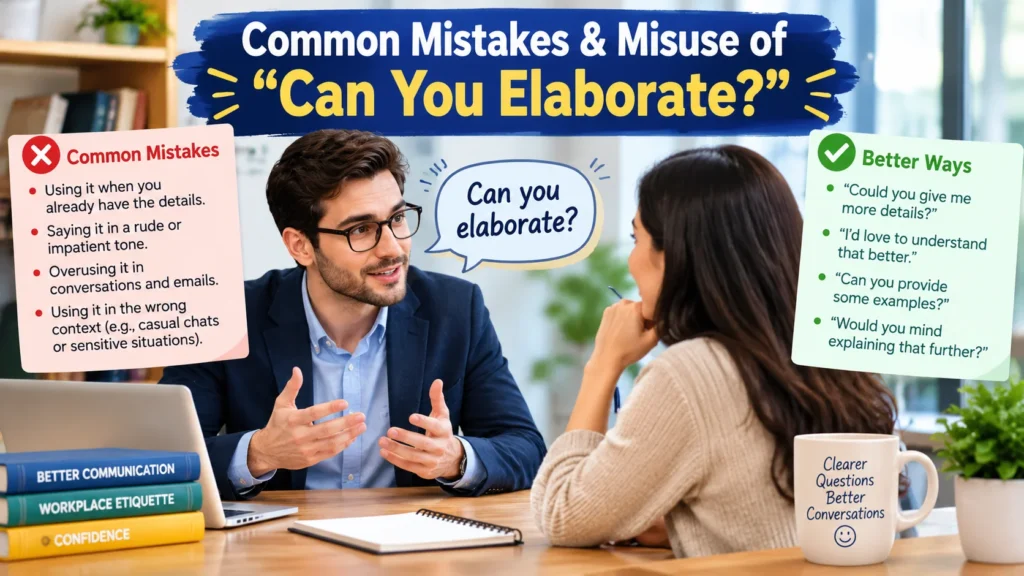
Even a polite phrase can become ineffective when it is used without considering context.
Overusing the same expression
Repeatedly asking “Can you elaborate?” can make a conversation feel like an interview. It may also suggest that you have not understood previous answers.
Better approach: Vary your wording and acknowledge what the person has already explained. For example, “That helps. Could you explain how the second step works?”
Using it without identifying the subject
A vague question may force the other person to guess what information you need.
Less effective: “Can you elaborate?”
More effective: “Can you elaborate on why the delivery date has changed?”
The second version identifies the missing information.
Using it when you actually disagree
Sometimes people ask someone to elaborate when their real intention is to challenge a claim. The question may sound neutral, but the underlying attitude can come across as dismissive.
If you disagree, explain your concern honestly: “Could you walk me through the evidence behind that conclusion? I interpreted the results differently.”
Confusing elaboration with clarification
Elaboration means adding information or developing an explanation. Clarification means making something easier to understand.
If a statement is confusing, ask someone to clarify it. If you understand the statement but need more depth, ask them to elaborate.
Ignoring cultural and language differences
Some speakers may interpret a brief request as an instruction rather than an invitation. English learners may also be unfamiliar with the verb elaborate.
When communicating across language backgrounds, simpler expressions such as “Could you explain that in more detail?” may be easier to understand.
Forgetting the other person’s circumstances
A person may not have enough information to answer immediately. Rather than repeating the question, ask whether they can provide more context later or identify what information is still needed.
Psychological Reason People Prefer “Can You Elaborate?”
People often use this expression because it provides a simple way to request information without immediately rejecting or criticizing another person’s statement.
Several communication habits help explain its appeal.
Cognitive load reduction
When people encounter unfamiliar information, they often need additional context before they can make sense of it. Asking someone to elaborate creates an opportunity to fill those gaps.
For example, a project manager who hears that a launch is delayed may ask for more details about staffing, technical issues, or dependencies before deciding how to respond.
Trust and authority signals
A thoughtful follow-up question can signal that the listener is paying attention and wants to understand the speaker’s reasoning.
In professional settings, this can support collaboration. However, the phrase alone does not guarantee trust. A dismissive delivery or repeated questioning may produce the opposite effect.
Attention economy
Modern communication often rewards brevity. Emails, chat messages, short videos, and meeting summaries compress complex ideas into small amounts of information.
As a result, people frequently need a second exchange to recover the background, assumptions, or reasoning omitted from an initial message.
Curiosity and active listening
Asking for elaboration can communicate curiosity rather than an immediate judgment. It allows the speaker to expand on an idea before the listener evaluates it.
This is especially helpful during brainstorming, coaching, interviews, and problem-solving discussions.
The desire to avoid assumptions
A follow-up question can prevent people from acting on incomplete information. Rather than guessing what a colleague meant, a listener can request further explanation.
Important distinction: The phrase itself does not prove that a person is curious, respectful, or skeptical. Those meanings emerge from the broader conversation, including the speaker’s tone, timing, and relationship with the listener.
US vs UK Usage of “Can You Elaborate?”
“Can you elaborate?” is understood in both American and British English. There is no major difference in its basic meaning, and it is appropriate in professional, academic, and everyday discussions in both countries.
Differences are more likely to involve communication style, degree of formality, and the alternatives people choose.
American English
In the United States, the phrase is common in workplace discussions, presentations, interviews, and business correspondence. American speakers may also choose more direct alternatives such as:
- “Can you give me more details?”
- “Can you explain what you mean?”
- “Can you expand on that?”
In a fast-paced meeting, adding the subject of the question can make the request more efficient.
British English
In the United Kingdom, “Can you elaborate?” is also a familiar professional expression. Depending on the setting, speakers may use softer alternatives such as:
- “Could you elaborate a little?”
- “Would you mind explaining that further?”
- “Could you provide a bit more detail?”
These expressions can sound more tentative or deferential, although their effect depends on the individual and the situation.
Is one version more polite?
Not necessarily. Both American and British speakers can use direct or indirect wording. The choice between “Can you elaborate?” and “Could you elaborate?” often reflects the desired level of softness rather than a strict regional rule.
| Feature | US English | UK English |
| Core meaning | Request a fuller explanation | Request a fuller explanation |
| Professional use | Common | Common |
| More direct alternative | “Can you give me more details?” | “Can you explain that a little more?” |
| Softer alternative | “Could you clarify that for me?” | “Would you mind elaborating a little?” |
| Regional distinction | No major difference in meaning | No major difference in meaning |
These are general tendencies, not fixed rules. Both versions are natural in either country.
Could You Explain That Further?

Meaning: This expression asks someone to give a more complete explanation of a statement, process, or idea.
Why This Phrase Works: It is straightforward and familiar, making it useful for people with different levels of English proficiency.
Real-World Usage Insight: Teachers, trainers, and colleagues can use it when someone has introduced a concept but has not fully explained how it works.
Best Use: Training sessions, educational discussions, technical explanations, and workplace conversations.
Avoid When: You only need a short confirmation or a specific missing number.
Tone: Neutral, respectful, and direct.
US vs UK Usage: Natural in both American and British English.
Example (Email / Message / Meeting): “I understand how the new dashboard tracks sales. Could you explain further how it handles refunds and canceled orders?”
Would You Mind Elaborating?
Meaning: This phrase politely asks someone to expand on a previous statement or provide a more detailed explanation.
Why This Phrase Works: The wording softens the request by presenting it as a considerate question rather than a direct demand.
Real-World Usage Insight: It can be useful when speaking with senior colleagues, clients, or people you do not know well.
Best Use: Formal meetings, professional emails, interviews, and respectful follow-up questions.
Avoid When: A quick, informal exchange calls for shorter and more natural wording.
Tone: Courteous, professional, and slightly formal.
US vs UK Usage: Appropriate in both countries, although the perceived formality varies by context.
Example (Email / Message / Meeting): “Thank you for outlining the proposed changes. Would you mind elaborating on how they might affect the current support team?”
Could You Give Me Some Additional Context?
Meaning: This expression asks for background information that would help someone understand a situation, decision, or statement.
Why This Phrase Works: It makes clear that the missing information may concern circumstances or history rather than the explanation itself.
Real-World Usage Insight: In distributed teams, people often receive messages without knowing what happened before the discussion. Asking for context helps prevent assumptions.
Best Use: Project handovers, workplace messages, decision-making, client discussions, and unfamiliar situations.
Avoid When: You already have the background and simply need a specific answer.
Tone: Professional, thoughtful, and collaborative.
US vs UK Usage: Common in both American and British workplaces.
Example (Email / Message / Meeting): “I saw the note about changing the campaign direction. Could you give me some additional context before I update the design?”
Can You Offer More Information?
Meaning: This phrase asks someone to share additional information about a subject.
Why This Phrase Works: It is broad enough for many situations and directs attention toward the information needed rather than the speaker’s ability to explain.
Real-World Usage Insight: It works particularly well when the listener knows the topic but has not received enough information to evaluate it.
Best Use: Customer service, research discussions, business correspondence, and information requests.
Avoid When: The issue is not missing information but a confusing or contradictory statement.
Tone: Neutral, professional, and practical.
US vs UK Usage: Understood in both varieties of English. “Could you provide more information?” is another natural option.
Example (Email / Message / Meeting): “I’m reviewing the supplier options. Can you offer more information about the warranty and replacement process?”
Could You Walk Me Through Your Reasoning?
Meaning: This phrase asks someone to explain the thinking or steps behind a conclusion, decision, or recommendation.
Why This Phrase Works: It encourages the speaker to show how they reached an answer rather than simply repeating the result.
Real-World Usage Insight: In problem-solving discussions, it helps reveal assumptions, overlooked details, and differences in interpretation.
Best Use: Interviews, technical reviews, strategy meetings, training, and decision discussions.
Avoid When: You are asking for a simple factual detail, or the person may interpret the question as an accusation without further context.
Tone: Analytical, collaborative, and professional.
US vs UK Usage: Common in both countries, especially in workplace and educational settings.
Example (Email / Message / Meeting): “Your recommendation makes sense. Could you walk me through your reasoning for prioritizing the mobile redesign over the checkout fixes?”
Could You Tell Me a Little More About That?
Meaning: This expression invites someone to provide additional information in a gentle, conversational way.
Why This Phrase Works: The wording is approachable and shows interest without demanding a formal or comprehensive explanation.
Real-World Usage Insight: It is useful when the goal is to keep a conversation flowing rather than obtain a structured report.
Best Use: Everyday conversations, friendly workplace chats, interviews, and informal discussions.
Avoid When: You need a formal record of specific facts or a precise technical explanation.
Tone: Warm, polite, and conversational.
US vs UK Usage: Natural in both American and British English.
Example (Email / Message / Meeting): “You mentioned you’re switching to freelance work next month. Could you tell me a little more about that? Have you already found your first client?”
Could You Help Me Understand Your Point?
Meaning: This phrase asks someone to explain their perspective, argument, or reasoning in a way the listener can understand.
Why This Phrase Works: It presents understanding as a shared goal and can sound less confrontational than directly questioning someone’s conclusion.
Real-World Usage Insight: It is particularly helpful when people disagree but want to keep the conversation constructive.
Best Use: Conflict resolution, feedback sessions, negotiations, team discussions, and sensitive workplace conversations.
Avoid When: Your intention is simply to obtain a factual detail that does not require exploring someone’s perspective.
Tone: Respectful, collaborative, and thoughtful.
US vs UK Usage: Appropriate in both varieties of English.
Example (Email / Message / Meeting): “I see why you prefer the shorter timeline. Could you help me understand your point about reducing the testing period?”
Comparison Table of 10 Best Alternatives
The best alternative depends on whether you need a detailed explanation, a clearer statement, additional facts, or a more conversational response. This table compares ten useful options by meaning, appropriate use, potential drawbacks, and tone.
| Phrase | Meaning | Best Use | Worst Use | Tone | US vs UK Usage |
| Could you provide more details? | Requests additional facts | Business emails and reports | Casual personal chats where warmth matters | Professional | Common in both |
| Could you clarify your point? | Requests greater clarity | Resolving confusion | When you need depth, not clarity | Focused and polite | Common in both |
| Could you expand on that? | Invites a fuller idea | Brainstorming and presentations | Requests requiring one specific fact | Collaborative | Common in both |
| Could you explain that further? | Requests a fuller explanation | Education and training | Simple yes-or-no questions | Neutral | Common in both |
| Would you mind elaborating? | Politely requests more explanation | Formal conversations | Urgent, fast-moving exchanges | Courteous | Common in both |
| Could you give me some additional context? | Requests background information | Project discussions | When only a precise figure is missing | Thoughtful | Common in both |
| Could you walk me through your reasoning? | Requests the thinking behind a conclusion | Decision-making and reviews | Emotionally sensitive situations without care | Analytical | Common in both |
| Could you tell me a little more about that? | Invites additional information | Friendly conversations | Highly formal records | Warm | Common in both |
| Could you share an example? | Requests a concrete illustration | Teaching and practical discussions | Confidential or sensitive subjects | Curious | Common in both |
| Tell me more | Invites someone to continue | Casual conversations | Formal business correspondence | Friendly | Common in both |
Conclusion
“Can you elaborate?” is a useful English expression for requesting more information, exploring an idea, or understanding someone’s reasoning. Its professional yet approachable tone makes it suitable for meetings, emails, presentations, educational discussions, and everyday conversations.
However, effective communication involves more than choosing a phrase with the correct meaning. The context, relationship, and purpose of your question all influence how the other person interprets it. “Could you clarify?” works better when something is unclear, while “Could you provide more details?” is more appropriate when you need specific facts. For friendly conversations, “Tell me more” often feels more natural.
When using “Can you elaborate?”, try to identify the particular point you want explained. This helps the other person provide a relevant answer and reduces unnecessary back-and-forth. If the subject is sensitive or the conversation is tense, a softer alternative can encourage a more comfortable exchange.
Ultimately, the best synonym is the one that matches your intention, respects your audience, and makes the next step in the conversation easier. Learning these alternatives can strengthen your professional writing, everyday English, and ability to communicate clearly in different situations.
FAQs
What does “Can you elaborate?” mean?
“Can you elaborate?” means asking someone to explain something in greater detail. It is commonly used when a statement, idea, or decision needs additional information. The phrase is appropriate for meetings, emails, presentations, and everyday conversations. It generally communicates curiosity or a need for clarification rather than disagreement, although context and delivery can affect how it is interpreted.
Is “Can you elaborate?” polite?
Yes, “Can you elaborate?” is generally considered polite and professional. However, it can sound abrupt if used without context, especially in a short message or tense conversation. Adding “please,” acknowledging the person’s previous explanation, or using “Could you elaborate on that point?” can make the request feel more considerate and collaborative.
What is a more professional way to say “Can you elaborate?”
Professional alternatives include “Could you provide further details?” “Could you expand on that point?” and “Could you clarify your reasoning?” The best choice depends on what you need. Use “provide further details” for factual information, “expand on that point” for a developing idea, and “clarify your reasoning” when you want to understand how someone concluded.
What is a casual way to say “Can you elaborate?”
Casual alternatives include “Tell me more,” “What do you mean by that?”, and “Can you unpack that for me?” These expressions work well with friends, colleagues you know well, and people in informal discussions. “Tell me more” sounds especially friendly, while “Can you unpack that?” is useful when an idea seems complex, and you want to explore it further.
What is the difference between “elaborate” and “clarify”?
To elaborate means to add more information, develop an idea, or explain something in greater depth. To clarify means to make something easier to understand or remove ambiguity. If you understand someone’s statement but want supporting details, ask them to elaborate. If you are unsure what the statement means, ask them to clarify.
Can I use “Can you elaborate?” in an email?
Yes, the phrase is appropriate in professional emails when you need additional information about a proposal, decision, report, or instruction. For a more polished request, specify the subject: “Could you elaborate on the revised timeline and explain how it affects the delivery date?” This approach makes your question easier to answer and reduces unnecessary follow-up messages.
Is “Could you elaborate?” better than “Can you elaborate?”
Both expressions are correct and widely understood. “Could you elaborate?” often sounds slightly softer or more deferential, while “Can you elaborate?” is direct and neutral. Neither is universally better. Choose “could” when you want a gentler request, particularly in formal communication, and “can” when a concise, straightforward question suits the situation.
Is “Can you elaborate?” rude or confrontational?
The expression is not inherently rude, but it can sound confrontational when delivered sharply or used during a disagreement. Some listeners may interpret it as a request to defend a statement. To communicate curiosity, ask a specific follow-up question, acknowledge what the person has already said, or use “Could you help me understand your reasoning?