
Imagine you are at work, and your manager suddenly changes a deadline without explaining what needs to happen next. You have several tasks waiting, your teammates need answers, and you are unsure which direction to take. You might naturally ask, “What am I supposed to do?” The question expresses confusion, requests guidance, or asks someone to clarify expectations.
“What am I supposed to do?” is a common English expression used when someone needs instructions, feels uncertain about a situation, or wants to understand their responsibilities. Depending on the speaker’s tone and the surrounding conversation, it can sound practical, frustrated, helpless, curious, or even sarcastic.
Although the phrase is natural in everyday English, it may not always be the best choice for professional emails, difficult conversations, or sensitive situations. Alternatives such as “What would you recommend?” or “Could you clarify the next steps?” can communicate the same basic need while sounding more collaborative and composed.
Understanding these alternatives helps professionals, students, ESL learners, and writers communicate more clearly. The right wording can turn uncertainty into a constructive request, reduce misunderstandings, and make it easier for others to offer useful guidance.
.
Origin & History of “What Am I Supposed to Do?”
The expression “What am I supposed to do?” developed from ordinary English question patterns rather than from a single identifiable historical event or famous quotation. Its meaning comes from the combination of the question word “what,” the subject “I,” and “supposed to,” which expresses an expectation, obligation, or anticipated action.
The expression “be supposed to” has long been used in English to discuss what people are expected or required to do. For example, a student may be supposed to submit an assignment by Friday, while an employee may be supposed to follow a particular procedure.
Over time, the question became a natural way to ask about expectations and responsibilities. In everyday conversation, its meaning expanded beyond requesting instructions. Speakers also began using it to express frustration when circumstances made an expected action difficult or impossible.
Consider two situations:
- Practical uncertainty: “The instructions are missing. What am I supposed to do?”
- Frustration: “You canceled the appointment, but now you’re blaming me. What am I supposed to do?”
The words remain the same, but the emotional meaning changes with the situation, emphasis, and delivery.
Today, the phrase is common in spoken English, workplace conversations, text messages, online discussions, television, and film. Its continued popularity reflects a basic communication need: people want to understand expectations, resolve uncertainty, and know how to proceed when circumstances are unclear.
When Should You Avoid “What Am I Supposed to Do?”
Although the phrase is grammatically correct and widely understood, certain situations call for more careful wording.
1. Highly formal communication
In formal emails, official reports, and communications with senior leadership, the phrase may sound too conversational or emotionally charged.
Instead of “What am I supposed to do about this request?” try “Could you advise me on the appropriate next steps?”
2. Legal or compliance-related situations
When dealing with contracts, official procedures, workplace policies, or legal obligations, avoid relying on a broad question that leaves the issue open to interpretation.
Ask a precise question, identify the relevant requirement, and request clarification from an appropriate authority.
For example: “Could you clarify which policy applies to this case and what documentation is required?”
3. Sensitive personal conversations
During disagreements, the phrase may sound defensive or accusatory, especially when delivered sharply.
If someone is explaining how your actions affected them, “What am I supposed to do?” might suggest that you are rejecting responsibility rather than listening.
A better alternative is: “I understand why this upset you. What would help us address it?”
4. Situations requiring immediate action
When safety, deadlines, or urgent decisions are involved, a broad question may delay the response.
Instead, ask for the specific information you need: “Should I evacuate now?” or “Who should I contact first?”
5. Conversations where expectations are already clear
Repeatedly asking what you are supposed to do when instructions have already been provided can make you appear disengaged.
If you need confirmation, summarize your understanding: “Just to confirm, I should complete the report before contacting the client, correct?”
The goal is not to eliminate the phrase. It is to use wording that matches the stakes, the relationship, and the information you need.
“What Am I Supposed to Do?” vs. Similar Expressions (Key Differences)
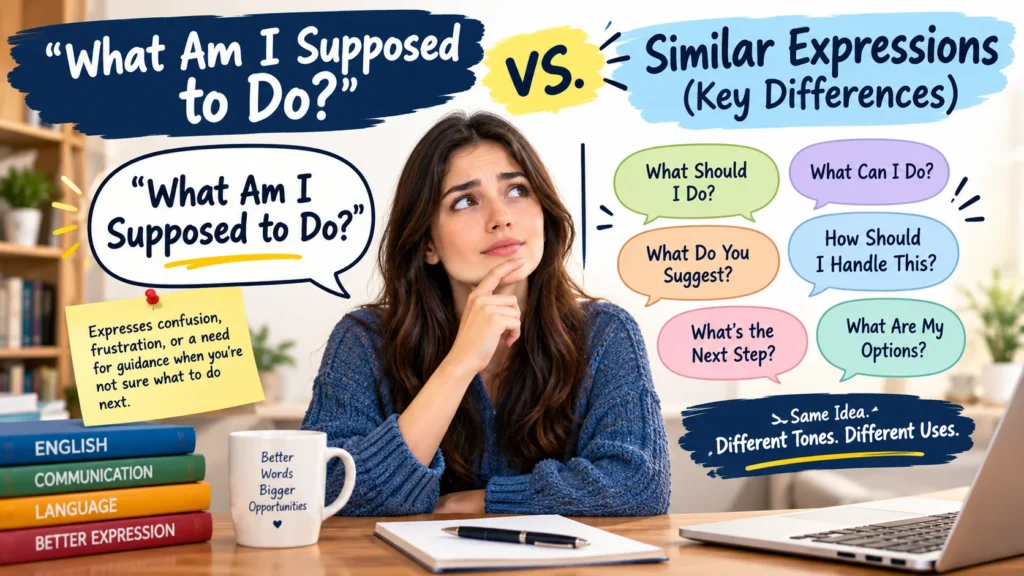
Several English expressions ask for guidance, but each emphasizes a slightly different need. Some request instructions, others invite recommendations, and a few communicate greater emotional uncertainty.
| Phrase | Meaning Difference | Tone Difference | Best Use Scenario |
| How should I proceed? | Asks for the appropriate next action. | Professional and measured. | Workplace decisions and formal emails. |
| What should I do? | Asks for advice about the best action. | Neutral and direct. | Everyday problems and decisions. |
| What are the next steps? | Focuses on the sequence of actions rather than personal uncertainty. | Professional and practical. | Projects, meetings, and planning. |
| What would you recommend? | Invites another person’s judgment or expertise. | Polite and collaborative. | Asking a manager, mentor, or specialist for advice. |
| Where do I go from here? | Asks how to move forward from the current situation. | Reflective and sometimes emotional. | Personal challenges, career decisions, or difficult transitions. |
| Now what? | Asks what happens or what to do next, often after an unexpected event. | Casual and sometimes impatient. | Informal conversations and text messages. |
How to choose the closest alternative
- Use “What should I do?” when you need straightforward advice.
- Use “How should I proceed?” when communicating professionally.
- Use “What are the next steps?” when you need a plan.
- Use “What would you recommend?” when you want another person’s opinion.
- Use “Where do I go from here?” when the situation feels uncertain or emotionally significant.
- Use “Now what?” in casual conversation when something unexpected happens.
The most effective alternative is the one that tells the listener what kind of response you need. If you need a decision, ask for a recommendation. If you need a procedure, request instructions. If you need reassurance, say so directly.
US vs UK Usage of “What Am I Supposed to Do?”
“What am I supposed to do?” is readily understandable in both American and British English. There is no major difference in its core meaning, although conversational habits, regional preferences, and workplace expectations can influence how it sounds.
American English
In the United States, the expression is common in everyday conversation, workplace discussions, entertainment, and digital communication.
Depending on delivery, it may sound like a straightforward request for advice or a stronger expression of frustration.
Common alternatives include:
- “What should I do?”
- “How should I handle this?”
- “What are my options?”
- “What’s the next step?”
In professional settings, American speakers may prefer a specific question that identifies the decision they need to make.
British English
In the United Kingdom, the phrase is equally understandable and can convey the same uncertainty or frustration.
Speakers may also use “What am I meant to do?” as a close alternative. In many contexts, “How should I go about this?” is another natural way to request guidance.
Common alternatives include:
- “What am I meant to do?”
- “How should I go about it?”
- “What would be the best way forward?”
- “What should I do next?”
Differences in tone and preference
| Feature | US English | UK English |
| Main phrase | Common and natural. | Common and natural. |
| Close alternative | “What should I do?” | “What am I meant to do?” |
| Professional wording | “How should I handle this?” | “How should I go about this?” |
| Possible emotional reading | Confusion, frustration, or a request for help. | Confusion, frustration, or a request for help. |
| Key consideration | Relationship and delivery. | Relationship and delivery. |
These are general tendencies, not strict rules. Both varieties use direct and indirect questions, and neither expression is exclusive to one country. In either variety, tone and context matter more than the choice of a single regional phrase.
“What Am I Supposed to Do?” in Digital & Modern Communication
Digital communication makes the phrase particularly useful because people often need to ask for clarification without the benefit of facial expressions, gestures, or vocal tone.
The challenge is that a short message may sound harsher than intended.
Emails
In emails, the phrase can communicate a genuine need for direction, but it may sound accusatory if the recipient is unaware of the problem.
Instead of:
“What am I supposed to do? The instructions don’t make sense.”
Try:
“I’m having trouble reconciling the two sets of instructions. Could you clarify which one I should follow?”
The second version identifies the difficulty and requests a specific resolution.
Slack and Microsoft Teams
Workplace messaging platforms encourage short, rapid exchanges. A direct question may be appropriate when the team already understands the context.
For example:
“The deployment is paused because the approval hasn’t come through. Should I continue with the documentation or wait for confirmation?”
This message is more actionable than a general question because it identifies the current problem and presents a clear decision.
WhatsApp and text messages
Among friends and family, the phrase is often used without sounding overly formal.
For example:
“The restaurant just canceled our booking, and everyone’s already on the way. What am I supposed to do now?”
Here, the question naturally communicates surprise and asks for suggestions.
If the recipient does not know the situation, a short explanation can help them respond meaningfully.
Social media and online communities
The phrase often appears in posts seeking advice, sharing frustrating experiences, or inviting other users to suggest solutions.
For example:
“I’ve applied for several internships, updated my résumé, and still haven’t received a response. What am I supposed to do differently?”
This wording invites practical suggestions. However, users who want specific feedback may get more useful responses by describing their industry, experience level, and current approach.
AI-generated summaries and automated communication
AI-generated summaries may reduce a complicated discussion to a short statement such as “The employee is unsure what to do next.” This can be useful, but it may remove the emotional context behind the original question.
For accurate summaries, distinguish between someone who needs instructions, someone who disagrees with a decision, and someone who is expressing distress. These situations may use the same words but require different responses.
Digital communication tip: When tone is difficult to read, pair the question with context and a clear request. A little extra information can prevent a short message from being mistaken for criticism.
Linguistic & Communication Insight

“What am I supposed to do?” is more than a request for instructions. It is a flexible expression whose meaning changes according to the relationship between speakers, the problem being discussed, and the expectations surrounding the conversation.
Understanding these factors helps you choose alternatives that communicate uncertainty without unintentionally sounding defensive, demanding, or disengaged.
Emotional weight and subtext
The literal meaning concerns an expected or appropriate action. The emotional meaning can be very different.
A student who asks a teacher, “What am I supposed to do if the assignment link doesn’t work?” is probably requesting practical help. An employee who says, “What am I supposed to do when you keep changing the deadline?” may be expressing frustration about an ongoing problem.
Native speakers often interpret the phrase through context rather than grammar alone. Vocal emphasis, pauses, previous disagreements, and the listener’s role can all affect its meaning.
The phrase can communicate:
- Uncertainty: The speaker does not know which action is correct.
- Dependence on guidance: The speaker expects another person to provide direction.
- Frustration: The speaker believes the available choices are difficult or unfair.
- Resistance: The speaker may question whether the expectation is reasonable.
- A need for reassurance: The speaker wants confirmation that a manageable solution exists.
These interpretations are possibilities rather than fixed meanings. A careful listener should consider the situation before deciding what the speaker intends.
Direct versus indirect phrasing
Direct questions are efficient because they make the need for an answer explicit. However, directness can sometimes place pressure on the listener, especially when the issue involves authority, disagreement, or personal responsibility.
Compare these expressions:
| Expression | Communication effect |
| “What am I supposed to do?” | Directly communicates uncertainty and may suggest frustration. |
| “What should I do?” | Requests advice without emphasizing an existing obligation as strongly. |
| “Could you clarify the next steps?” | Requests information in a professional, task-focused way. |
| “What would you recommend?” | Invites the other person’s judgment and experience. |
| “Could we work out the best approach together?” | Emphasizes collaboration and shared problem-solving. |
Indirect phrasing is not automatically more polite or more effective. If a situation requires a clear decision, excessive softening can make the request difficult to understand.
The most effective approach balances directness with consideration for the listener.
Professional communication perspective
In a workplace, the phrase can signal that expectations are unclear, resources are insufficient, or a decision requires managerial input.
The speaker’s wording may also influence how others interpret their level of ownership. A general question can sound as though the speaker expects someone else to solve the problem. A focused question that identifies possible solutions communicates greater initiative.
For example:
Less constructive: “The client rejected the draft. What am I supposed to do?”
More constructive: “The client wants a different direction. I can revise the introduction or prepare a new outline first. Which option would you prefer?”
The second version still asks for guidance, but it demonstrates that the speaker has considered the available choices.
This does not mean employees should always solve problems independently. Asking for help is appropriate when the decision exceeds their authority, requires specialist knowledge, or carries significant risk.
Pragmatic reasons for choosing alternatives
Experienced communicators often choose different wording to shape the response they receive.
- To reduce defensiveness: “Could you clarify what you expect?” focuses on understanding rather than blame.
- To encourage collaboration: “How can we move forward?” invites shared responsibility.
- To request expertise: “What would you recommend?” recognizes the other person’s knowledge.
- To establish priorities: “Which task should I handle first?” turns uncertainty into a concrete decision.
- To communicate urgency: “What needs to happen immediately?” makes the time-sensitive issue explicit.
- To confirm responsibility: “What am I responsible for in this situation?” clarifies the boundaries of a role.
These differences are practical. A question framed around the actual decision is more likely to produce a relevant answer than a broad expression of uncertainty.
Social signaling: How word choice affects trust
People do not evaluate communication solely by its literal content. They also make judgments about whether the speaker seems cooperative, confident, open to feedback, or willing to take responsibility.
For example, “Tell me what to do” may communicate a desire for clear direction, but it can also suggest dependence when used repeatedly. “Here is what I’ve considered. Which option do you think is best?” communicates a similar need while showing independent thought.
Neither style is universally superior. A new employee may reasonably need explicit instructions, while an experienced professional may benefit from discussing options and trade-offs.
Trust is generally supported when the wording matches the actual need, acknowledges relevant constraints, and gives the other person enough information to respond.
Tone and context guidance
Before using “What am I supposed to do?”, consider three questions:
- What do I need? Instructions, advice, permission, reassurance, or a decision?
- Who am I speaking to? A friend, manager, teacher, client, or someone involved in a disagreement?
- How might the question sound? Curious, neutral, frustrated, or accusatory?
If you need a clear procedure, ask for the next steps. If you feel overwhelmed, explain that you need help working through the options. If you disagree with an expectation, describe the practical problem rather than disguising the disagreement as a request for instructions.
The central communication lesson is simple: Effective wording makes your intention easier to understand. You do not need to avoid direct language; you need to choose direct language that fits the situation.
Could You Point Me in the Right Direction?
Meaning: This expression asks someone to provide initial guidance, useful information, or a starting point for solving a problem.
Why This Phrase Works: It sounds approachable and recognizes that the other person may not need to provide a complete solution.
Real-World Usage Insight: It works well when you know what you want to achieve but are unsure where to begin.
Best Use: Networking, research, unfamiliar software, workplace questions, and academic projects.
Avoid When: The situation requires precise instructions or urgent action.
Tone: Friendly, polite, and collaborative.
US vs UK Usage: Natural in both American and British English, especially in informal professional communication.
Example (Email / Message / Meeting): “I’m trying to understand the company’s reimbursement process, but the internal guide seems outdated. Could you point me in the right direction?”
Comparison Table of 10 Best Alternatives
The best alternative depends on whether you need instructions, advice, reassurance, or a collaborative solution. This table compares ten useful expressions by meaning, appropriate context, tone, and regional usage.
| Phrase | Meaning | Best Use | Worst Use | Tone | US vs UK Usage |
| How should I proceed? | Asks for the appropriate next action. | Formal emails and workplace decisions. | Casual chats with close friends. | Professional | Natural in both. |
| What should I do? | Requests advice about an action. | Everyday decisions and personal questions. | Situations requiring an official procedure. | Neutral | Common in both. |
| What are the next steps? | Asks for a sequence of actions. | Project planning and meetings. | Emotional conversations needing reassurance. | Practical | Common in both. |
| Could you clarify what I should do? | Requests clearer instructions. | Work assignments and academic tasks. | Situations where the real issue is disagreement. | Polite | Natural in both. |
| What would you recommend? | Requests another person’s advice. | Mentoring and expert guidance. | Situations requiring formal authorization. | Collaborative | Common in both. |
| How would you like me to handle this? | Asks about another person’s preferred approach. | Client requests and team responsibilities. | Tasks governed by mandatory procedures. | Respectful | Natural in both. |
| What options do I have? | Asks about available choices. | Decisions and problem-solving. | Situations with only one possible action. | Practical | Common in both. |
| Let’s figure out the next step. | Suggests identifying a solution together. | Teamwork and shared problems. | Situations requiring an immediate independent decision. | Supportive | Natural in both. |
| What’s the best way forward? | Asks for a suitable path ahead. | Planning and resolving disagreements. | Simple tasks needing direct instruction. | Professional | More established in some UK business contexts; understood in the US. |
| Now what? | Asks what happens or what to do next. | Casual conversations and unexpected events. | Formal emails and sensitive discussions. | Casual | Common in both. |
Conclusion
“What am I supposed to do?” is a natural English expression that communicates uncertainty, requests guidance, and sometimes expresses frustration. Its meaning depends on the situation, the relationship between speakers, and the way the question is delivered.
If you want to sound more professional, alternatives such as “How should I proceed?” and “Could you clarify the next steps?” can help you request clear instructions without sounding confrontational. For collaborative conversations, “Let’s figure out the next step” encourages shared problem-solving, while “What would you recommend?” invites another person’s expertise.
The key is to choose words that reflect your actual intention. If you need instructions, ask for the next steps. If you want advice, request a recommendation. If you feel overwhelmed, explain what is making the situation difficult.
FAQs
What is another way to say “What am I supposed to do?”
You can say “What should I do?”, “How should I proceed?”, “What are the next steps?”, or “What would you recommend?” Each alternative has a slightly different purpose. Choose the one that matches whether you need instructions, advice, a decision, or help identifying a practical solution.
Is “What am I supposed to do?” grammatically correct?
Yes, “What am I supposed to do?” is grammatically correct. It uses the present-tense form of “be supposed to” to ask about an expected or appropriate action. The expression is common in spoken English, written messages, and everyday conversations across a wide range of situations.
Is “What am I supposed to do?” rude?
Not necessarily. The phrase is generally acceptable, but it can sound rude or confrontational when delivered sarcastically or during an argument. In professional communication, “Could you clarify what I should do next?” often sounds more constructive because it requests guidance without implying blame.
What is the difference between “What should I do?” and “What am I supposed to do?”
“What should I do?” usually asks for advice about the best action. “What am I supposed to do?” often emphasizes expectations, responsibilities, or uncertainty about what is required. Both expressions can request guidance, but the second may communicate frustration when the speaker feels restricted by circumstances.
How do you say “What am I supposed to do?” professionally?
Professional alternatives include “How should I proceed?, “Could you clarify the next steps?”, and “What would you recommend in this situation?” These phrases work well in workplace emails, meetings, and discussions with supervisors because they focus on instructions, decisions, and practical solutions.
What is a polite alternative to “What am I supposed to do?”
A polite alternative is “Could you help me understand what to do next?” This wording communicates uncertainty while inviting assistance. You can also say “Would you mind guiding me through this?” when you need support with an unfamiliar task or want to acknowledge another person’s experience.
What does “What am I supposed to do now?” mean?
“What am I supposed to do now?” asks what action is appropriate after a new event, unexpected problem, or change in circumstances. The word “now” emphasizes the immediate situation. Depending on context, the question can express genuine confusion, urgency, disappointment, or frustration.
What is a casual synonym for “What am I supposed to do?”
Casual alternatives include “Now what?”, “What do I do now?”, “What’s my next move?”, and “Any ideas?” These expressions are common in conversations with friends, family, and familiar colleagues. However, “Now what?” can sound impatient, so your delivery and the surrounding context matter.
Is “What am I supposed to do?” common in American and British English?
Yes, the expression is common and understandable in both American and British English. Its core meaning remains the same, although speakers may prefer alternatives such as “What am I meant to do?” or “How should I go about this?” in particular situations. Tone and context influence its interpretation in both varieties.
How can I ask for help without sounding helpless?
Explain the problem briefly, mention what you have already considered, and ask a focused question. For example, “I’ve reviewed both options, but I’m unsure which meets the deadline. Which would you recommend?” This approach communicates that you need guidance while showing initiative and a willingness to find a solution.