
Imagine your team is one point away from winning a close game, and someone says, “We’ve definitely got this.” A teammate immediately replies, “Don’t jinx it!” Everyone understands the message: enjoy the possibility, but do not speak too confidently before the outcome is certain.
“Don’t jinx it” is a common informal English expression used when someone believes that talking too confidently about a positive future result might somehow cause it to go wrong. It is usually playful rather than serious. The phrase can appear in conversations about exams, job offers, sports, travel plans, relationships, purchases, deadlines, and other uncertain outcomes.
For ESL learners and professionals, understanding this expression is useful because its literal words do not fully explain its conversational meaning. Tone matters. In a friendly conversation, “Don’t jinx it” can sound humorous and familiar. In a formal workplace message, however, alternatives such as “Let’s not get ahead of ourselves” or “Let’s wait until it’s confirmed” may communicate the same underlying caution more clearly and professionally.
What Does “Don’t Jinx It” Mean?
“Don’t jinx it” means “don’t say or do something that you believe could cause a good situation to go wrong.” It is commonly used when an outcome has not yet been confirmed, especially when someone predicts success too confidently. The expression often reflects superstition, caution, humor, or a desire to avoid celebrating before something is certain.
In simple terms, if someone says “Don’t jinx it,” they are usually asking another person not to assume that everything will work out yet.
For example:
“The interview went really well. I think I got the job.”
A friend might respond:
“Sounds promising, but don’t jinx it!”
The speaker is not necessarily making a serious claim about supernatural forces. In modern English, the expression is often a lighthearted way to say “Let’s wait and see.”
Origin & History of “Don’t Jinx It”
The expression comes from the word “jinx,” which means a person, thing, action, or situation believed to bring bad luck. The modern word has a particularly strong connection with early twentieth-century American sports, especially baseball. Merriam-Webster dates the noun jinx to the early 1900s and notes its early use as American sports slang. (Merriam-Webster)
The deeper history is less certain. One traditional explanation connects jinx with jynx, the name of the wryneck bird, which was associated with charms and magic in earlier traditions. The Greek and Latin history behind that connection is plausible, but researchers have also proposed alternative explanations involving American popular culture and nineteenth-century characters such as Jinks Hoodoo. (Etymology Online)
Early American examples show jinks and jinx being used for bad luck in sports. Baseball writers helped popularize the term, and the meaning eventually expanded beyond athletics into everyday American English. (Baseball Almanac)
The modern phrase “Don’t jinx it” therefore represents a broader development: a sports-related superstition became an everyday conversational expression. Today, it is frequently used without any serious belief in magic. It can simply mean “Don’t assume success before we know the result.”
Synonyms & Alternatives by Tone
Professional & Neutral Alternatives
- Let’s not get ahead of ourselves.
- Let’s wait until it’s confirmed.
- Let’s not assume anything yet.
- Let’s wait and see.
- Let’s keep expectations realistic.
Polite & Supportive Alternatives
- Hopefully, it works out.
- Let’s see how it goes.
- We’ll know soon enough.
- Let’s take it one step at a time.
- I’m hopeful, but let’s wait for confirmation.
When Should You Use “Don’t Jinx It”?
Professional Settings
Use “Don’t jinx it” selectively at work. It can work well among colleagues who already have a relaxed relationship, particularly during informal conversations.
For example:
“The client seems ready to sign.”
“I hope so. Don’t jinx i we still need the contract.”
The phrase adds personality and humor. However, a formal client email would usually benefit from clearer wording:
“The client appears interested, but let’s wait for the signed agreement before treating it as confirmed.”
Casual Conversations
This is where “Don’t jinx it” feels most natural. Friends and family commonly use it when discussing uncertain positive events.
Examples include:
- “The weather looks perfect for Saturday.”
- “Don’t jinx it!”
- “I think I’ll pass the exam.”
- “Don’t say that yet!”
- “We might actually get there early.”
- “Don’t jinx us.”
Writing, Presentations, and Digital Communication
The phrase works naturally in:
- Text messages
- WhatsApp conversations
- Social media comments
- Informal blogs
- Team chats
- Casual presentations
It is less suitable for academic papers, legal documents, official reports, and highly formal business communication.
When It Is Especially Effective
“Don’t jinx it” is especially effective when the speaker wants to express caution without sounding overly serious. It allows someone to challenge premature confidence while keeping the interaction friendly.
That combination of caution and humor explains why the phrase remains useful in everyday English.
When Should You Avoid “Don’t Jinx It”?
Avoid the expression when the audience may interpret it too literally or when precise language is more important than conversational personality.
Overly Formal Situations
In formal business correspondence, replace it with:
“Let’s wait for confirmation.”
or:
“We should avoid treating the outcome as final until all requirements have been completed.”
Legal, Academic, or Sensitive Contexts
A legal document should not rely on an idiom to communicate uncertainty. Similarly, academic writing generally benefits from explicit statements rather than expressions based on superstition.
Instead of:
“We don’t want to jinx the project.”
write:
“The project is progressing well, although the outcome remains uncertain.”
Situations Where Nuance May Be Lost
ESL learners, international teams, or readers unfamiliar with the expression may interpret “jinx” as meaning an actual curse.
When clarity is more important than informality, use:
“Let’s not assume the result yet.”
Is “Don’t Jinx It” Professional, Polite, or Casual?
“Don’t jinx it” is primarily casual and conversational.
It is not inherently rude. In fact, it can sound friendly because it often expresses shared hope and uncertainty. However, its informal and slightly superstitious flavor makes it less appropriate for highly formal communication.
Tone Analysis
The phrase can communicate several things simultaneously:
- Caution: The outcome is not certain.
- Humor: The speaker is not necessarily being serious about bad luck.
- Hope: The speaker wants the positive outcome to happen.
- Uncertainty: The situation could still change.
- Social connection: The speaker assumes the listener understands the cultural meaning.
Its emotional subtext is often:
“I really hope this works out, so let’s not celebrate too early.”
That is different from simply saying “No.”
Pros and Cons of Using “Don’t Jinx It”
Advantages
- Clarity: In familiar conversational contexts, the intended caution is immediately recognizable.
- Efficiency: Three words can communicate uncertainty, hope, and playful caution.
- Accessibility: The expression is widely understood in everyday English, particularly in American English.
- Social warmth: It can make a response sound less rigid than a formal warning.
- Emotional balance: It acknowledges optimism without treating an uncertain outcome as guaranteed.
Potential Drawbacks
- Oversimplification: It can replace a more precise explanation when the circumstances actually require one.
- Tone mismatch: It may sound too casual in a formal workplace or academic setting.
- Cultural misunderstanding: Some international English speakers may not immediately understand the superstition-based meaning.
- Repetition: Frequent use can make someone’s communication sound predictable or overly cautious.
- Ambiguity: It does not explain why an outcome remains uncertain.
Real-Life Examples of “Don’t Jinx It” by Context
Emails
Informal workplace email:
“The client seems ready to approve the proposal. Don’t jinx it, but this could be a good week for us.”
For a formal external email, use clearer wording such as:
“The client appears positive, although we should wait for formal approval.”
Meetings
“If we finish testing today, we can launch tomorrow.”
A colleague might respond:
“Let’s not jinx it. We still have the final security check.”
Presentations
A presenter discussing a project milestone might say:
“We’re ahead of schedule right now, but I don’t want to jinx it—we still have two important stages left.”
Conversations
“The restaurant has a table available, and there’s no traffic.”
“Don’t jinx it. We haven’t even left yet.”
Social Media
“Three days into vacation and we haven’t had a single rainy afternoon. Don’t jinx it!”
Here, the expression is clearly playful.
“Don’t Jinx It” vs Similar Expressions: Key Differences
| Phrase | Meaning Difference | Tone Difference | Best Use Scenario |
| Don’t tempt fate. | Warns against deliberately acting as though bad luck cannot happen. | More dramatic and slightly serious. | Risky situations or humorous warnings. |
| Fingers crossed. | Expresses hope for a favorable result rather than warning someone. | Positive and supportive. | Exams, interviews, applications, uncertain plans. |
| Knock on wood. | A traditional response intended to avoid bad luck after mentioning something positive. | Playful and superstitious. | Casual conversation after praising good fortune. |
| Let’s not get ahead of ourselves. | Advises people not to assume success before the evidence is final. | Professional and measured. | Work, projects, negotiations, planning. |
| Don’t count your chickens before they hatch. | Warns against relying on something that has not happened yet. | Idiomatic and somewhat old-fashioned. | Business, money, plans, expected results. |
| Let’s wait and see. | Simply acknowledges that the outcome is not known yet. | Neutral and calm. | Almost any situation involving uncertainty. |
The key distinction is that “Don’t jinx it” focuses on the perceived risk of saying something too confidently, while “Let’s not get ahead of ourselves” focuses on the practical mistake of treating an uncertain outcome as certain.
Common Mistakes & Misuse of “Don’t Jinx It”
Overuse
Using the phrase after every positive statement can make conversations feel unnecessarily superstitious.
Instead of repeatedly saying:
“Don’t jinx it.”
Vary your language:
“Hopefully.”
“Let’s wait and see.”
“It’s looking promising.”
Incorrect Context
Do not use it when someone is simply reporting a fact.
For example:
“The payment was received yesterday.”
There is no reason to say:
“Don’t jinx it.”
The outcome has already happened.
Contradictory Usage
The phrase usually responds to an uncertain positive prediction. Saying “Don’t jinx it” after a confirmed negative event does not make logical sense.
Cultural Misunderstandings
Not every English speaker interprets jinx in exactly the same way. Learners should understand that it is generally an idiomatic expression, not a literal claim that speech causes events to change.
US vs UK Usage of “Don’t Jinx It”
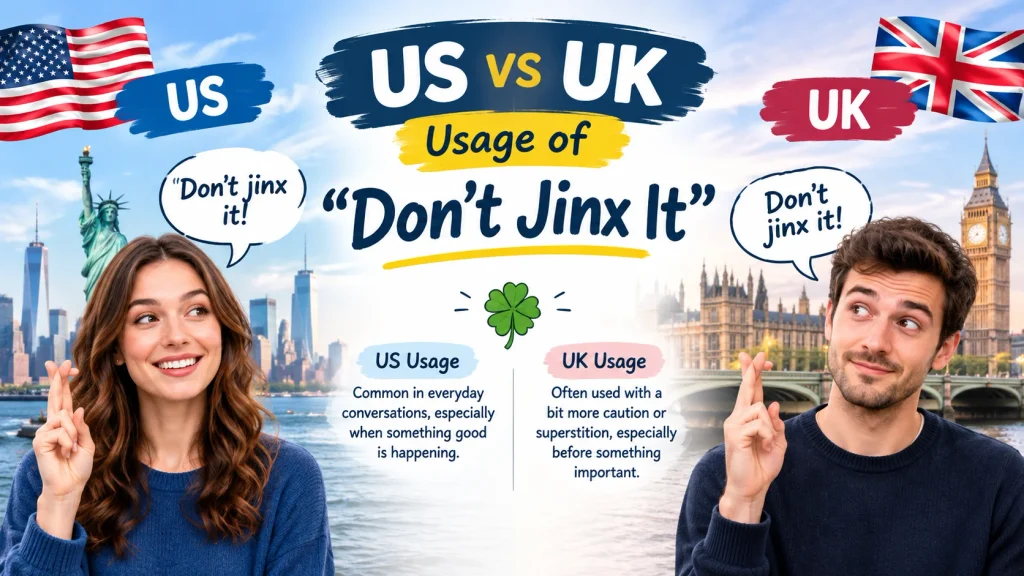
“Don’t jinx it” is understood in both American and British English. The word jinx has strong documented roots in American English, particularly early twentieth-century baseball slang, before spreading into broader English usage. (Merriam-Webster)
In the United States, the expression is especially natural in casual conversation, sports, work chats, and everyday discussions.
British speakers also understand and use jinx, although expressions such as “touch wood” can be especially familiar in British contexts for the related idea of warding off bad luck.
The difference is therefore less about whether the phrase is understood and more about regional preference and conversational style.
“Don’t Jinx It” in Digital & Modern Communication
Emails
In an informal internal email:
“The numbers look strong so far. Don’t jinx it, but we may beat the target.”
For clients or senior executives, a neutral alternative is usually better.
Slack / WhatsApp
The expression works naturally in short messages:
“Looks like everyone can make Friday’s dinner. Don’t jinx it 😂”
Social Media
Social media often favors the playful version:
“No delays, no lost luggage, and my flight is actually early. Don’t jinx it!”
AI-Generated Summaries
An AI-generated business summary should generally avoid idiomatic expressions unless the original tone needs to be preserved.
Instead of summarizing:
“The team said, ‘Don’t jinx it.’”
as:
“The team warned against bad luck,”
a better context-sensitive summary might be:
“The team expressed optimism while acknowledging that the outcome was not yet certain.”
This preserves the practical meaning rather than taking the superstition literally.
Linguistic & Communication Insight
Emotional Weight & Subtext
Native speakers generally hear more than the literal words in “Don’t jinx it.” The phrase often communicates hope, caution, uncertainty, and mild humor simultaneously.
Someone saying it usually does not mean:
“Your words possess supernatural power.”
Instead, the social meaning is closer to:
“We want this to happen, so let’s not act as though it is guaranteed.”
Direct vs Indirect Phrasing
“Don’t jinx it” is indirect because it does not explicitly explain the practical reason for caution.
Compare:
“Don’t jinx it.”
with:
“The outcome isn’t confirmed yet, so let’s wait before assuming it’s successful.”
The second version is longer but more precise. The first is more socially efficient.
Professional Communication Perspective
In a workplace, the choice depends heavily on the relationship between speakers.
Among close colleagues:
“Don’t jinx it—we’re almost there.”
can sound warm and natural.
In a board presentation:
“We should wait for final confirmation before declaring success.”
is much safer.
Experienced communicators adjust wording according to audience, stakes, relationship, and purpose.
Meaning, Usage & Examples for Each Alternative
Let’s Not Get Ahead of Ourselves
Meaning: This means we should not assume success or make decisions based on an outcome that has not been confirmed.
Why This Phrase Works: It communicates the practical idea behind “Don’t jinx it” without relying on superstition.
Real-World Usage Insight: It is particularly natural when a team is excited about a possible deal, promotion, launch, or milestone but still has important steps remaining.
Best Use: Meetings, business discussions, project planning, negotiations.
Avoid When: You want a very lighthearted or playful response.
Tone: Professional, measured, and cautious.
US vs UK Usage: Common and natural in both varieties of English.
Example (Meeting): “The client sounded ready to move forward, but let’s not get ahead of ourselves. We still need the signed agreement.”
Let’s Wait and See
Meaning: This means the outcome is not known, so it is better to wait for events to develop.
Why This Phrase Works: It avoids superstition entirely and expresses uncertainty clearly.
Real-World Usage Insight: It is one of the safest alternatives because it works in professional and casual conversations.
Best Use: Predictions, plans, results, interviews, weather, and uncertain situations.
Avoid When: Immediate action is required, and waiting is not actually an option.
Tone: Neutral, calm, and flexible.
US vs UK Usage: Very common in both US and UK English.
Example (Email): “The early feedback has been encouraging, but let’s wait and see what the final survey results show.”
Fingers Crossed
Meaning: This expresses hope that an uncertain situation will have a positive result.
Why This Phrase Works: Unlike “Don’t jinx it,” it focuses more on hope than on preventing bad luck.
Real-World Usage Insight: It is particularly useful after applying for something or waiting for a result.
Best Use: Job applications, exams, interviews, competitions, appointments.
Avoid When: A definite result has already been announced.
Tone: Hopeful, supportive, and informal.
US vs UK Usage: Very common in both American and British English.
Example (Social Media): “I submitted my final application today. Fingers crossed!”
Let’s Not Celebrate Too Soon
Meaning: This means people should avoid celebrating before the desired result is actually achieved.
Why This Phrase Works: It clearly communicates the idea of postponing celebration until success is certain.
Real-World Usage Insight: It is useful when a group is visibly excited but still has one or two hurdles left.
Best Use: Sports, projects, competitions, work milestones.
Avoid When: There is no expectation of celebration.
Tone: Friendly, direct, and encouraging.
US vs UK Usage: Common and easily understood in both.
Example (Meeting): “We’re leading the proposal process, but let’s not celebrate too soon—the final decision is next week.”
Hopefully, It Works Out
Meaning: This expresses a positive wish without claiming that success is certain.
Why This Phrase Works: It keeps optimism while avoiding overconfidence.
Real-World Usage Insight: It is a useful replacement when speaking to someone anxious about an uncertain result.
Best Use: Personal messages, applications, plans, decisions.
Avoid When: You need to make a firm factual statement.
Tone: Warm, supportive, and optimistic.
US vs UK Usage: Common in both.
Example (Message): “The interview felt much better than I expected. Hopefully, it works out.”
It’s Looking Good So Far
Meaning: This recognizes positive evidence while making clear that the outcome is still uncertain.
Why This Phrase Works: It balances optimism with accuracy.
Real-World Usage Insight: It is particularly useful when you want to encourage someone without making a promise.
Best Use: Work updates, exams, applications, projects, events.
Avoid When: The evidence is actually negative or inconclusive.
Tone: Positive, measured, and conversational.
US vs UK Usage: Natural in both.
Example (Meeting): “The first round of testing passed successfully. It’s looking good so far, but we still need the final results.”
Comparison Table of 10 Best Alternatives
The strongest alternative depends on the situation. Professional audiences generally benefit from direct expressions such as “Let’s nd see,” while casual conversations can comfortably use idioms such as “Don’t tempt fate” or “Knock on wood.”
| Phrase | Meaning | Best Use | Worst Use | Tone | US vs UK Usage |
| Let’s Not Get Ahead of Ourselves | Avoid assuming success too early. | Workplace discussions and planning. | Highly casual jokes. | Professional and measured. | Common in both. |
| Let’s Wait and See | Wait for the actual outcome. | General uncertainty. | Situations requiring immediate action. | Neutral and calm. | Common in both. |
| Don’t Tempt Fate | Avoid provoking possible bad luck. | Casual warnings and risky situations. | Formal documents. | Playful and dramatic. | Common in both. |
| Fingers Crossed | Hope for a good result. | Applications, exams, interviews. | Confirmed outcomes. | Hopeful and friendly. | Common in both. |
| Knock on Wood | Ward off bad luck after good news. | Casual conversations. | Formal writing. | Playful and traditional. | US: common; UK: “touch wood” also common. |
| Let’s Not Assume Anything Yet | Keep the result open until confirmed. | Business and factual discussions. | Lighthearted social banter. | Practical and neutral. | Common in both. |
| Let’s Not Celebrate Too Soon | Wait before treating something as successful. | Projects, sports, competitions. | Situations with no expected celebration. | Friendly and direct. | Common in both. |
| Hopefully, It Works Out | Express hope without certainty. | Personal and supportive messages. | Formal factual reports. | Warm and optimistic. | Common in both. |
| Let’s Take It One Step at a Time | Focus on the current stage. | Long projects or stressful situations. | Urgent decisions. | Calm and reassuring. | Common in both. |
| Don’t Count Yois ur Chickens Before They Hatch | Do not rely on an uncertain result. | Traditional advice and business talk. | Concise modern corporate writing. | Idiomatic and traditional. | Familiar in both. |
Final Takeaway
“Don’t jinx it” means “don’t speak or act as though a positive outcome is guaranteed when it has not happened yet.” It is informal, widely understandable, and often humorous. Its purpose is usually not to express a literal belief in supernatural bad luck but to communicate caution, hope, and uncertainty in a short, socially familiar way.
The best alternative depends on the audience. In a relaxed conversation, “Don’t tempt fate,” “Fingers crossed,” or “Knock on wood” can preserve the playful feeling. In professional communication, “Let’s wait and see,” “Let’s not assume anything yet,” or “Let’s not get ahead of ourselves” usually provides greater clarity.
Understanding these differences helps ESL learners, professionals, writers, and speakers choose language that fits both meaning and context. The most effective communicator is not simply someone who knows many synonyms; it is someone who knows when each expression sounds natural, appropriate, and precise.
Conclusion
“Don’t jinx it” is a common informal English expression used to caution someone against assuming that a positive outcome is certain before it actually happens. Although the phrase has roots in ideas about bad luck and superstition, modern speakers often use it playfully rather than literally. Its meaning is closely connected to hope, uncertainty, caution, and avoiding premature confidence.
The expression works naturally in conversations, text messages, social media, and informal workplace communication. However, it may sound too casual for legal documents, academic writing, formal reports, or professional messages where precision is essential. In those situations, alternatives such as “Let’s wait and see,” “Let’s not assume anything yet,” or “Let’s not get ahead of ourselves” are usually more appropriate.
Ultimately, understanding “Don’t jinx it” involves more than knowing its dictionary definition. The speaker’s relationship with the listener, the communication setting, and the intended tone all influence whether the phrase sounds natural, humorous, cautious, or inappropriate.
FAQs
What does “Don’t Jinx It” mean?
“Don’t jinx it” means not to say or do something that might supposedly cause a positive situation to go wrong. In modern English, it is usually a playful way to say, “Let’s not assume everything will work out yet.” It is commonly used when discussing uncertain results, plans, sports, exams, interviews, travel, or other anticipated events.
Is “Don’t Jinx It” a common expression?
Yes, “Don’t jinx it” is a common informal expression, particularly in American English and everyday conversational English. It is frequently heard among friends, coworkers, families, and sports fans. The phrase is also common in text messages, social media, and workplace chats. Its meaning is generally easy to understand from context, even when speakers do not literally believe in bad luck.
Is “Don’t Jinx It” professional?
“Don’t jinx it” is informal rather than fully professional. It can be appropriate among friendly coworkers in relaxed conversations or internal messages, but it is usually unsuitable for formal reports, legal documents, academic writing, and client-facing communication. Professional alternatives include “Let’s wait and see,” “Let’s not assume anything yet,” and “Let’s wait for confirmation.”
Is “Don’t Jinx It” rude?
No, “Don’t jinx it” is generally not rude. It usually sounds playful, friendly, or mildly cautious. However, tone and context matter. If said sharply, it could sound dismissive or irritated. With friends or familiar coworkers, it often communicates shared hope that something positive will happen without creating unnecessary seriousness around an uncertain outcome.
What are the best synonyms for “Don’t Jinx It”?
Useful alternatives include “Let’s not get ahead of ourselves,” “Let’s wait and see,” “Don’t tempt fate,” “Fingers crossed,” “Knock on wood,” “Let’s not assume anything yet,” and “Let’s not celebrate too soon.” The best choice depends on the intended tone. Professional communication generally favors direct alternatives, while casual conversations allow more playful idioms.
What is the difference between “Don’t Jinx It” and “Don’t Tempt Fate”?
“Don’t jinx it” usually means not to say something that could supposedly cause a good situation to go wrong. “Don’t tempt fate” suggests that someone should not behave as though bad luck or danger cannot happen. Both are informal and can be playful, but “don’t tempt fate” often sounds slightly more dramatic or cautionary.
What is a professional way to say “Don’t Jinx It”?
A professional alternative is “Let’s not get ahead of ourselves.” Other options include “Let’s wait for confirmation,” “Let’s not assume anything yet,” and “Let’s wait and see.” These expressions communicate uncertainty without relying on superstition or informal idiomatic language, making them better suited to workplace meetings, reports, emails, and client communication.
Can “Don’t Jinx It” be used in an email?
Yes, but it depends on the audience and relationship. In an informal internal email to familiar colleagues, “Don’t jinx it” can sound natural and friendly. For clients, executives, or formal correspondence, clearer wording is usually preferable. For example, “The results look promising, but let’s wait for final confirmation” sounds more precise and professional.
What does “Don’t Jinx It” mean in texting?
In texting, “Don’t jinx it” usually means “Don’t get too confident because the situation could still change.” It often appears after someone makes a positive prediction, such as “We might actually arrive early.” A reply like “Don’t jinx it!” is usually humorous and shows that the sender shares the hope while recognizing that the outcome is uncertain.
What is the opposite of “Don’t Jinx It”?
There is no single exact opposite, but expressions such as “Go ahead and celebrate,” “It’s definitely happening,” or “We know it’s a sure thing” convey greater confidence. The contrast is between caution about an uncertain outcome and treating that outcome as certain. In practice, the opposite attitude is confidence without concern about premature celebration or bad luck.