
Imagine receiving an email from a colleague that says, “Please see below for the updated project timeline.” You immediately know what to do: look farther down in the message for the information you need. The phrase is simple, useful, and widely understood, but it can sometimes sound repetitive or slightly formal when used frequently.
“Please see below” is a common expression in emails, reports, business correspondence, and digital communication. It directs the reader to information that appears later in the same message, document, or thread. However, the best wording depends on your audience, relationship, purpose, and desired tone. Choosing alternatives such as “Please refer to the information below,” “Details are provided below,” or “You’ll find the information below” can make communication clearer, warmer, or more natural.
This guide explains the meaning, history, tone, appropriate uses, common mistakes, and practical alternatives to “Please see below.” It also compares related expressions so you can choose the wording that fits your situation rather than relying on one phrase repeatedly.
What Does “Please See Below” Mean?
“Please see below” means that the reader should look farther down in the current email, document, message, or other written material to find information relevant to the subject being discussed. It is commonly used to direct attention to details, instructions, explanations, attachments, lists, examples, or answers presented later in the communication.
Origin & History of “Please See Below”
The expression “please see” comes from the traditional use of see to mean “look at,” “refer to,” or “consult.” In older formal writing, readers were frequently directed to other sections of documents using expressions such as “see below,” “see above,” “see page 10,” or “see the following.”
The addition of “please” makes the direction sound more courteous. Rather than simply writing “See below,” the writer uses a polite imperative: “Please see below.”
The phrase became particularly common in professional correspondence as business communication moved from letters and printed reports to email. Email made it easy to place additional information beneath an introductory sentence, creating a natural need for expressions that tell readers where to look.
Today, “Please see below” remains standard business English. However, modern workplace communication often favors more specific alternatives. Instead of merely directing attention downward, writers may explain exactly what the reader will find: “The revised schedule is below,” “I’ve included the requested figures below,” or “Details of the next steps are provided below.”
The underlying function has remained stable: to guide the reader toward information that appears later in the communication.
Synonyms & Alternatives by Tone
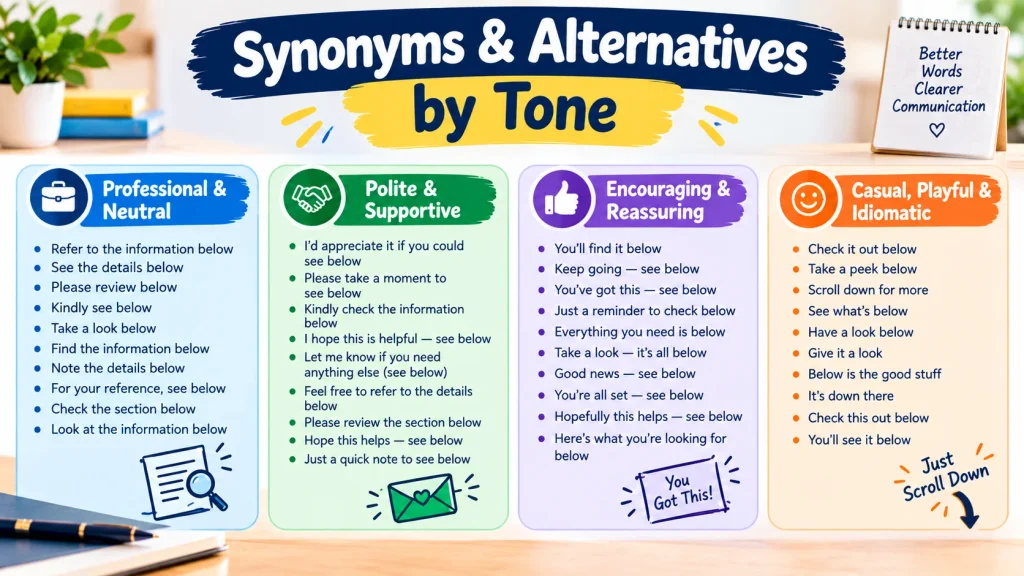
Professional & Neutral Alternatives
- Please refer to the information below.
- Please see the details below.
- Please find the information below.
- Details are provided below.
- The information is outlined below.
- The relevant information is listed below.
- Please review the information below.
- Further details are included below.
Polite & Supportive Alternatives
- You’ll find the information below.
- I’ve included the details below for your reference.
- Please take a look at the information below.
- For your convenience, the details are provided below.
- I’ve outlined the relevant information below.
Encouraging & Reassuring Alternatives
- You can find the details below.
- Everything you need is included below.
- The requested information is included below.
- I’ve included the next steps below.
- The details you requested are outlined below.
Casual, Playful & Idiomatic Alternatives
- See below.
- Check out the details below.
- Take a look below.
- Here are the details.
- More information is below.
- Here’s what you need to know.
- The details are right below.
When Should You Avoid “Please See Below”?
Although the phrase is grammatically correct, it is not ideal in every situation.
Overly formal situations
If you are writing to a close colleague or communicating through a fast-moving chat platform, “Please see below” may sound unnecessarily formal.
Instead:
Here are the details.
may be more natural.
Legal, academic, or sensitive contexts
In legal, academic, financial, or highly sensitive communication, vague directions can create ambiguity. If the reader needs to identify a particular provision, figure, requirement, or source, specify exactly what they should consult.
Instead of:
Please see below.
write:
Please refer to Section 4 for the revised payment terms.
Situations where nuance may be lost
The phrase tells the reader where to look but not necessarily why the information matters.
For important communication, add context:
Please see the summary below for the three changes that require your approval.
This is more useful than a generic direction.
Is “Please See Below” Professional, Polite, or Casual?
“Please see below” is generally professional and polite, with a neutral-to-formal tone.
The word “please” signals courtesy, while “see below” provides a direct instruction. It does not normally express emotion, urgency, enthusiasm, or personal warmth.
Its perceived tone can change according to context.
| Context | Likely Perception |
| Formal business email | Professional and appropriate |
| Internal workplace email | Neutral and slightly formal |
| Academic writing | Acceptable, but specificity may be preferable |
| Customer service | Polite and functional |
| Casual text | Somewhat formal |
| Slack or instant messaging | Often more formal than necessary |
| Legal communication | Acceptable but potentially too vague |
The phrase becomes warmer when followed by a helpful explanation:
Please see below for the information you requested.
It can sound abrupt when used alone:
Please see below.
The difference is small, but context matters.
Pros and Cons of Using “Please See Below”
Advantages
- Clarity: It immediately tells the reader where to look.
- Efficiency: It avoids unnecessary explanation.
- Accessibility: Most English speakers understand the expression easily.
- Professionalism: It fits standard workplace communication.
- Versatility: It works in emails, reports, messages, and administrative documents.
Potential Drawbacks
- Oversimplification: It may not tell the reader what information to expect.
- Tone mismatch: It can sound too formal in casual communication.
- Repetition: Frequent use can make emails feel formulaic.
- Weak specificity: It identifies location rather than purpose.
- Potential ambiguity: In long messages, “below” may require the reader to search.
A stronger version often names the information:
Please see the updated budget figures below.
Real-Life Examples of “Please See Below” by Context
Emails
Hi Sarah,
Please see below for the revised agenda for Thursday’s meeting. I’ve also added two items suggested by the finance team.
Meetings
I’ve summarized the three decisions we made today. Please see below before Friday’s follow-up call.
Presentations
Please see below for a comparison of the current and proposed timelines.
Conversations
I don’t have the address with me, but please see below in the message I sent you earlier.
Social media
Full details are below, including the registration deadline and event schedule.
In informal social media writing, however, “Please see below” is often less natural than “Details below” or “Here’s everything you need to know.”
“Please See Below” vs Similar Expressions (Key Differences)
The alternatives below are related, but they are not completely interchangeable. Some emphasize reference, some emphasize the information itself, and others sound more conversational.
| Phrase | Meaning Difference | Tone Difference | Best Use Scenario |
| Please refer to the information below | Directs the reader to consult specific information | Formal and professional | Reports, formal emails, instructions |
| Please see the details below | Directs attention specifically to details | Professional and neutral | Business emails and updates |
| Please find the information below | Presents information for the reader to locate | Formal and traditional | Business correspondence |
| Details are provided below | States that information has been supplied | Neutral and objective | Reports and professional documents |
| You’ll find the information below | Tells the reader where the information is in a warmer way | Friendly and professional | Customer service and workplace email |
| Please review the information below | Asks the reader to actively examine the information | Professional and directive | Approvals, decisions, reviews |
The key distinction is that “please see below” primarily directs attention, while phrases such as “please review” can also imply that the reader should evaluate or act on the information.
Common Mistakes & Misuse of “Please See Below”
Overuse
Repeating “please see below” in every email can make writing sound mechanical.
Instead of:
Please see the details below.
The complete schedule.
Please see below for the pricing.
Combine related information into one clear sentence.
Incorrect context
Avoid using the phrase when there is nothing actually below the sentence. This can happen when an email is edited, shortened, or converted into another format.
Contradictory usage
Do not say:
Please see below for the attached document.
An attachment is not necessarily “below.” If the document is attached, say:
Please see the attached document.
Cultural misunderstandings
English learners may sometimes interpret “please see” as an invitation to physically look at something. In professional English, it often simply means “please refer to” or “please consult.”
Psychological Reasons People Prefer “Please See Below”

Several practical communication factors explain why the expression remains common.
Cognitive load reduction
Readers process information more efficiently when they are told where relevant material is located. A short directional phrase reduces the effort required to scan a message.
Trust and authority signals
Clear workplace directions can make communication feel organized. However, overly formal language does not automatically create authority. Specific, useful information generally builds more trust than formal wording alone.
Attention economy
Modern readers often scan emails rather than reading every sentence carefully. A phrase such as “Please see the updated costs below” helps readers identify where useful information begins.
Modern communication habits
Email, messaging platforms, collaborative documents, and AI-generated summaries have increased the amount of information people receive. Concise signposting has therefore become increasingly valuable.
“
Please Refer to the Information Below
Meaning: “Please refer to the information below” asks the reader to consult information appearing later in the message or document. It is especially useful when the information is important enough to be treated as a reference point rather than merely something to glance at.
Why This Phrase Works: It clearly identifies the information as relevant and gives the reader a direct instruction.
Real-World Usage Insight: This wording is common in formal workplace communication, reports, administrative messages, and instructions where accuracy matters.
Best Use: Formal emails, reports, policies, procedures, and business correspondence.
Avoid When: Writing a quick message to a close colleague where a shorter expression would sound more natural.
Tone: Formal, professional, precise.
US vs UK Usage: Common and easily understood in both American and British English, with no significant difference in meaning.
Example (Email / Message / Meeting): Please refer to the information below for the revised payment schedule before submitting your expense report.
Please See the Details Below
Meaning: “Please see the details below” directs attention specifically to details provided later in the message.
Why This Phrase Works: It is more informative than simply saying “please see below” because the reader knows what kind of information to expect.
Real-World Usage Insight: It works particularly well when introducing schedules, pricing, specifications, deadlines, or project updates.
Best Use: Professional emails, customer service, project communication.
Avoid When: The material below is not actually detailed information.
Tone: Neutral, professional, courteous.
US vs UK Usage: Natural in both varieties of English.
Example (Email / Message / Meeting): Please see the details below for the client onboarding session, including the meeting time and required documents.
Details Are Provided Below
Meaning: This phrase states that relevant details have been supplied later in the document or message.
Why This Phrase Works: It is concise and objective without directly ordering the reader to do anything.
Real-World Usage Insight: It is useful when the writer wants to sound professional without repeatedly using “please.”
Best Use: Reports, instructions, professional emails, and documentation.
Avoid When: A warm, personal tone is important.
Tone: Neutral, objective, professional.
US vs UK Usage: Fully natural in both US and UK English.
Example (Email / Message / Meeting): Details are provided below regarding the updated return process and the deadline for submitting requests.
The Information Is Outlined Below
Meaning: This expression tells readers that the main points or structure of the information appear later in the document.
Why This Phrase Works: “Outlined” suggests that the material has been organized into understandable points.
Real-World Usage Insight: It is particularly useful for summaries, plans, proposals, and project updates.
Best Use: Business documents, reports, presentations, and strategic communication.
Avoid When: The information consists of one very short fact.
Tone: Professional, organized, slightly formal.
US vs UK Usage: Common in both varieties.
Example (Email / Message / Meeting): The information is outlined below so everyone has the same understanding of the revised launch plan.
The Relevant Information Is Listed Below
Meaning: This phrase tells the reader that information relevant to the current subject has been placed in a list below.
Why This Phrase Works: It combines location with relevance, helping the reader understand why the following material matters.
Real-World Usage Insight: It works well before bullet points, requirements, questions, or action items.
Best Use: Instructions, checklists, reports, and workplace emails.
Avoid When: The content below is presented as paragraphs rather than a list.
Tone: Formal, clear, structured.
US vs UK Usage: Natural in both American and British English.
Example (Email / Message / Meeting): The relevant information is listed below so you can prepare for the client call.
Please Review the Information Below
Meaning: This expression asks the reader not merely to look at information but to examine it carefully.
Why This Phrase Works: It communicates a stronger expectation of attention than “please see below.”
Real-World Usage Insight: The phrase is useful when the recipient needs to confirm, approve, correct, or respond to something.
Best Use: Reviews, approvals, financial documents, project drafts, and workplace decisions.
Avoid When: You only want to tell someone where information is located.
Tone: Professional, direct, action-oriented.
US vs UK Usage: Widely used in both.
Example (Email / Message / Meeting): Please review the information below and confirm that the delivery dates still work for your team.
Further Details Are Included Below
Meaning: This expression tells the reader that additional information follows later in the message or document.
Why This Phrase Works: “Further details” clearly indicates that the upcoming material expands on something already mentioned.
Real-World Usage Insight: It is especially useful when a summary comes first, and supporting information follows.
Best Use: Reports, proposals, project updates, and explanatory emails.
Avoid When: The information below introduces the topic rather than adding detail.
Tone: Professional, polished, neutral.
US vs UK Usage: Common in both American and British English.
Example (Email / Message / Meeting): We can move forward with the proposed schedule. Further details are included below.
I’ve Included the Details Below for Your Reference
Meaning: This expression explains that the writer has intentionally supplied information below so the recipient can consult it.
Why This Phrase Works: It emphasizes helpfulness rather than simply giving a direction.
Real-World Usage Insight: It works well when sharing information that the recipient may need now or later.
Best Use: Professional emails, customer support, follow-ups, and project communication.
Avoid When: You need a very brief instruction in a fast-paced chat.
Tone: Polite, supportive, professional.
US vs UK Usage: Natural in both American and British English.
Example (Email / Message / Meeting): I’ve included the details below for your reference in case you need them when completing the registration form.
Please Take a Look at the Information Below
Meaning: This expression politely asks someone to look at information appearing later in the communication.
Why This Phrase Works: It sounds less formal and more conversational than “please refer to.”
Real-World Usage Insight: It can make internal communication feel more approachable while remaining polite.
Best Use: Team messages, friendly workplace emails, and informal professional communication.
Avoid When: Writing highly formal contracts, legal documents, or official notices.
Tone: Polite, friendly, conversational.
US vs UK Usage: Used naturally in both regions.
Example (Email / Message / Meeting): When you have a minute, please take a look at the information below and let me know which option you prefer.
For Your Convenience, the Details Are Provided Below
Meaning: This phrase tells the reader that information has been placed below to make it easier for them to access.
Why This Phrase Works: It emphasizes consideration for the reader and can make a formal message feel more service-oriented.
Real-World Usage Insight: It is particularly effective when providing information the recipient could otherwise need to request separately.
Best Use: Customer service, administrative communication, professional follow-ups.
Avoid When: The message is extremely casual, or the information is already obvious.
Tone: Courteous, formal, service-oriented.
US vs UK Usage: Understood and used in both varieties.
Example (Email / Message / Meeting): For your convenience, the details are provided below, including the contact information for each department.
I’ve Outlined the Relevant Information Below
Meaning: This expression tells the reader that the writer has summarized or organized the information below.
Why This Phrase Works: It signals that the information has been selected and arranged for easier reading.
Real-World Usage Insight: It is useful when a reader needs the key points rather than a long explanation.
Best Use: Project updates, summaries, proposals, and professional emails.
Avoid When: The following material is unorganized or highly detailed rather than summarized.
Tone: Professional, organized, helpful.
US vs UK Usage: Common in both American and British English.
Example (Email / Message / Meeting): I’ve outlined the relevant information below so you can quickly see what has changed since our last meeting.
The Requested Information Is Included Below
Meaning: This phrase confirms that information previously requested by the reader has been provided later in the message.
Why This Phrase Works: It connects the response directly to the recipient’s earlier request.
Real-World Usage Insight: It is particularly useful in follow-up emails because it makes the purpose of the message immediately clear.
Best Use: Customer service, workplace correspondence, administrative requests.
Avoid When: The information was not actually requested.
Tone: Professional, polite, responsive.
US vs UK Usage: Common and natural in both varieties.
Example (Email / Message / Meeting): The requested information is included below, along with the supporting figures from last quarter.
Comparison Table of 10 Best Alternatives
The following options are among the most useful replacements for “Please see below.” The best choice depends on whether you want to emphasize professionalism, helpfulness, specificity, or action.
| Phrase | Meaning | Best Use | Worst Use | Tone | US vs UK Usage |
| Please refer to the information below | Directs the reader to consult specific information | Formal documents and emails | Casual chats | Formal, professional | Common in both |
| Please see the details below | Directs attention to specific details | Business emails | Very informal messages | Neutral, professional | Common in both |
| Please find the information below | Presents information for the reader | Formal correspondence | Casual messaging | Traditional, formal | Common in both |
| Details are provided below | States that details have been supplied | Reports and documentation | Personal messages | Objective, neutral | Common in both |
| The information is outlined below | Indicates that information has been organized | Plans and summaries | One-line facts | Professional, structured | Common in both |
| Please review the information below | Asks the reader to examine the material | Approvals and decisions | Simple information sharing | Direct, professional | Common in both |
| You’ll find the information below | Tells the reader where to locate information | Workplace and customer emails | Highly formal legal writing | Friendly, professional | Common in both |
| Further details are included below | Introduces additional information | Follow-ups and reports | First-time explanations | Polished, neutral | Common in both |
| I’ve included the details below for your reference | Offers information for consultation | Helpful follow-ups | Fast chat messages | Supportive, professional | Common in both |
| You can find the details below | Indicates where information is located | Digital communication | Formal approvals | Friendly, accessible | Common in both |
Conclusion
“Please see below” is a clear, polite, and widely understood phrase used to direct readers toward information that appears later in an email, document, message, or report. While it remains professional and grammatically correct, using the same expression repeatedly can make communication feel routine or overly formal. Choosing an appropriate alternative can make your writing more precise and better suited to your audience. For example, “Please see the details below” adds specificity, while “You’ll find the information below” creates a friendlier tone. If the reader is expected to take action, “Please review the information below” is more effective because it communicates the intended response. The key is to match the wording with the context, relationship, and purpose of the message. Whether you are writing a business email, academic document, customer response, or casual message, understanding these subtle differences can help you communicate more naturally, professionally, and confidently.
FAQs
What does “Please see below” mean?
“Please see below” means that the reader should look farther down in the same email, document, or message to find relevant information. It is commonly used to introduce details, instructions, answers, schedules, lists, or explanations. The phrase is polite and professional, although a more specific alternative can sometimes make the message clearer and easier to understand.
Is “Please see below” grammatically correct?
Yes, “Please see below” is grammatically correct and widely used in professional English. Here, “see” means “look at” or “refer to,” rather than simply using the word in its literal visual sense. The phrase works especially well in emails and documents when the reader needs to locate information appearing later in the communication.
Is “Please see below” professional?
Yes, “Please see below” is professional, polite, and neutral-to-formal. It is appropriate for workplace emails, business correspondence, customer communication, and administrative documents. However, it may sound slightly formal in casual conversations or instant messages. In those situations, expressions such as “Here are the details” or “You’ll find the information below” may sound more natural.
What is a better alternative to “Please see below”?
A better alternative depends on your intended tone. “Please see the details below” is a strong professional option, while “You’ll find the information below” sounds friendlier. For additional information, use “Further details are included below.” If you want the recipient to examine or approve something, “Please review the information below” is more precise.
Can I use “Please see below” in an email?
Yes, “Please see below” is commonly used in emails to direct recipients to information appearing farther down in the message. For greater clarity, identify what they should look for. For example, “Please see the revised schedule below” is more informative than simply saying “Please see below,” particularly when the email contains several sections.
Is “Please see below” too formal?
“Please see below” can sound slightly formal, but it is not excessively formal. Its suitability depends on the audience and communication channel. It fits naturally in professional emails and reports but may feel stiff in casual texts or quick workplace chats. In informal situations, “See below,” “Take a look below,” or “Here are the details” may work better.
What is the difference between “Please see below” and “Please refer to below”?
“Please see below” is natural and standard English, while “please refer to below” is generally incomplete or awkward. The verb “refer” normally works better with a noun phrase, such as “Please refer to the information below” or “Please refer to the section below.” These alternatives are especially useful in formal documents.
Should I say “Please see below” or “Please see the below”?
In most modern English, “Please see below” is the more natural choice. “Below” can function as an adverb indicating location. “Please see the below” is generally awkward unless “below” modifies an understood noun in a particular construction. For clear professional writing, use “Please see the details below” or simply “Please see below.”
What can I say instead of “Please see below” in a casual message?
For casual communication, you can use “Here are the details,” “Take a look below,” “You’ll find it below,” “Details below,” or “Here’s what you need to know.” These expressions communicate the same basic idea while sounding less formal. The best option depends on whether you are talking to a friend, colleague, customer, or larger audience.
Is “Please see below” used in both American and British English?
Yes. “Please see below” is widely understood in both American and British English. There is no important difference in its basic meaning or grammatical correctness between the two varieties. Differences are more likely to come from individual writing preferences, workplace culture, and formality rather than regional grammar. Professional writers in both regions commonly use the phrase.