
Imagine a friend makes fun of your opinion, challenges you during a friendly competition, or tells you that you cannot do something. You might respond with a sarcastic comeback to show that you are not impressed. In American English, “eat my shorts” is a famous informal expression used to communicate defiance, annoyance, or playful disrespect.
The phrase became widely recognizable through The Simpsons, particularly through Bart Simpson, whose rebellious personality made the expression a memorable catchphrase. Today, people may encounter it in television shows, memes, online conversations, and casual jokes. However, understanding its meaning involves more than knowing its literal words. The phrase can sound funny among friends but rude or immature in a professional setting.
Learning alternatives such as “Give me a break,” “Nice try,” “Not a chance,” and “I respectfully disagree” helps you express similar feelings with different levels of intensity. Some alternatives are playful, some communicate firm boundaries, and others are appropriate for professional disagreements.
What Does “Eat My Shorts” Mean?
“Eat my shorts” is an informal, often insulting expression used to show defiance, annoyance, or contempt toward another person. It roughly communicates that the speaker dismisses someone’s criticism, rejects their attitude, or refuses to be intimidated. The phrase is commonly associated with sarcastic humor, rebellious behavior, American television, and casual arguments.
Origin & History of “Eat My Shorts”
The expression “eat my shorts” belongs to a broader tradition of humorous insults in English. Speakers often use exaggerated or absurd commands to reject criticism without offering a detailed explanation. In this case, the unusual wording makes the phrase memorable while giving it a deliberately disrespectful tone.
The precise origin of the expression is uncertain. Similar irreverent insults and expressions involving clothing existed before the phrase became widely recognized. Therefore, it is more accurate to discuss the phrase’s popularization than to claim that a particular television character invented it.
How Bart Simpson Popularized the Phrase
The expression became especially famous through The Simpsons, the American animated television series. Bart Simpson frequently uses “eat my shorts” as a cheeky response to authority figures, criticism, and attempts to control his behavior.
Bart’s character is rebellious, mischievous, and frequently unwilling to follow rules without question. His catchphrase reflects these characteristics and became a recognizable part of the show’s humor.
The series helped introduce the expression to a wider audience. Viewers began associating it with youthful independence, sarcastic comebacks, and exaggerated resistance to authority.
The Cultural Meaning Behind the Expression
Popular expressions often become memorable because they are connected to recognizable characters or situations. In this case, the phrase gained cultural significance because it represents a particular kind of rebellious humor.
Its meaning can include several related ideas:
- Defiance: Rejecting another person’s authority or criticism.
- Dismissal: Showing that you do not take a comment seriously.
- Sarcasm: Responding with deliberate exaggeration.
- Playful disrespect: Teasing someone in a familiar relationship.
- Resistance: Communicating that you will not change your position simply because someone demands it.
These meanings overlap, but context determines which one a listener perceives.
How Its Meaning Has Changed Over Time
The phrase is now used both as an insult and as a cultural reference. Someone may quote it because they remember the television show rather than because they genuinely want to offend another person.
Online communication has also helped preserve the expression through memes, reaction images, and nostalgic references. In these situations, the phrase may function as a joke about rebellion rather than a direct attack.
Nevertheless, its cultural familiarity does not remove its rude undertone. A listener who does not recognize the reference may interpret it as an ordinary insult.
Synonyms & Alternatives by Tone
The best alternative depends on the message you want to communicate. If you want to tease a friend, a playful expression may be suitable. If you want to reject a suggestion, a direct but respectful phrase may work better.
Professional & Neutral Alternatives
- I disagree.
- I don’t accept that.
- I see things differently.
- I stand by my decision.
- Let’s agree to disagree.
- I don’t appreciate that remark.
- I won’t be spoken to that way.
- I respectfully disagree.
- That doesn’t change my position.
- Let’s keep this respectful.
Polite & Supportive Alternatives
- Let’s talk about this calmly.
- I understand your point, but I disagree.
- I would appreciate a more respectful approach.
- Let’s focus on the issue.
- I hear what you’re saying.
- Could we approach this differently?
- Let’s give each other some space.
- I would prefer to leave it there.
Encouraging & Reassuring Alternatives
- I know where I stand.
- I’m comfortable with my decision.
- I won’t let that discourage me.
- I can handle the criticism.
- I’ll stick to what I believe.
- Let’s move forward.
- I’m confident in my approach.
- I don’t need everyone’s approval.
Casual, Playful & Idiomatic Alternatives
- Get lost.
- Give me a break.
- Whatever.
- Talk to the hand.
- Nice try.
- As if!
- Dream on.
- Get over yourself.
- Not a chance.
- Save it.
- Take a hike.
- Buzz off.
These alternatives do not all mean the same thing. “Get lost” is a direct dismissal, “give me a break” expresses disbelief or frustration, and “I respectfully disagree” communicates a difference of opinion without an insult.
“Eat My Shorts” vs. Similar Expressions
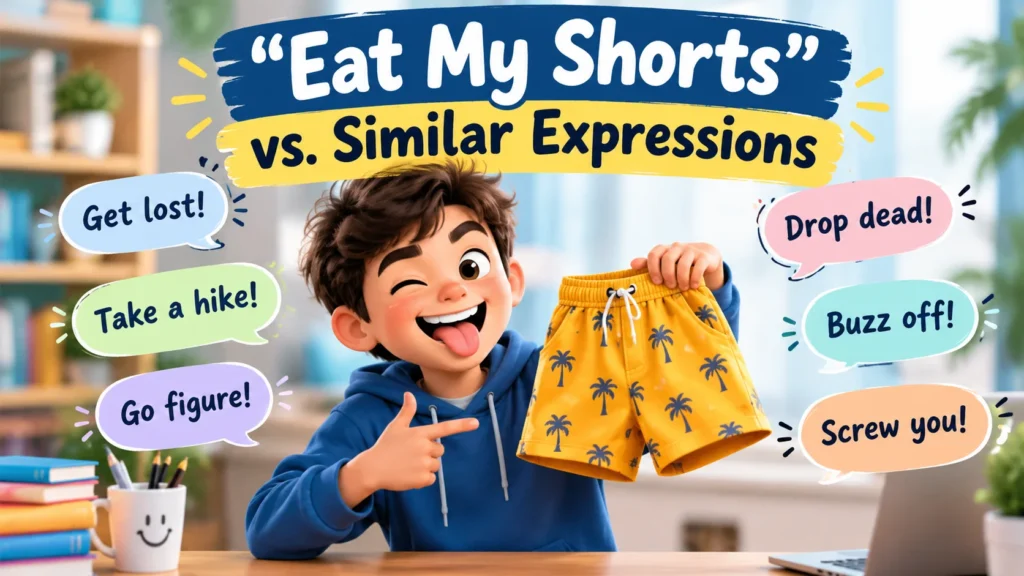
Different expressions communicate different forms of rejection. Some emphasize frustration, others communicate refusal, and some preserve respect.
| Phrase | Meaning Difference | Tone Difference | Best Use Scenario |
| Eat my shorts | Rejects criticism through an insulting comeback | Sarcastic, irreverent | Playful banter |
| Get lost | Tells someone to go away | Dismissive, hostile | Informal rejection |
| Give me a break | Expresses disbelief or frustration | Conversational, annoyed | Responding to unreasonable claims |
| Talk to the hand | Refuses to listen | Mocking, exaggerated | Comedy and playful banter |
| Whatever | Shows indifference or resignation | Casual, potentially passive-aggressive | Low-stakes disagreements |
| I respectfully disagree | States a different opinion politely | Professional, diplomatic | Meetings and formal discussions |
| Nice try | Suggests an attempt has failed | Playful or mildly sarcastic | Friendly competition |
The main difference is the speaker’s intention. “Eat my shorts” combines defiance with an insulting edge. “Give me a break” emphasizes frustration, while “I respectfully disagree” focuses on the disagreement itself. “Nice try” is often less confrontational, depending on how it is delivered.
Common Mistakes & Misuse of “Eat My Shorts”
Overusing the Expression
Using the same comeback in every disagreement can make it lose its humorous effect. It may also suggest that the speaker avoids explaining their opinions.
Better approach: Give a reason when the issue matters. Use playful insults only when the context supports them.
Using It With Unfamiliar People
A close friend may understand your sarcasm, but a new coworker or stranger may interpret the phrase as genuine hostility.
Better approach: Begin with neutral language until you understand the other person’s communication style.
Treating It as a Neutral Synonym for Disagreement
“Eat my shorts” carries more disrespect than “I disagree.” The expressions are not interchangeable.
Better approach: Use “I disagree” to challenge an opinion and “I don’t appreciate that remark” to address an inappropriate comment.
Using It in Formal Writing
The phrase is generally unsuitable for academic essays, business reports, and official correspondence unless it is being quoted or analyzed.
Better approach: Use precise language that clearly communicates your position.
Assuming Everyone Knows the Cultural Reference
Not every English speaker has watched The Simpsons or recognizes Bart Simpson’s catchphrase.
Better approach: Consider the audience and explain the reference if necessary.
Assuming Sarcasm Cannot Hurt Anyone
A phrase intended as a joke can still offend someone. Saying “I was only joking” does not automatically remove the effect of an insulting comment.
Better approach: Pay attention to the listener’s reaction and acknowledge their feelings if the joke causes discomfort.
Psychological Reasons People Prefer “Eat My Shorts”
People often choose short, provocative expressions because they communicate an emotional reaction quickly. The phrase can deliver defiance without requiring a long explanation.
Cognitive Load Reduction
When people are annoyed, they may prefer a ready-made response rather than constructing a detailed argument. Familiar expressions make it easier to communicate an immediate reaction.
However, a quick comeback may express frustration without explaining the underlying problem.
Independence and Authority
The phrase can signal that the speaker refuses to be intimidated by another person’s authority. In fictional dialogue, this often portrays confidence or rebellion.
In real life, the same behavior can be interpreted differently. Challenging unfair treatment may appear assertive, while dismissing reasonable feedback may appear defensive.
Attention and Memorability
Short, unusual expressions can attract attention in memes, comments, and entertainment. Their memorable wording makes them easy to recognize and repeat.
The phrase also benefits from its connection to a well-known television character.
Modern Communication Habits
Messaging platforms encourage brief reactions, emojis, memes, and cultural references. This environment makes catchphrases convenient.
However, text often removes facial expressions and vocal cues. A message intended as a joke may therefore be interpreted as hostile.
US vs UK Usage of “Eat My Shorts”
The expression is strongly associated with American English popular culture, particularly The Simpsons. It is also understood by many British English speakers, although recognition and everyday use vary.
American English
In the United States, “eat my shorts” is widely recognizable as a sarcastic catchphrase associated with Bart Simpson. It can be used jokingly, quoted nostalgically, or delivered as an exaggerated insult.
Its familiarity does not make it polite. Outside a playful exchange, it may still sound dismissive.
British English
In the United Kingdom, many people recognize the phrase through American television. However, it may sound more like an imported American catchphrase than an ordinary everyday expression.
Other British expressions, such as “give over,” can communicate disbelief or irritation in appropriate contexts, but they are not exact synonyms.
| Feature | US English | UK English |
| Cultural association | Strong connection with American television | Often recognized through American media |
| Formality | Very informal | Very informal |
| Politeness | Potentially insulting | Potentially insulting |
| Everyday familiarity | Widely recognizable | Familiar to many, but not universal |
| Possible alternative | Give me a break | Give over, where appropriate |
These are general tendencies, not universal rules. Age, personal preferences, and familiarity with American media can influence interpretation.
“Eat My Shorts” in Digital & Modern Communication
Emails
Avoid using the phrase in professional emails to reject suggestions or respond to criticism. Messages can be forwarded or read without the context that originally made the joke understandable.
Instead of writing, “Eat my shorts. That plan won’t work,” consider:
“I don’t think this plan addresses the main issue. Could we review another option?”
The revised version explains the disagreement and encourages a constructive discussion.
Slack and WhatsApp
In informal group chats, the expression may be appropriate when everyone shares an established sense of humor. It is less suitable in workplace channels used for project updates, client discussions, or conflict resolution.
“Nice try 😂” may communicate playful resistance, while “I disagree with that approach” is more appropriate for a work-related discussion.
Social Media
The phrase works in nostalgic memes, television discussions, humorous reactions, and posts about resisting criticism.
However, directing it at someone during a public argument can escalate the conflict. If your goal is to challenge an idea, focus on the claim rather than insulting its author.
AI-Generated Summaries
Educational articles and AI-generated summaries should distinguish the expression’s dictionary meaning from its social tone.
A useful summary would be:
“‘Eat my shorts’ is an informal, often sarcastic insult used to express defiance or dismiss criticism.”
This explanation is more informative than simply calling it a synonym for “disagree.”
Linguistic & Communication Insight
The phrase illustrates how meaning depends on more than dictionary definitions. Its wording, social setting, cultural associations, and the relationship between speakers all affect how it is understood.
Emotional Weight and Subtext
At its core, the expression communicates resistance. The speaker is not simply offering a different opinion but rejecting the other person’s position in a deliberately provocative way.
Its possible subtext includes:
- “Your criticism does not intimidate me.”
- “I refuse to accept your demand.”
- “I’m annoyed and want you to know it.”
- “I’m teasing you rather than taking this seriously.”
A friend laughing during a video game may use the phrase playfully. Someone shouting it during a heated disagreement may communicate contempt.
Direct vs. Indirect Phrasing
“Eat my shorts” is direct in its rejection but indirect in its explanation. It makes resistance obvious without explaining the reason.
Compare these alternatives:
- Direct and insulting: “Eat my shorts.”
- Direct and professional: “I disagree with your conclusion.”
- Firm boundary: “I won’t accept being spoken to that way.”
- Indirect and conciliatory: “I’m not sure we’re seeing this the same way.”
- Collaborative: “Could we look at the issue from another angle?”
Each expression performs a different task. One provokes, another states disagreement, and another invites collaboration.
Professional Communication Perspective
In the workplace, disagreement is unavoidable. How people express it affects whether colleagues see them as thoughtful, defensive, cooperative, or disrespectful.
If a colleague dismisses your contribution during a meeting, replying “Eat my shorts” shifts attention from the original problem to your reaction.
A more effective response might be:
“I’d like to finish explaining the proposal before we decide whether it will work.”
This protects your opportunity to speak without making the disagreement personal.
Why Professionals Choose Alternatives
Experienced communicators choose wording based on the outcome they want. They may soften a phrase to reduce defensiveness, strengthen it to establish a boundary, or use neutral language to keep a discussion focused.
- Choose “I respectfully disagree” when preserving a working relationship matters.
- Choose “Please don’t speak to me that way” when you need a clear boundary.
- Choose “Give me a break” to express disbelief in an informal conversation.
- Choose “Nice try” for playful resistance.
- Choose “Let’s focus on the issue” when a discussion becomes personal.
These expressions have different meanings, but each can help communicate a specific intention.
Social Signaling
Language influences how others perceive confidence, humor, and respect. A provocative comeback may signal independence or hostility, while a measured disagreement may suggest self-control and willingness to cooperate.
Neither directness nor politeness automatically makes someone right. The important question is whether the wording fits the situation and communicates the intended message.
Tone and Context Guidance
Before using “eat my shorts,” consider three questions:
- Who is listening? A close friend may understand your humor, while a client may hear an insult.
- What is at stake? A friendly competition is different from a serious workplace disagreement.
- What outcome do you want? A playful comeback may create laughter, but a clear explanation is more likely to resolve a practical problem.
The most useful communication skill is knowing when a comeback helps and when another response will produce a better result.
I Won’t Be Spoken to That Way
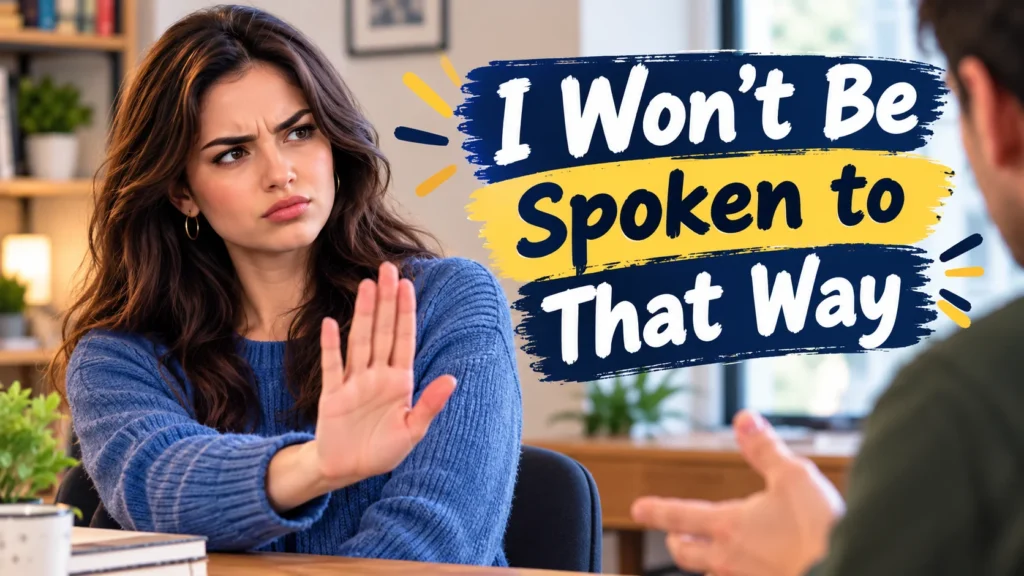
Meaning: A firm statement that you will not accept disrespectful or inappropriate treatment.
Why This Phrase Works: It establishes a personal boundary without insulting the other person or abandoning the issue under discussion.
Real-World Usage Insight: This expression addresses how someone is speaking rather than whether their argument is correct.
Best Use: Workplace conflict, personal boundary-setting, and situations involving repeated interruptions or insults.
Avoid When: The other person has offered reasonable criticism respectfully.
Tone: Assertive, serious, controlled.
US vs UK Usage: Natural and appropriate in both varieties of English.
Example (Meeting): “I won’t be spoken to that way. If we can discuss the missed deadline without personal remarks, I’m happy to work through the problem.”
As If!
Meaning: An informal expression used to reject a suggestion or claim as unbelievable, unrealistic, or unlikely.
Why This Phrase Works: It communicates disbelief in a short, expressive way and can make a comeback sound playful.
Real-World Usage Insight: The expression has a strong association with American teen slang and popular culture, particularly the 1990s. Depending on delivery, it can sound humorous or dismissive.
Best Use: Casual conversations, playful teasing, and humorous reactions to unrealistic suggestions.
Avoid When: You need to explain a serious disagreement or respond sensitively to someone.
Tone: Playful, sarcastic, incredulous.
US vs UK Usage: Recognized in both varieties, with strong associations with American popular culture.
Example (Message): “As if! You said you’d be ready in five minutes last time, and I ended up waiting outside for half an hour.”
Dream On
Meaning: A dismissive expression suggesting that someone’s hope, plan, or expectation is unrealistic.
Why This Phrase Works: It communicates disbelief in another person’s prediction without requiring a lengthy explanation.
Real-World Usage Insight: The phrase may be playful between friends but can sound condescending when used to dismiss a genuine ambition.
Best Use: Casual banter, humorous challenges, and exaggerated predictions.
Avoid When: Encouraging someone who is making a sincere effort or discussing an important personal goal.
Tone: Sarcastic, teasing, sometimes discouraging.
US vs UK Usage: Widely understood in both American and British English.
Example (Conversation): “Dream on if you think I’m letting you choose the music for the entire road trip again.”
Comparison Table of 10 Best Alternatives
The table below summarizes ten particularly useful alternatives. Choose a phrase based on whether you want to express frustration, make a joke, reject a proposal, or establish a boundary.
| Phrase | Meaning | Best Use | Worst Use | Tone | US vs UK Usage |
| Get lost | Tells someone to go away | Informal rejection | Professional discussions | Dismissive | Common in both |
| Give me a break | Expresses disbelief or frustration | Casual disagreements | Sensitive conversations | Sarcastic | Common in both |
| Talk to the hand | Refuses to listen | Comedy and playful banter | Serious discussions | Mocking | More associated with US slang |
| Whatever | Expresses indifference | Low-stakes arguments | Important discussions | Casual, potentially passive-aggressive | Common in both |
| I respectfully disagree | States disagreement politely | Work and academic settings | Playful banter | Diplomatic | Common in both |
| Nice try | Suggests an attempt has failed | Friendly competition | Sensitive emotional situations | Playful, sometimes sarcastic | Common in both |
| Not a chance | Rejects a proposal firmly | Clear refusals | Situations requiring negotiation | Assertive | Common in both |
| I don’t appreciate that remark | Identifies an unwelcome comment | Workplace and personal boundaries | Harmless mutual teasing | Firm, controlled | Common in both |
| I stand by my decision | Expresses confidence in a choice | Meetings and decision-making | Situations requiring reconsideration | Confident | Common in both |
| Let’s agree to disagree | Accepts differing opinions | Ending unproductive debates | Unresolved safety or factual issues | Diplomatic | Common in both |
Conclusion
“Eat my shorts” is an informal, sarcastic expression used to communicate defiance, rejection, or contempt. Its association with Bart Simpson and The Simpsons has helped make it a recognizable part of American popular culture. Although it can be funny among friends, it may sound insulting or immature in serious conversations.
The best alternative depends on your intention. Choose “nice try” for playful resistance, “give me a break” for disbelief, and “I respectfully disagree” when professionalism matters. If someone crosses a boundary, “I won’t be spoken to that way” communicates firmness without relying on an insult.
Understanding these differences helps English learners, students, writers, and professionals communicate more naturally. Good communication is not simply about finding a synonym; it is about choosing language that fits the audience, relationship, and situation. When humor is appropriate, a cheeky expression can add personality. When clarity and respect matter, a thoughtful alternative usually works better.
FAQs
What does “eat my shorts” mean?
“Eat my shorts” is an informal, often insulting expression used to show defiance, annoyance, or contempt. It roughly means that the speaker dismisses another person’s criticism or refuses to be intimidated. The phrase is often used sarcastically or humorously and is strongly associated with Bart Simpson from The Simpsons.
Is “eat my shorts” a bad word?
It is not a conventional swear word, but it is considered rude or disrespectful in many situations. Its insulting tone makes it unsuitable for most professional or formal settings. Among friends who understand the joke, it can be playful rather than genuinely offensive.
Who made “eat my shorts” famous?
Bart Simpson, the rebellious character from The Simpsons, helped popularize the phrase through his frequent use of it as a sarcastic comeback. The expression became closely associated with his defiant personality and the show’s humor. However, its exact historical origin is uncertain.
What is another way to say “eat my shorts”?
Alternatives include “get lost,” “give me a break,” “nice try,” “not a chance,” and “whatever.” For professional situations, “I respectfully disagree” or “I stand by my decision” communicates disagreement more appropriately. The best alternative depends on whether you want to sound playful, frustrated, firm, or diplomatic.
Is “eat my shorts” professional?
No. The expression is generally too informal and confrontational for professional communication. Using it with a manager, client, colleague, or customer may make you appear disrespectful. Instead, say “I disagree with that approach” or “I don’t appreciate that remark,” depending on whether you are challenging an idea or addressing inappropriate behavior.
Is “eat my shorts” sarcastic?
Yes, it is commonly used sarcastically. The speaker often uses exaggerated disrespect to reject criticism or demonstrate defiance. However, sarcasm depends on context, delivery, and the relationship between speakers. The same words may sound funny among friends but hostile during a serious disagreement.
Is “eat my shorts” an American expression?
The phrase is strongly associated with American English and American television culture. Its popularity grew through The Simpsons, although its exact origin is uncertain. Many British English speakers also recognize it, but familiarity and everyday use vary.
Can I use “eat my shorts” with friends?
Yes, if your friends understand your sense of humor and recognize that you are joking. It may work during playful arguments, friendly competitions, or nostalgic discussions about television. However, avoid assuming everyone finds it funny. If a friend appears genuinely upset, acknowledge their reaction and choose more considerate wording.
What is the difference between “eat my shorts” and “get lost”?
Both expressions can dismiss another person, but their emphasis differs. “Eat my shorts” often communicates rebellious defiance through a sarcastic insult, while “get lost” more directly tells someone to leave or stop bothering you. Neither is particularly polite, and both should be used cautiously when a relationship or professional outcome matters.
How can I disagree without sounding rude?
Use language that challenges the idea rather than attacking the person. Expressions such as “I respectfully disagree,” “I see things differently,” and “Could we consider another approach?” communicate disagreement constructively. If someone is disrespectful, state your boundary calmly and clearly. This approach helps you remain assertive while keeping the conversation focused on the issue.