
Imagine your team is preparing a presentation, but you are unsure whether the client will request additional changes. Your manager says, “We can arrange another review if need be.” This simple sentence communicates flexibility without making extra work sound compulsory.
The phrase “if need be” means if something becomes necessary or circumstances require a particular action. It is commonly used in professional emails, meetings, everyday conversations, presentations, and formal writing. Although the expression is clear and grammatically correct, it can sound slightly traditional compared with alternatives such as “if necessary” or “if needed.”
Choosing the right alternative helps you communicate more naturally. For example, “if required” emphasizes a condition, while “if that would help” makes an offer sound warmer. Understanding these differences is valuable for professionals, students, ESL learners, and content writers who want to express flexibility without creating confusion.
This guide explains the meaning, origin, usage, advantages, and limitations of “if need be,” with practical examples and alternatives for different communication situations.
What Does “If Need Be” Mean?
“If need be” means if something becomes necessary or if circumstances require a particular action. The expression indicates that someone is willing or prepared to do something if the situation calls for it. It is commonly used in professional communication, everyday conversations, planning, instructions, and formal writing to describe a possible action without suggesting that it must happen immediately.
Origin & History of “If Need Be”
The expression “if need be” comes from traditional English usage. It combines if, which introduces a condition, need, which refers to necessity, and be, which expresses a possible state or circumstance. Together, the words convey the idea of acting if a need exists.
English has long used conditional expressions to describe actions that depend on future circumstances. “If need be” belongs to this broader pattern of language that allows people to discuss possibilities without making immediate commitments.
The phrase has remained useful because its meaning applies to many situations. A manager may offer additional support, a colleague may suggest changing a schedule, or a friend may propose an alternative plan. In each case, the action remains possible but depends on whether circumstances make it necessary.
Over time, alternatives such as “if necessary” and “if needed” have become popular in modern communication. These expressions communicate similar ideas, although their tone and formality can differ.
There is no single historical event responsible for the phrase. Its continued use reflects a common communication need: people want to show that they are prepared to respond to changing circumstances without promising that additional action will definitely occur.
Today, “if need be” has a slightly traditional or formal quality, but it remains understandable and grammatically correct. It is suitable for professional correspondence, planning, formal discussions, and everyday speech when conditional willingness is the intended meaning.
Synonyms & Alternatives by Tone
Different alternatives communicate slightly different attitudes. Some emphasize necessity, others focus on support, and some suggest that a difficult situation may require action.
Professional & Neutral Alternatives
- If necessary
- If required
- If needed
- If circumstances require
- If the situation calls for it
- Should the need arise
- As necessary
- Where necessary
- If circumstances warrant it
- If deemed necessary
Polite & Supportive Alternatives
- If you need me to
- If that would help
- If you need any assistance
- Should you need further support
- If it would be helpful
- If necessary, I would be happy to
- Whenever needed
- If you require additional help
Encouraging & Reassuring Alternatives
- If it comes to that
- If we have to
- If necessary, we can
- If things change
- If the need arises
- If we find it necessary
- If circumstances change
- If it becomes important
Casual, Playful & Idiomatic Alternatives
- If it comes down to it
- If push comes to shove
- If we have to
- Just in case
- If things get that far
- If it turns out we need to
- If worse comes to worst
- If we end up needing to
Quick tip: “If necessary” is a reliable professional alternative, “if needed” works well in everyday messages, and “if that would help” is useful when offering assistance. “If push comes to shove” is more informal and suggests a difficult situation or last resort.
When Should You Use “If Need Be”?
Use “if need be” when you want to communicate that an action is possible but depends on circumstances. It allows you to show flexibility without committing to something before you know whether it will be necessary.
Professional Settings
The phrase is useful when discussing deadlines, project changes, staffing, or additional resources.
Example: “We can ask another team member to review the proposal if need be.”
This sentence communicates readiness without suggesting that extra support is already required.
Casual Conversations
You can use the expression when discussing alternative plans with friends or family.
Example: “We can take a taxi if need be.”
In a relaxed conversation, “if we have to” or “if needed” may sound more natural.
Emails and Presentations
In emails, the phrase helps keep messages concise while offering a possible next step.
Example: “I can provide a separate breakdown of the figures if need be.”
In presentations, it can explain how a plan might change if circumstances require it.
Planning and Decision-Making
The phrase works well when the outcome depends on information that is not yet available.
Example: “We can request additional funding if need be.”
It communicates preparedness without treating a possible expense as a confirmed requirement.
When It Is Especially Effective
Use “if need be” when you want to offer a backup plan, communicate flexibility, show willingness to help, or explain that a decision depends on future circumstances.
When Should You Avoid “If Need Be”?
Although the phrase is useful, certain situations call for more direct or precise wording.
When Something Is Mandatory
“If need be” suggests that an action depends on necessity. It should not make a compulsory task sound optional.
Instead of “Employees should submit their timesheets if need be,” write, “Employees must submit their timesheets by Friday” when submission is mandatory.
In Legal or Technical Writing
Legal documents, policies, and technical instructions often require precise conditions. Rather than using a general expression, explain who must act, what triggers the action, and when it must happen.
In Sensitive Conversations
The phrase may sound impersonal when someone needs emotional support.
Instead of “I can talk to you if need be,” consider “I’m here if you want to talk.”
The second expression sounds more personal and reassuring.
When Immediate Action Is Required
If an action must happen immediately, conditional wording can create unnecessary uncertainty. Give a clear instruction when the circumstances already require action.
When the Condition Is Unclear
“We can change the schedule if need be” is understandable, but it does not explain what would justify the change.
A clearer version is: “We can change the schedule if the supplier cannot deliver the equipment by Thursday.”
Is “If Need Be” Professional, Polite, or Casual?
“If need be” is generally neutral to formal, professional, and polite. It communicates conditional willingness without necessarily placing pressure on the listener.
| Quality | Typical Effect |
| Professionalism | Appropriate for emails, meetings, and reports. |
| Politeness | Offers an option without demanding immediate action. |
| Formality | Slightly traditional compared with “if needed.” |
| Directness | Moderate; the exact condition may remain unstated. |
| Emotional warmth | Relatively restrained unless paired with supportive wording. |
| Flexibility | Keeps an alternative available. |
A manager might say, “I can stay longer if need be,” to offer additional support. A client may hear “We can arrange another review if need be” as a measured professional response.
However, when speaking to someone experiencing a personal difficulty, “I’m here if you need me” may communicate more warmth.
The phrase itself is not inherently cold or impolite. Its effect depends on the relationship, situation, and surrounding words.
Pros and Cons of Using “If Need Be”
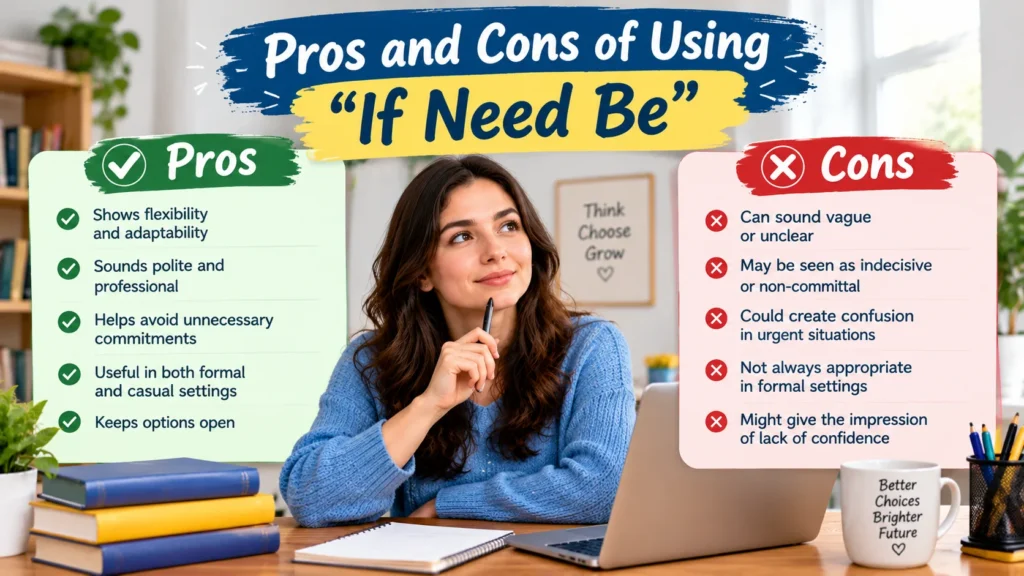
Advantages
- Conciseness: Communicates a conditional possibility in three words.
- Professional flexibility: Leaves room for a backup plan.
- Politeness: Offers assistance without making it compulsory.
- Versatility: Works in emails, presentations, meetings, and conversations.
- Efficiency: Avoids lengthy explanations when the condition is already understood.
Potential Drawbacks
- Traditional tone: Some readers may prefer “if needed.”
- Possible ambiguity: The phrase does not always explain when an action becomes necessary.
- Limited warmth: It can sound impersonal in sensitive conversations.
- Tone mismatch: It may feel overly formal in casual chats.
- Repetition: Frequent use can make writing sound stiff.
The best approach is to use the phrase when it fits the situation and replace it when a simpler or more specific expression would improve clarity.
Real-Life Examples of “If Need Be” by Context
“Hi Jordan, I’ve attached the revised proposal with the updated figures. I can walk you through the changes tomorrow if need be.”
This offers additional assistance without assuming that another meeting is necessary.
Meeting
“We should finish the review by Friday. If need be, we can move the final discussion to Monday.”
The speaker provides a backup plan while keeping the original schedule.
Presentation
“We’ll use the existing data for the initial assessment and collect additional feedback if need be.”
This communicates a possible next step without making extra work automatic.
Everyday Conversation
“We can stop at the grocery store on our way home if need be.”
The expression leaves room for a practical adjustment.
Social Media
“I’ve shared the checklist here and can add a more detailed guide if need be.”
The sentence is concise and leaves open the possibility of providing more information.
Customer Support
“We can arrange a replacement if need be after confirming the issue with your order.”
This offers a possible solution while connecting it to the circumstances.
“If Need Be” vs. Similar Expressions: Key Differences
The following expressions share a general meaning, but they differ in tone, emphasis, and the situations where they work best.
| Phrase | Meaning Difference | Tone Difference | Best Use Scenario |
| If necessary | Directly refers to necessity. | Neutral and professional. | Business writing and instructions. |
| If needed | Refers to a need for action or support. | Conversational and concise. | Emails and everyday messages. |
| If required | Emphasizes a requirement or condition. | Formal and procedural. | Policies and technical instructions. |
| If the need arises | Suggests a future need may develop. | Polished and formal. | Contingency planning. |
| Should the need arise | Expresses a future possibility traditionally. | Formal and measured. | Reports and official correspondence. |
| If push comes to shove | Suggests decisive action under pressure. | Casual and forceful. | Difficult decisions and last-resort plans. |
Choose “if necessary” for a direct professional alternative, “if needed” for everyday messages, and “if required” for instructions involving a condition or obligation. “Should the need arise” works in formal correspondence, while “if push comes to shove” is best for informal discussions about difficult choices.
Psychological Reason People Prefer “If Need Be”
Cognitive Load Reduction
Short expressions can make messages easier to process when the context is clear. “If need be” compresses the idea of acting when circumstances make something necessary.
However, brevity is not always better. If the condition is unclear, a longer explanation may reduce confusion.
Trust and Authority Signals
Offering a backup plan can suggest that someone has considered possible obstacles.
For example, “We can bring in another reviewer if need be” shows that an additional option has been considered. Trustworthiness, however, depends on whether the plan is realistic and whether the speaker follows through.
Attention Economy
Workplaces involve emails, notifications, meetings, and competing priorities. Concise expressions help people communicate possible next steps efficiently.
Nevertheless, a short but vague message may be less useful than a sentence that identifies the relevant condition.
Modern Communication Habits
Digital communication encourages wording that is easy to scan. This helps explain why “if needed” and “if necessary” often fit modern workplace messages.
Conditional expressions also allow people to avoid making premature promises while remaining prepared to respond.
Preserving Flexibility
Sometimes people do not know whether extra work will be required. “If need be” lets them keep an option open without promising that it will definitely be used.
For example, a project manager might say, “We can arrange another review if need be.” The sentence preserves flexibility while keeping the current plan intact.
US vs UK Usage of “If Need Be”
“If need be” is understood in both American and British English. Its basic meaning remains the same, although preferences can vary by speaker, profession, and situation.
American English
American speakers commonly use “if necessary” and “if needed” in professional communication. “If need be” is also understood, but it may sound slightly traditional in casual conversation.
Example: “We can move the deadline if need be.”
A more conversational alternative is “We can move the deadline if needed.”
British English
British speakers also use “if need be,” particularly in formal or measured communication. “If necessary” works across many contexts, while “should the need arise” can sound more traditional.
Example: “We can arrange an additional meeting if need be.”
A more conversational alternative is “We can arrange another meeting if needed.”
| Aspect | US English | UK English |
| Basic meaning | If it becomes necessary. | If it becomes necessary. |
| Common alternative | If necessary; if needed. | If necessary; if needed. |
| Formal alternative | Should the need arise. | Should the need arise. |
| Casual alternative | If we have to. | If we have to. |
| Major meaning difference | None. | None. |
These are general tendencies, not strict regional rules. Personal and professional communication styles can matter more than nationality.
“If Need Be” in Digital & Modern Communication
Emails
“I’ve included the latest figures in the report. I can provide a separate breakdown if need be.”
Use “if necessary” for a direct professional tone or “if that would be helpful” when you want to sound more supportive.
Slack and WhatsApp
For a workplace message, write: “We can schedule a quick call if needed.”
For a casual conversation, you might write: “We can grab a taxi if we have to.”
Social Media
“I’ll share the full resource list if needed” is brief and easy to understand. On conversational platforms, “if needed” often sounds more natural than the slightly traditional “if need be.”
AI-Generated Summaries
AI-generated summaries may use “if necessary,” “if required,” or “if need be” to describe possible actions. These expressions should reflect the actual meaning.
- “Additional analysis may be conducted if necessary” describes a possible action.
- “Additional analysis is required” states a requirement.
- “Additional analysis will be conducted” describes a planned action.
A possible action, a mandatory action, and a confirmed plan communicate different levels of certainty.
Linguistic & Communication Insight

Emotional Weight and Subtext
At its core, “if need be” communicates conditional willingness. The speaker indicates that an action remains available, but only if circumstances make it necessary.
In a workplace discussion, this can suggest calm preparation rather than urgency.
For example, “I can take over the presentation if need be” indicates that the speaker is prepared to step in if required. It does not necessarily mean that the current presenter is expected to fail.
The emotional effect depends on the surrounding words. A direct offer can sound collaborative, while a vague contingency can sound distant.
Direct vs. Indirect Phrasing
“If need be” is indirect because it does not specify exactly when an action will occur. However, it is not inherently evasive.
- Conditional: “We can extend the deadline if need be.”
- Specific: “We can extend the deadline if the client requests more time.”
- Supportive: “If the client needs more time, I’m happy to discuss an extension.”
- Decisive: “We’ll extend the deadline by two days.”
The first preserves flexibility, the second defines a condition, the third emphasizes cooperation, and the fourth communicates a decision.
Professional Communication Perspective
In the workplace, “if need be” can help people discuss possible changes without prematurely committing resources.
A manager might say, “We can bring in additional support if need be.” This communicates that a backup option exists.
However, if employees need to know who will make the decision or what qualifies as a problem, the phrase needs additional detail.
A strong professional message combines flexibility with a clear condition. This prevents a reasonable offer from being mistaken for a vague promise.
Why Professionals Choose Alternatives
Different expressions communicate different intentions:
- If necessary: Emphasizes the condition.
- If needed: Keeps the message conversational.
- If required: Highlights a rule or obligation.
- If that would help: Puts the recipient’s needs first.
- Should the need arise: Creates a formal impression.
- If we have to: Sounds direct and may suggest reluctance.
Choosing the right expression can reduce defensiveness and make collaboration easier. For example, “We can revise the proposal if that would help” sounds more responsive to a client’s preferences than “We can revise it if need be.”
Social Signaling
People sometimes infer attitudes from how an offer is phrased. Neutral wording may suggest composure, while a warmer alternative can communicate personal involvement.
Compare “I can help if need be” with “I’m happy to help if you need me.” The first emphasizes availability as a contingency; the second explicitly communicates willingness and support.
These impressions are contextual. A person’s actions, previous behavior, and relationship with the listener usually matter more than one expression alone.
Tone and Context Guidance
To communicate effectively:
- Match the level of formality to your audience.
- Explain the condition when precision matters.
- Add warmth when offering personal support.
- Avoid conditional language when an action is compulsory.
- Distinguish a possible action from a confirmed decision.
Effective communication involves choosing words that fit the intended meaning, relationship, situation, and desired outcome.
Comparison Table of 10 Best Alternatives
This table summarizes ten useful alternatives according to their meaning, ideal context, limitations, and tone. Use it to select the expression that best matches your communication goal.
| Phrase | Meaning | Best Use | Worst Use | Tone | US vs UK Usage |
| If necessary | If circumstances make it necessary. | Professional writing and instructions. | When a warm, personal offer is needed. | Neutral | Common in both. |
| If needed | If additional action or support is needed. | Emails, chats, and everyday speech. | When a formal obligation must be specified. | Conversational | Common in both. |
| If required | If a requirement makes action necessary. | Policies and procedures. | Friendly personal conversations. | Formal | Common in both. |
| If circumstances require | If conditions make action necessary. | Business planning and reports. | Quick, casual messages. | Formal | Understood in both. |
| Should the need arise | If a future need develops. | Formal correspondence and proposals. | Casual chats and informal social posts. | Traditional | Understood in both. |
| As necessary | Whenever circumstances require action. | Procedures and ongoing responsibilities. | Situations needing a specific deadline. | Professional | Common in both. |
| If that would help | If an action would benefit someone. | Teamwork and customer support. | Mandatory instructions. | Warm | Natural in both. |
| If you need me to | If another person requires your action. | Collaboration and personal offers. | Confirming a fixed responsibility. | Friendly | Natural in both. |
| If it comes down to it | If circumstances eventually require action. | Informal contingency planning. | Highly formal documents. | Casual | Understood in both. |
| If push comes to shove | If pressure forces decisive action. | Difficult choices and last-resort plans. | Routine business updates. | Idiomatic | Understood in both. |
Conclusion
“If need be” is a versatile English expression that communicates willingness to act when circumstances make an action necessary. It is useful in professional emails, meetings, everyday conversations, and contingency planning because it keeps options open without suggesting that additional action must happen immediately.
However, choosing the right alternative can make your communication clearer and more natural. “If necessary” is a reliable choice for professional writing, while “if needed” suits everyday messages. If you want to express warmth, “if that would help” can make an offer feel more supportive. For formal procedures, “if required” communicates a stronger sense of obligation.
The most effective choice depends on your audience, purpose, and intended tone. Consider whether you are offering help, describing a possible action, explaining a requirement, or preparing for an uncertain situation. When precision matters, explain the condition rather than relying on a general expression.
By understanding these distinctions, you can use “if need be” confidently and select alternatives that make your English more precise, professional, and approachable.
FAQs
What does “if need be” mean in simple English?
“If need be” means “if necessary” or “if it becomes necessary.” It describes an action that someone is willing or prepared to take if circumstances require it. For example, “We can arrange another meeting if need be” means another meeting can be arranged if the situation makes it necessary.
What is the best synonym for “if need be”?
“If necessary” is generally the best all-purpose synonym because it is clear, neutral, and suitable for professional and everyday communication. “If needed” is a more conversational alternative, while “if required” is useful when referring to rules, instructions, or obligations.
Is “if need be” grammatically correct?
Yes, “if need be” is grammatically correct and established English usage. It is a conditional expression meaning “if necessity arises.” For example, “I’ll help with the presentation if need be” is correct. Although the phrase has a traditional tone, it remains understandable and appropriate in modern English.
Is “if need be” formal or informal?
“If need be” is generally neutral to formal. It works in professional emails, meetings, reports, and carefully worded conversations. In casual chats, “if needed” or “if we have to” may sound more natural. The appropriate choice depends on the audience and the level of formality required.
Is “if need be” the same as “if necessary”?
The expressions have essentially the same central meaning: an action can occur if circumstances make it necessary. The main difference is style. “If necessary” often sounds more direct and contemporary, while “if need be” can sound slightly more traditional. Both are suitable for many professional contexts.
Can I use “if need be” in a professional email?
Yes. The expression can communicate flexibility and readiness without suggesting that extra work is immediately required. For example, “I can provide additional documentation if need be” is appropriate in many workplace emails. If the recipient needs a precise condition, consider specifying when the documentation will be necessary.
What is the difference between “if need be” and “if required”?
“If need be” generally describes an action that may become necessary, whereas “if required” emphasizes a requirement or condition. For example, “We can schedule another meeting if need be” offers flexibility. “Submit the additional form if required” refers to a procedural condition.
Is “if need be” used in American and British English?
Yes. The expression is understood and used in both American and British English. Its fundamental meaning remains the same, although individual speakers may prefer alternatives such as “if needed” or “if necessary.” Differences in tone often reflect the situation, profession, and personal writing style rather than nationality.
What is a casual alternative to “if need be”?
“If we have to,” “if needed,” and “if it comes down to it” are useful casual alternatives. “If we have to” is direct, “if needed” is neutral, and “if it comes down to it” suggests that an action may become necessary after other options have been considered.
When should I avoid using “if need be”?
Avoid using “if need be” when the action is mandatory, the condition must be legally precise, or the listener needs immediate instructions. It can also sound impersonal when someone expects emotional support. In these situations, use direct instructions, clearly defined conditions, or warmer alternatives such as “I’m here if you need me.”