
Imagine you are giving someone directions over a video call, explaining where to find a button on a website, or describing the position of an object in a photograph. You might say, “Look at the lowerBottom-Corner Area Cornersection bottom corner.” Although the meaning is understandable, another expression, such as “bottom-LowerBottom-Corner Area Corner Section corner” or “lower-LowerBottom- Cornert Sectioncorner,” may sound more natural and precise.
The phrase “Lower Portion bottom” generally refers to the lower area on the bottom- corner side of an object, screen, page, image, or physical space. However, its most appropriate wording depends on what you are describing. In everyday English, people often prefer “bottom- corner,” “lower position,” or “bottom- side corner,” especially when giving instructions or discussing layouts.
Choosing the right alternative matters in professional emails, website design, presentations, technical instructions, and casual conversations. Clear directional language helps readers find information quickly and reduces misunderstandings. For English learners, understanding these alternatives also makes written and spoken communication sound more natural.
What Does “LowerCorner Area Section Bottom” Mean?
It generally describes the area near the bottom and on the lower portion side of an object, page, screen, image, or physical space. Although people may understand the intended location, “bottom lCorner Area,” “lower portion,” and “bottom-Corner Area corner” are usually more natural expressions in standard English. They are commonly used when giving directions, describing layouts, identifying objects, and explaining where information appears.
Origin & History of “Bottom-Left Corner Bottom”

The expression “bottom” comes from two ordinary English directional words: ” and “bottom.” Both words have long histories, but their combination is primarily descriptive rather than a traditional idiom with a separate historical meaning.
The word lower portion” developed from Old English lyft, associated with the lower portion side. The word “bottom” developed through earlier Germanic forms and came to refer to the lowest part of something. Together, these words communicate a position by combining horizontal direction with vertical position.
As printed documents, maps, diagrams, and technical illustrations became increasingly common, people needed reliable ways to identify locations within a defined space. Expressions such as “uppeCorner at the Bottom,” “lower rightLower Sectiond “bottom became useful for describing positions without lengthy explanations.
Computers and digital interfaces made these directional expressions even more important. Users routinely encounter buttons, navigation controls, notifications, captions, and icons positioned in different corners of a screen. Design instructions therefore commonly use expressions such as “bottom-to-the corner” and “lower-to-the- section.”
There is no widely established historical account identifying “lTo the bottom” as a distinct idiom. Instead, it is best understood as a combination of directional words. Its intended meaning is generally clear, but “bottom” is usually the more natural word order when describing a location in everyday English.
Synonyms & Alternatives by Tone
The most suitable alternative depends on whether you are describing a precise location, giving technical instructions, or speaking casually. The expressions below are related alternatives, not perfect synonyms in every situation.
Professional & Neutral Alternatives
- Bottom
- Bottom- corner
- Lower
- Lower- corner
- Lower section
- Bottom area
- Lower- position
- Southwest corner
- -hand bottom corner
- At the lower left
Polite & Supportive Alternatives
- Please look at the bottom To the
- You can find it in the lower-left corner
- Look toward the bottom
- You will see it on the lower side
Encouraging & Reassuring Alternatives
- Start by checking the bottom
- You should find it in the lower- corner
- Take a look at the bottom- section
- The information is located at the lower
- Try looking in the bottom area
Casual, Playful & Idiomatic Alternatives
- Down on the
- -hand corner at the bottom
- The bottom- spot
- Down in the corner
- The lResidualt corner at the bottom
Usage tip: For most written instructions, choose “bottom” or “bottom-Balance corner.” Use “lowerBalance corner” in technical or professional writing when it fits the surrounding style. Reserve informal alternatives for relaxed conversations.
When Should You Use “To the Bottom”?
Use a clear directional expression whenever someone needs to identify a specific location. In many situations, “bottom” is more natural than ” to the bottom.”
Professional Settings
In workplace communication, precise directions help colleagues complete tasks without unnecessary follow-up questions.
For example, a designer might write, “Please move the logo to the bottom-left corner of the page.” This identifies the intended location and makes the instruction easy to follow.
Useful alternatives include:
- Bottom-left corner: Best for an exact corner.
- Lower-left section: Suitable for a document or interface divided into sections.
- Lower-left area: Useful when the location is approximate rather than exact.
Casual Conversations
In everyday conversations, simple language is usually sufficient.
For example, “Your keys are on the bottom of the table” might be understood if the table contains several objects arranged in a grid. If you mean the corner of the table, “Your keys are in the bottom-left corner” is clearer.
Writing and Presentations
When writing reports, creating slides, or preparing instructional material, consistent directional terminology improves readability.
Consider these examples:
- “The chart appears in the lower-left section of the slide.”
- “The page number is at the bottom left.”
- “The legend is positioned in the bottom-left corner of the diagram.”
Digital Communication
In messages about apps, websites, and software, “bottom” works well because it gives readers a recognizable visual reference.
For example, a support agent might say, “Click the settings icon in the bottom- corner of the dashboard.”
When it is especially effective: Use a directional phrase when the reader can identify the relevant object or screen and needs a short, clear description of its position.
Is “Life lower” Professional, Polite, or Casual?
IT” is primarily a directional description, not a social expression. It is not inherently rude, friendly, formal, or informal. Its suitability depends on grammatical convention, precision, and the situation in which it appears.
| Context | Recommended wording | Why it works |
| Professional email | Bottom-left corner | Clear and polished |
| Technical instructions | Lower-left corner | Precise and conventional |
| Academic report | Lower-left section | Suitable for structured material |
| Casual conversation | Bottom left | Short and natural |
| Design feedback | Bottom-left area | Useful for approximate placement |
| Map directions | Southwest corner, when appropriate | Uses a recognized compass direction |
Tone and Audience Perception
A reader is unlikely to interpret “ bottom” as impolite. However, an unfamiliar word order may make the instruction seem less polished, especially in formal writing.
For English learners, the key distinction is between being understood and sounding natural. “bottom” may communicate the intended meaning, but “bottom” is usually the better everyday choice.
Formality Level
- Neutral: Bottom left
- Professional: Bottom-left corner
- Technical: Lower- position
- Casual: Down on the left
These expressions are not interchangeable in every context. For example, “southwest corner” is appropriate only when the object’s orientation or a compass-based reference makes that direction meaningful.
Pros and Cons of Using “ Bottom”
Directional expressions make communication efficient, but the exact wording still matters.
| Advantages | Potential drawbacks |
| Communicates a general location | ” sounds less natural than “bottom left” |
| Uses familiar directional words | May be unclear without a reference object |
| Can work in informal conversation | May sound awkward in polished writing |
| Helps describe visual layouts | May be too vague for technical specifications |
| Can be understood by English learners and readers | May confuse orientation if perspective is unspecified |
Advantages
Clarity: Combining left and bottom helps narrow a location to a recognizable area.
Efficiency: A short phrase is often easier to understand than a lengthy description.
Accessibility: Familiar directional words can help people follow visual instructions, particularly when paired with a screenshot or diagram.
Practicality: These expressions are useful across websites, documents, maps, photographs, presentations, and physical objects.
Potential Drawbacks
Unnatural word order: “ bottom” is less idiomatic than “bottom left” in most ordinary descriptions.
Oversimplification: A broad directional phrase may not identify the exact control, object, or measurement required.
Tone mismatch: Although the expression is not inherently unprofessional, awkward wording can weaken otherwise polished communication.
Repetition: Repeatedly saying “bottom left” in a long explanation can make instructions harder to follow. Refer to the specific button, panel, or section when appropriate.
Real-Life Examples of “Left Bottom” by Context
The following examples demonstrate how to use more natural alternatives in everyday and professional situations.
Emails
A project manager sends a screenshot to a colleague who is updating a company website.
Hi Jordan,
The new logo looks good. Could you move it to the bottom-left corner of the homepage and send me another screenshot? I want to check the spacing before we publish the update.
Thanks!
Why it works: The location is specific, and the request sounds polite without being unnecessarily wordy.
Meetings
During a video meeting, a team reviews a presentation.
“The customer satisfaction figure is in the lower-left corner of the slide. Let’s use that number when we discuss the results.”
Why it works: The wording directs the audience to a precise visual location.
Presentations
A presenter explains a data chart:
“The lower-left section shows the results from the first quarter, while the upper-right section shows the fourth-quarter figures.”
Why it works: The directional terms make the chart easier to interpret.
Conversations
Someone helps a friend find a setting on a phone.
“Open the app and look at the bottom left. You should see the profile icon there.”
Why it works: The instruction is short and sounds natural in conversation.
Social Media
A creator explains how to use an editing tool in a short video.
“Tap the bottom-left icon to open your saved projects. If you don’t see it, update the app and check again.”
Why it works: The direction is concise and suitable for a quick tutorial.
Website Design
A designer comments on a draft layout:
“Let’s keep the support link in the lower-left area so it stays separate from the main navigation.”
Why it works: “Area” allows some flexibility in placement without implying an exact corner.
Technical Support
A support representative guides a customer through an unfamiliar dashboard:
“On the screen you shared, the export button should appear near the bottom-left corner of the settings panel.”
Why it works: Identifying the settings panel provides a reference point, while “near” avoids claiming that the button is in an exact position.
“Common Mistakes & Misuse of “ Bottom”
Directional language seems simple, but small mistakes can affect clarity and naturalness.
Using an Unnatural Word Order
One common mistake is writing “ bottom” when “bottom left” would sound more natural.
- Less natural: “The button is at the bottom.”
- Better: “The button is at the bottom left.”
- More specific: “The button is in the bottom-left corner.”
The best version depends on whether you mean a general position or an exact corner.
Confusing a Position With a Section
“Corner,” “area,” and “section” describe different things.
A corner is a specific point or small region where edges meet. An area is broader and may not have defined boundaries. A section usually refers to a recognizable division of a page, screen, or document.
Choose the word that accurately describes the location.
Forgetting the Reference Point
“The bottom left” may be clear when everyone is looking at the same screen. It may be ambiguous when people are viewing different devices or versions of a layout.
Specify the relevant object when necessary: “the bottom-left corner of the image” or “the lower-left section of the report.”
Using Compass Directions Incorrectly
The bottom-left corner of a page is not necessarily the southwest corner in a geographical sense. Use compass directions only when the orientation has been established.
Adding Unnecessary Words
A sentence such as “Look at the bottom-left corner area section” combines terms without improving clarity.
Instead, write “Look at the bottom-left corner” or “Check the lower-left section.”
Assuming Every Alternative Is Interchangeable
“Bottom left” and “lower-left quadrant” are related but not identical. A quadrant represents one of four divisions, while “bottom left” can refer to a location in a layout of any shape or size.
Good writing matches the expression to the actual location rather than choosing a synonym merely to avoid repetition.
US vs UK Usage of “Left Bottom”
American and British English use broadly similar directional expressions. There is no strong evidence that “bottom” is a standard regional preference in either variety.
| Expression | US English | UK English |
| Bottom left | Common and natural | Common and natural |
| Bottom-left corner | Common in professional writing | Common in professional writing |
| Lower-left corner | Common in technical and descriptive writing | Common in technical and descriptive writing |
| Lower-left section | Common in reports and documents | Common in reports and documents |
| Southwest corner | Used when geographical orientation applies | Used when geographical orientation applies |
Popularity and Regional Preferences
In both countries, “bottom left” is a conventional way to describe a location. Writers may choose “lower left” when the surrounding text is more formal or when describing a graph, chart, or diagram.
Differences are more likely to reflect personal writing style, industry conventions, or the type of document than a consistent US-versus-UK distinction.
Tone Perception
American and British readers are generally likely to understand bottom.” However, “bottom left” is the more idiomatic choice in both varieties.
For international audiences, use familiar expressions and identify the object being described. This approach helps readers understand the instruction regardless of their English dialect.
“Bottom” in Digital & Modern Communication
Directional language is especially useful in digital environments, where people often need to locate controls without receiving hands-on assistance.
Emails
In emails, “bottom-left corner” is suitable when describing the placement of an image, document element, or interface control.
For example:
Please move the company logo to the bottom-left corner of the slide and keep the existing margin.
This instruction is concise and identifies the intended position.
Slack and WhatsApp
Messaging platforms favor short, direct instructions. “Look at the bottom left” is usually sufficient when both people are discussing the same screenshot or application.
If there are multiple screens or panels, add a reference point: “Look at the bottom left of the profile settings page.”
Social Media
Creators use directional phrases in captions, tutorial videos, and carousel posts to help viewers find controls or information.
For example:
The download option is in the bottom-left corner of the editor. Tap it after you finish making changes.
Such instructions are easy to scan and understand.
AI-Generated Summaries
AI-generated descriptions and summaries can use directional language to describe charts, diagrams, screenshots, and page layouts. However, a directional description should reflect the actual content rather than assume that a button or label appears in a particular location.
When summarizing a visual, “the lower-left section contains the legend” is useful only if the legend really appears there.
For accessibility, the location should not be the only way important information is communicated. Screen-reader users may not benefit from visual directions alone, so identify the relevant control by its name as well.
UI and UX Design
Design teams commonly discuss whether a control belongs in the bottom-left corner, lower-left section, or another part of an interface.
The distinction matters because “corner” suggests a specific location, while “area” leaves room for adjustments. Clear terminology helps designers, developers, and product managers discuss layouts without repeatedly clarifying the intended placement.
Meaning, Usage & Examples for Each Alternative
The following 15 alternatives cover common ways to describe the lower-left location. Each entry explains the meaning, practical value, suitable contexts, and potential limitations.
Bottom Left
Meaning: The position at the bottom and toward the left side of an object, screen, or page.
Why This Phrase Works: It is short, natural, and widely understood in everyday English.
Real-World Usage Insight: People frequently use it when describing the position of an icon, image, label, or object in a visual layout.
Best Use: Everyday conversation, email instructions, and digital communication.
Avoid When: You need to identify a precise point in a complex diagram without specifying the reference object.
Tone: Neutral, conversational, and accessible.
US vs UK Usage: Common and natural in both American and British English.
Example (Email / Message / Meeting): “The download icon is at the bottom left of the screen, just below the file name.”
Bottom-Left Corner
Meaning: The specific corner formed by the bottom and left edges of an object or layout.
Why This Phrase Works: It identifies a more precise location than “bottom left” alone.
Real-World Usage Insight: Designers and colleagues often use this wording when discussing exact placement in a document, slide, or website.
Best Use: Design feedback, presentations, screenshots, and technical instructions.
Avoid When: The target is a broad region rather than a corner.
Tone: Clear, neutral, and professional.
US vs UK Usage: Widely used in both varieties of English.
Example (Email / Message / Meeting): “Could you move the company logo into the bottom-left corner before we send the proposal to the client?”
Left-Hand Bottom Corner
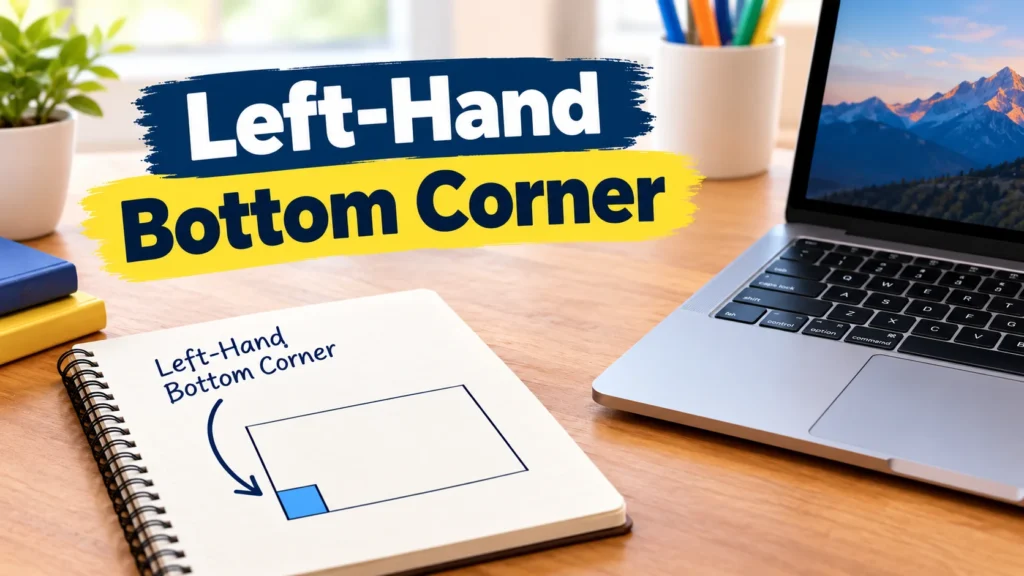
Meaning: The bottom corner on the left-hand side of an object.
Why This Phrase Works: It spells out the direction in a way that can help when explaining a physical object or printed page.
Real-World Usage Insight: Although understandable, this expression is wordier than “bottom-left corner” and is not usually the first choice in concise writing.
Best Use: Informal spoken explanations or descriptions where this wording feels natural.
Avoid When: Writing concise technical instructions or polished professional copy.
Tone: Descriptive and conversational.
US vs UK Usage: Understandable in both varieties. “Bottom-left corner” is generally more concise in both.
Example (Email / Message / Meeting): “The serial number is printed in the left-hand bottom corner of the label.”
At the Lower Left
Meaning: Located at or near the lower-left part of a defined space.
Why This Phrase Works: It fits smoothly into sentences describing where information appears.
Real-World Usage Insight: The expression is useful when the sentence focuses on the location of content rather than the exact shape of the area.
Best Use: Reports, image descriptions, diagrams, and presentations.
Avoid When: You need to distinguish a precise corner from a nearby position.
Tone: Neutral and descriptive.
US vs UK Usage: Natural in both American and British English.
Example (Email / Message / Meeting): “The legend appears at the lower left, beneath the main chart.”
Comparison Table of 10 Best Alternatives
The best alternative depends on the level of precision and the audience. This table compares ten useful expressions so you can quickly choose one that suits your sentence, document, or conversation.
| Phrase | Meaning | Best Use | Worst Use | Tone | US vs UK Usage |
| Bottom left | General lower-left location | Everyday directions | When exact measurements are needed | Neutral | Common in both |
| Bottom-left corner | Exact corner at the bottom and left | Design and professional instructions | Describing a broad region | Professional | Common in both |
| Lower left | Lower part of the left side | Charts and descriptions | When a specific point must be identified | Neutral | Common in both |
| Lower-left corner | Precisely identified lower-left corner | Technical documents and diagrams | When orientation is unclear | Professional | Common in both |
| Lower-left section | A defined lower-left section | Reports and page layouts | Describing a single icon | Formal and descriptive | Common in both |
| Bottom-left area | General area in the lower-left portion | Design feedback | Exact technical placement | Neutral | Common in both |
| Lower-left position | Relative placement in the lower-left part | Interface design | Casual conversation when unnecessary | Technical | Understood in both |
| At the lower left | Location at the lower-left side | Charts and written descriptions | When the object is unspecified | Neutral | Common in both |
| Lower-left region | A general or defined lower-left region | Data visualization and image analysis | Simple everyday directions | Analytical | Common in both |
| Southwest corner | Compass-based southwestern corner | Maps and site plans | Unoriented screens or images | Geographical | Common in both |
Conclusion
That ” is generally understandable, but “bottom left” is usually the more natural expression in everyday English. When you need to identify an exact corner, “bottom-left corner” or “lower-left corner” offers greater precision. For larger parts of a page, image, or interface, “lower-left section” and “bottom-left area” may be more appropriate.
The right expression depends on the object you are describing, the precision required, and the audience receiving your instructions. In casual conversations, short wording often works well. In professional writing, technical documentation, and design discussions, a more specific description can prevent confusion.
American and British English generally follow the same conventions for these expressions, so the main consideration is clarity rather than regional preference. Avoid treating every alternative as interchangeable: a corner, section, and region can describe different locations.
Ultimately, choose wording that sounds natural, accurately describes the position, and helps the reader find what you mean. A small improvement in directional language can make emails, presentations, tutorials, and everyday instructions easier to understand.
FAQs
What does “bottom” mean?
“ bottom” generally refers to the lower area on the left side of an object, page, or screen. Although the meaning is usually understandable, “bottom left” is more natural in standard English. Use “bottom-left corner” when you want to identify the precise corner where the bottom and left edges meet.
Is “left bottom” grammatically correct?
The words are grammatical individually, but “ bottom” is not the usual word order for describing a location. Most English speakers would say “bottom left,” “lower left,” or “bottom-left corner.” Choosing the conventional expression makes your writing sound more natural and professional.
What is the most common synonym for “left bottom”?
“Bottom left” is the most useful everyday alternative. Other options include “bottom-left corner,” “lower-left corner,” and “lower-left area.” The best choice depends on whether you mean an exact corner, a general location, or a defined section of a document or screen.
Should I write “bottom left” or “bottom-left”?
Both forms can be correct, depending on how the words function in a sentence. “Look at the bottom left” is a common standalone direction. In “the bottom-left corner,” the hyphen connects the words as a compound modifier before the noun. Follow your publication’s style guide for consistency.
Is “bottom-left corner” professional?
Yes. “Bottom-left corner” is clear, conventional, and appropriate for professional emails, reports, design feedback, and technical instructions. It identifies a specific location without sounding unnecessarily formal. When the location is approximate rather than exact, “bottom-left area” may be more accurate.
What is the difference between “lower left” and “bottom left”?
Both describe a location toward the lower-left side of an object or layout. “Bottom left” is common in everyday directions, while “lower left” often works well in formal descriptions, charts, and diagrams. Neither expression automatically identifies an exact corner unless the context makes that clear.
Do Americans and British speakers use bottom” differently?
There is no strong evidence of a meaningful regional difference in the standard usage of these expressions. American and British English both commonly use “bottom left,” “bottom-left corner,” and “lower-left corner.” Differences are more likely to reflect individual style or the communication context.
How do I describe the bottom-left corner of a website?
You can say, “The icon is in the bottom-left corner of the website” or “The icon appears at the bottom left of the screen.” For design instructions, identify the specific page or panel if multiple areas could be confused. This makes the location easier to find.
Can I use “southwest corner” instead of “bottom-left corner”?
Only when the object has an established compass orientation. “Southwest corner” refers to geographical directions, whereas “bottom-left corner” describes a position relative to the way an object is displayed. They are not interchangeable for every image, screen, or document.
What is the best way to use directional phrases in professional writing?
Choose familiar wording, identify the reference object, and be as precise as the task requires. For example, “Select the export button in the bottom-left corner of the dashboard” is more helpful than “Click the thing at the bottom.” Add measurements or coordinates when the exact position is critical.