Imagine a student who struggles with fractions at first but gradually improves through short lessons, regular practice, and helpful feedback. Instead of being expected to understand everything at once, the student builds knowledge one step at a time. The same approach can help an employee learning new software, a professional developing leadership skills, or an adult studying a new language.
This process is commonly associated with progressive learning: an approach to learning in which knowledge, skills, and understanding develop gradually, often from simpler concepts to more advanced ones.
Progressive learning is relevant in modern education, workplace training, online courses, and personal development. However, the phrase can describe different approaches depending on the situation. Sometimes, step-by-step learning communicates the idea more clearly. In other contexts, continuous learning, incremental learning, or skill development may be more appropriate.
What Does “Progressive Learning” Mean?
Progressive learning is an approach to education or skill development in which knowledge and abilities grow gradually through connected learning experiences. It often involves moving from basic concepts to more advanced material, practicing new skills, and using feedback to improve. It can be applied in classrooms, workplace training, online courses, and independent study.
Origin & History of “Experiential Learning”
The expression progressive learning combines two established English words: progressive and learning. Its modern meaning reflects the general idea that knowledge and abilities can develop over time through experience, practice, and increasingly complex tasks.
The linguistic roots of the phrase
The word progressive comes through French from Latin roots associated with moving forward or advancing. The word learning developed from Old English leornian, meaning to acquire knowledge or become informed through study or experience.
Together, these words describe a process in which learning advances rather than remaining fixed at one level.
Although the individual words have long histories, progressive learning does not have one universally accepted historical origin as a formal educational term. Its meaning depends on the field and context in which it appears.
Connection with progressive education
The phrase is closely related to the broader history of progressive education, an educational movement that gained influence during the late nineteenth and early twentieth centuries.
Educational thinkers such as John Dewey emphasized experience, inquiry, reflection, and the relationship between education and everyday life. Progressive educational approaches challenged teaching methods that relied exclusively on memorization and passive listening.
These ideas helped popularize learning environments in which students actively participate, investigate problems, and connect new information with what they already know.
However, progressive education and progressive learning are not identical. Progressive education refers to a broader educational philosophy, while progressive learning can simply describe the gradual development of knowledge or skills.
How the meaning evolved
Over time, the expression became useful in several settings:
- Traditional education: Lessons are organized so students can develop foundational knowledge before tackling more complex topics.
- Workplace training: Employees learn new responsibilities through guided practice and increasingly challenging assignments.
- Online education: Learners complete modules, receive feedback, and advance through a course at a manageable pace.
- Personal development: Individuals build abilities through regular practice, reflection, and experience.
- Technology and artificial intelligence: Related terminology can describe systems that update their behavior or improve their performance as new information becomes available.
The important distinction is that progressive learning does not always mean the same thing in education, personal development, and computing. When precision matters, explain whether you mean gradual human learning, an instructional method, or a technical process.
Synonyms & Alternatives by Tone
The best alternative depends on what you want to emphasize. Some expressions focus on the order of instruction, while others highlight continued improvement, practical experience, or changes in difficulty.
Professional & Neutral Alternatives
- Step-by-step learning
- Incremental learning
- Structured learning
- Sequential learning
- Continuous learning
- Cumulative learning
- Developmental learning
- Gradual learning
Polite & Supportive Alternatives
- Learning at your own pace
- Guided learning
- Supported learning
- Personalized learning
Encouraging & Reassuring Alternatives
- Learning through practice
- Building knowledge gradually
- Skill development
- Learning through experience
Casual, Playful & Idiomatic Alternatives
- Learning one step at a time
- Getting better as you go
- Building on what you know
- Growing your skills
- Learning as you go
These expressions overlap, but they are not interchangeable in every situation. For example, sequential learning emphasizes order, while continuous learning emphasizes ongoing development. Personalized learning focuses on adapting instruction to an individual’s needs rather than simply progressing from easy material to difficult material.
When Should You Avoid “Learning Progression”?
Although the phrase is useful, it is not the best choice for every situation. Sometimes, a more specific expression communicates your intended meaning more accurately.
In highly formal or technical documents
In research papers, formal training standards, and technical documentation, the phrase may be too broad unless you define it.
For example, if you mean that students must complete Module A before Module B, sequential learning may be more precise.
If you mean that new knowledge builds on previously learned material, cumulative learning may be the better choice.
In legal or policy documents
Policies and contractual documents require precise descriptions of responsibilities, conditions, and procedures.
Instead of writing, “Employees will receive progressive learning,” specify the actual training requirements, completion stages, assessment criteria, or development opportunities.
The problem is not that the phrase is unprofessional. It is that the expression alone may leave important details undefined.
When describing ongoing education rather than gradual progression
A person can continue learning throughout their career without following a fixed sequence.
In that situation, continuous learning or lifelong learning may be more appropriate.
For example, an experienced software developer who regularly studies new technologies is engaged in continuous learning, even if the learning does not follow a carefully planned progression.
When individual needs differ significantly
Progressive learning can suggest an organized path, but learners do not always develop at the same speed.
If the emphasis is on adapting lessons to individual strengths, challenges, or interests, personalized learning or adaptive learning may communicate the idea better.
When the phrase could oversimplify a sensitive issue
Learning progress can be affected by access to resources, teaching quality, disability, language barriers, workload, and personal circumstances.
Avoid implying that everyone will progress at the same rate simply because a learning program follows a structured sequence.
A more thoughtful description acknowledges that learners may need different levels of support, practice, or time.
Is “Lifelong Learning” Professional, Polite, or Casual?
Progressive learning is generally professional and neutral. It is suitable for educational materials, business presentations, workplace training plans, and discussions about personal development.
Its tone is more descriptive than emotional. It explains an approach to learning rather than directly expressing praise, criticism, encouragement, or urgency.
| Context | Tone | Audience perception |
| Academic writing | Formal and descriptive | An organized approach to developing knowledge |
| Workplace training | Professional and practical | Skills develop through planned stages |
| Educational websites | Informative and accessible | Learning is a gradual process |
| Personal development | Positive and constructive | Improvement can happen over time |
| Casual conversation | Slightly technical | May sound more formal than necessary |
| Marketing copy | Aspirational | May suggest structured growth or improvement |
Is it polite?
Yes. The phrase is not inherently rude, confrontational, or demanding. It can support an encouraging message by emphasizing that people do not need to master everything immediately.
However, politeness depends on the full message.
Compare these examples:
- Supportive: “Our progressive learning approach gives everyone time to practice new skills.”
- Less supportive: “You need progressive learning because you clearly don’t understand the basics.”
The second sentence sounds critical because of its wording, not because the phrase itself is impolite.
Is it formal or informal?
The expression is best described as neutral to moderately formal. It fits professional communication but may feel unnecessarily technical in an everyday conversation.
For a colleague, “Let’s learn this step by step” is more conversational than “Let’s adopt a progressive learning approach.”
Choose the version that matches the audience’s familiarity with educational terminology.
“Common Mistakes & Misuse of “Progressive Learning”
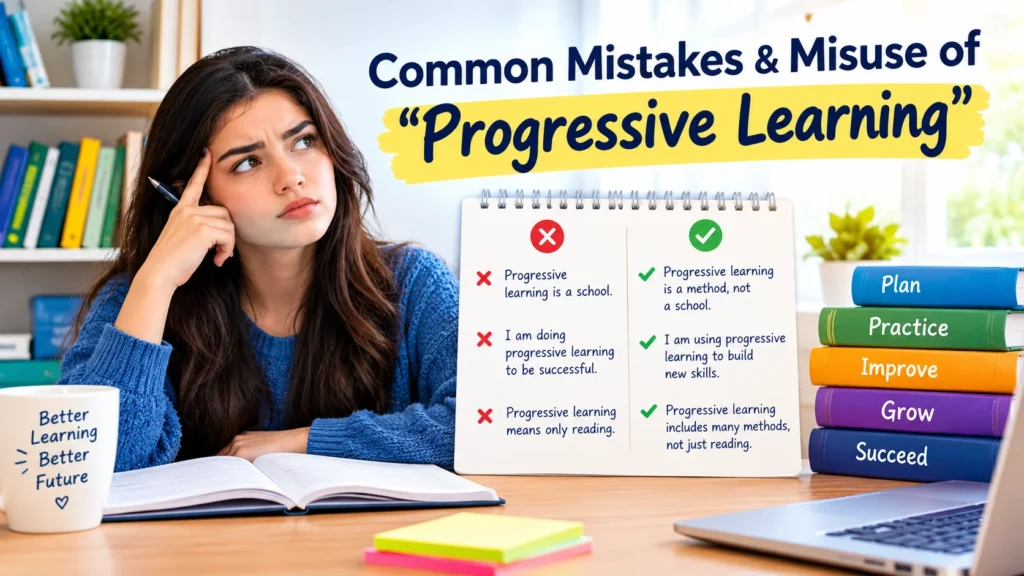
Using progressive learning correctly requires more than understanding its basic definition. Writers should also consider the intended meaning, the audience, and the context in which the phrase appears.
Overusing the expression
Repeating progressive learning in every paragraph can make an article feel mechanical. This is especially noticeable in educational blogs, training materials, and SEO content.
Better approach: Use the main phrase where it is most relevant, then introduce accurate alternatives such as guided learning, skill development, and building knowledge gradually.
Natural variation improves readability without forcing unrelated keywords into the content.
Use it when you mean continuous learning
Progressive learning generally suggests development or progression. Continuous learning focuses on learning that continues over time.
For example, an employee who completes regular professional development courses may participate in continuous learning without following a single progression from beginner to advanced.
Choose the term that reflects the actual process.
Confusing Cumulative Learning with personalized learning
A course can gradually increase in difficulty while giving every learner the same activities. That is not necessarily personalized learning.
Personalized learning involves adjusting instruction, learning materials, pace, or support to better meet individual needs.
The distinction matters: progression describes how learning develops, while personalization describes how learning is tailored.
Assuming that every learner progresses at the same rate
People have different backgrounds, prior knowledge, learning preferences, and opportunities to practice. A fixed sequence may help organize instruction, but it does not guarantee identical results.
Avoid statements suggesting that everyone will master a skill after the same number of lessons or practice sessions.
Using the phrase without explaining the method
“The program encourages progressive learning” sounds reasonable, but it does not tell readers what the program actually involves.
A clearer explanation might mention short lessons, practical exercises, feedback, review sessions, and increasingly challenging tasks.
Overlooking cultural and linguistic differences
Some audiences are familiar with educational terminology, while others may find it abstract. ESL learners, for example, may understand learning one step at a time more easily than progressive learning.
Use plain English when accessibility is the priority. In formal documents, define specialized terminology when necessary.
US vs UK Usage of “progressive Learning”
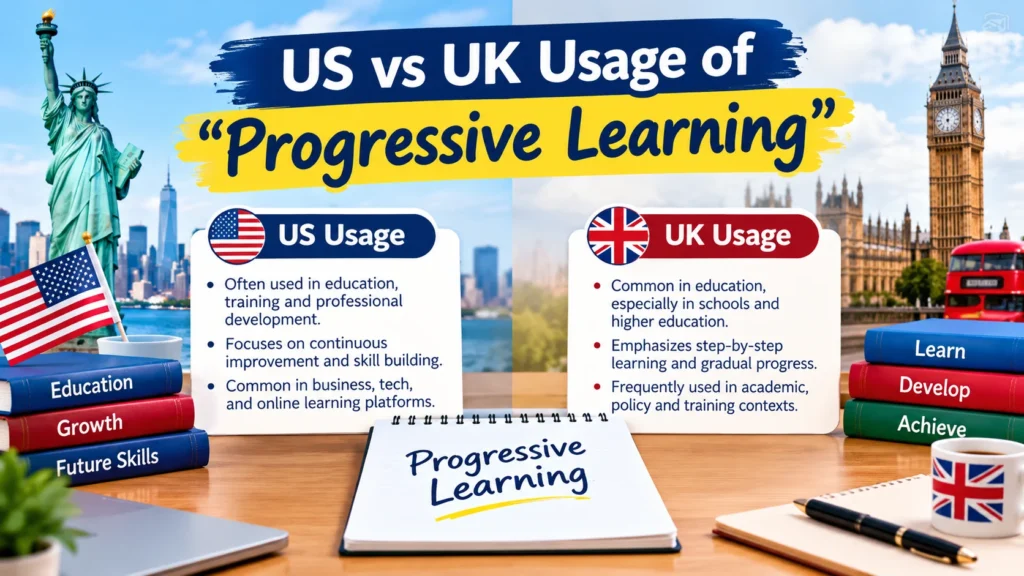
The expression progressive learning is understandable in both American and British English. There is no widely established difference in its core meaning between the two varieties.
The main differences are more likely to arise from educational terminology, institutional preferences, and the surrounding context than from the phrase itself.
Usage in American English
In the United States, the expression can appear in educational discussions, workplace training, online courses, and professional development materials.
Depending on the intended meaning, American writers may also prefer expressions such as step-by-step learning, continuous learning, or personalized learning.
For general audiences, plain-language alternatives can be more immediately understandable than an abstract educational term.
Usage in British English
In the United Kingdom, progressive learning is also understandable in educational and professional settings. Writers may use it to describe the development of knowledge, structured instruction, or a broader learning approach.
As in American English, lifelong learning, continuing professional development, and learning at your own pace may be more suitable when those specific ideas are intended.
Differences in tone and perception
| Feature | US English | UK English |
| Core meaning | Gradual development of knowledge or skills | Gradual development of knowledge or skills |
| Professional use | Education, training, career development | Education, training, professional development |
| Plain-language alternative | Step-by-step learning | Learning step by step |
| Ongoing development | Continuous learning | Lifelong learning or continuing professional development, depending on context |
| Formality | Neutral to moderately formal | Neutral to moderately formal |
These are practical options, not strict regional rules. Both varieties use overlapping vocabulary, and individual organizations may have their own preferred terminology.
Recommendation: For international audiences, use progressive learning when it accurately describes the method, then explain the process in straightforward language. This approach reduces ambiguity across regions.
“Sequential Learning” in Digital & Modern Communication
Digital communication has made structured learning approaches increasingly visible. Online courses, workplace messaging tools, educational platforms, and AI-supported learning resources often organize information into manageable stages.
The phrase can describe these approaches, but its exact meaning should remain clear.
Emails
In professional emails, progressive learning can explain a training plan or introduce a new process.
Example:
“We’ll introduce the reporting system through progressive learning sessions, starting with basic navigation and moving on to advanced reporting tools.”
If the recipient is unfamiliar with the terminology, step-by-step training may be clearer.
Slack and WhatsApp
In workplace chats, concise and conversational language is usually more effective than formal terminology.
Instead of writing:
“Please follow the progressive learning framework before proceeding.”
Try:
“Let’s cover the basics first, then move on to the more advanced features.”
The second message makes the next step clear and feels more collaborative.
Social media
On educational and professional development accounts, the phrase can describe a general approach to improving skills.
Example:
“Progressive learning is about building on what you already know. Start with the basics, practice consistently, and take on more challenging tasks as your confidence grows.”
For short captions, learning one step at a time may be more engaging and accessible.
Online courses and learning platforms
Course creators may use progressive learning to describe a sequence of lessons, exercises, quizzes, and projects.
A useful course description explains how the sequence works, whether learners can review earlier lessons, and what they should be able to do by the end.
Avoid implying that every learner must follow an identical pace unless the course actually requires it.
AI-generated summaries and educational tools
AI tools can summarize material, explain difficult concepts, create practice questions, and adapt explanations to a learner’s requests. These features can support a progressive learning approach when used thoughtfully.
For example, a learner might first request an explanation of a basic programming concept, then work through a simple example, and finally ask for a more challenging exercise.
However, AI-generated information should be checked for accuracy. A sequence of increasingly difficult explanations is useful only when the underlying content is reliable and appropriate for the learner’s needs.
Practical takeaway: Digital learning works best when the learner can understand the next step, practice what they have learned, and identify misunderstandings before moving forward.
Linguistic & Communication Insight
Understanding progressive learning from a communication perspective involves more than defining the words. It also requires considering what the phrase suggests about expectations, relationships, competence, and the way learning is organized.
Emotional weight and subtext
The phrase often carries a constructive, forward-looking tone. It suggests that knowledge and ability can develop through time and effort rather than appearing fully formed.
In a workplace, this can reassure employees who are learning a new process. A manager who says, “We’ll use progressive learning to introduce the new system,” may be signaling that the team is not expected to master every feature immediately.
However, the phrase can also sound impersonal if the situation calls for direct reassurance.
Compare:
- “We use a progressive learning model for new employees.”
- “We’ll start with the basics, and I’ll help you work through the more difficult parts.”
The first describes a system. The second communicates personal support.
Neither is universally better. The appropriate choice depends on whether the speaker needs to explain a process, build confidence, or establish a supportive relationship.
Direct versus indirect phrasing
Progressive learning is a descriptive phrase rather than a direct instruction. It does not specify what someone must do next, how quickly they should progress, or what happens if they struggle.
That can be an advantage when discussing an overall approach, but it may be insufficient when immediate action is required.
For instance:
- General approach: “Our team follows a progressive learning model.”
- Direct instruction: “Complete the introductory lesson before starting the advanced exercise.”
- Collaborative instruction: “Let’s review the basics together before we try the advanced exercise.”
The first communicates the framework, the second establishes a requirement, and the third emphasizes collaboration.
Experienced communicators choose wording according to the action they need the audience to understand. They do not rely on a broad concept when a concrete instruction would prevent confusion.
Professional communication perspective
In the workplace, progressive learning can help describe employee onboarding, continuing development, software training, and the acquisition of new responsibilities.
Its effectiveness depends on whether the phrase is supported by a clear explanation.
Consider a manager announcing a new reporting system. Saying that the team will receive progressive learning communicates a general plan, but employees may still wonder when training begins, which tools they must learn first, and where they can get help.
A stronger message explains the sequence:
“We’ll begin with the daily reporting tasks on Monday, practice them together during the first week, and introduce the advanced dashboard after everyone is comfortable with the basics.”
The second message is more actionable because it connects the learning approach to specific tasks and expectations.
Why professionals choose alternatives
Different alternatives communicate different priorities.
- Step-by-step learning emphasizes clarity and manageable stages.
- Continuous learning emphasizes ongoing development and adaptability.
- Guided learning emphasizes support from a teacher, mentor, or instructor.
- Personalized learning emphasizes individual needs and adjustments.
- Cumulative learning emphasizes connections between previous and new knowledge.
Choosing among these phrases helps professionals communicate the intended benefit instead of using one expression for every situation.
For example, a manager trying to reassure a new employee may prefer guided learning. A company describing its long-term development culture may prefer continuous learning. An instructional designer explaining how a course is organized may prefer sequential learning.
Social signaling, trust, and engagement
Word choice can influence how audiences perceive a speaker’s competence and intentions. Clear language often makes a message easier to understand, while unnecessary technical terminology can create distance.
Using progressive learning in a curriculum proposal may signal that the writer is familiar with educational planning. Using learning one step at a time in a message to a struggling beginner may communicate greater warmth and accessibility.
Neither expression automatically creates trust. Trust develops when the wording matches the experience—for example, when a course described as supportive genuinely provides useful feedback and opportunities to practice.
Tone and context guidance
Before using progressive learning, consider three questions:
- What do I want to emphasize? Use sequential learning for order, incremental learning for small additions, or continuous learning for ongoing development.
- Who is my audience? Educational professionals may understand the term immediately, while general readers may benefit from a plain-English explanation.
- What should the audience do next? If a practical action is required, describe the steps rather than relying on a broad label.
Ultimately, effective communication connects terminology with context. Progressive learning is useful when it accurately describes development over time. The best alternative is the one that preserves your intended meaning while making the message easier for your audience to understand.
Comparison Table of 10 Best Alternatives
The following table compares ten useful alternatives to progressive learning. Use it to choose wording that matches your audience, the learning method you are describing, and the level of formality you need.
| Phrase | Meaning | Best Use | Worst Use | Tone | US vs UK Usage |
| Step-by-step learning | Learning through clear stages | Beginner guides and tutorials | Flexible, exploratory learning without fixed steps | Clear and practical | Common in both |
| Incremental learning | Adding knowledge or skills in small amounts | Technical training and measurable improvement | Describing every form of education | Precise and professional | Common in both |
| Structured learning | Learning within an organized framework | Courses and training plans | Informal, unplanned exploration | Organized and neutral | Common in both |
| Sequential learning | Learning activities completed in a particular order | Prerequisites and procedural training | Learning environments requiring flexible order | Formal and systematic | Common in both |
| Continuous learning | Ongoing acquisition of knowledge | Career development and lifelong education | A fixed sequence of lessons | Professional and forward-looking | Common in both |
| Cumulative learning | New knowledge builds on previous knowledge | Academic subjects and curriculum planning | Learning that does not rely on earlier knowledge | Academic and analytical | Common in both |
| Gradual learning | Learning develops over time | Beginner instruction and supportive guidance | A highly specific technical method | Friendly and accessible | Common in both |
| Guided learning | Learning with direction and feedback | Mentoring and supervised training | Entirely independent study | Supportive and professional | Common in both |
| Personalized learning | Learning adapted to individual needs | Tailored courses and individual development | Identical instruction for every learner | Inclusive and learner-focused | Common in both |
| Skill development | Improving practical abilities | Workplace training and career planning | Describing knowledge acquisition without a skill focus | Direct and professional | Common in both |
Conclusion
Progressive learning describes an approach in which knowledge, understanding, and skills develop over time, often through connected stages, regular practice, and increasingly challenging activities. It is useful in education, workplace training, online courses, and personal development because it communicates the idea that meaningful improvement usually takes time.
However, the phrase is not the best choice for every situation. Step-by-step learning is clearer when explaining a process to beginners, continuous learning emphasizes ongoing development, and incremental learning highlights small additions or improvements. Similarly, guided learning emphasizes support, while personalized learning focuses on individual needs.
When choosing an alternative, consider your audience, the purpose of your message, and the specific aspect of learning you want to describe. In professional writing, avoid relying on broad terminology without explaining how the learning process works. Concrete details about practice, feedback, lesson structure, and skill development make your message more useful and credible.
Ultimately, the best expression is the one that communicates your intended meaning accurately, naturally, and clearly.
FAQs
What is progressive learning in simple words?
Progressive learning means developing knowledge or skills gradually, often by starting with basic concepts and moving toward more advanced ones. It may involve practice, feedback, and reviewing earlier material. For example, a beginner learning English might start with common words, then build sentences, and eventually practice longer conversations.
What is another word for progressive learning?
Useful alternatives include step-by-step learning, incremental learning, structured learning, sequential learning, and gradual learning. The best choice depends on your intended meaning. Use step-by-step learning for clear stages, continuous learning for ongoing education, and cumulative learning when new knowledge builds on previously learned concepts.
Is progressive learning the same as continuous learning?
No. Progressive learning generally emphasizes development or progression, often through connected stages. Continuous learning emphasizes the ongoing acquisition of knowledge and skills over time. A course can use progressive learning to organize lessons, while a professional can practice continuous learning throughout an entire career without following one fixed sequence.
What are the main benefits of progressive learning?
Progressive learning can help learners manage complex information, practice foundational skills, receive feedback, and develop confidence as they improve. It can also make training programs easier to organize. Its effectiveness depends on suitable instruction, meaningful practice, appropriate challenges, and support that reflects learners’ needs.
How is progressive learning used in education?
In education, progressive learning may involve introducing basic concepts before advanced topics, connecting new information with prior knowledge, and giving students opportunities to practice. For example, a science course might introduce fundamental concepts before asking students to interpret experimental results. The exact approach depends on the subject and learning objectives.
Is progressive learning a formal educational theory?
Not necessarily. Progressive learning is a broad expression rather than one universally defined educational theory. It can describe gradual skill development or a structured learning approach. It is related in wording to progressive education, a broader educational movement, but the two expressions should not automatically be treated as equivalent.
Is progressive learning professional language?
Yes. Progressive learning is generally professional and neutral. It can be used in training proposals, educational articles, workplace presentations, and curriculum descriptions. However, step-by-step learning may be more accessible for a general audience, while sequential or incremental learning may be more precise in technical documents.
What is the difference between progressive and personalized learning?
Progressive learning emphasizes how knowledge or skills develop over time. Personalized learning emphasizes adapting instruction, materials, or pacing to an individual’s needs and goals. A course may combine both approaches by gradually increasing difficulty while providing different exercises or levels of support to different learners.