
Imagine a colleague has been away from work for a few weeks, and you want to stop by to see how they are doing. You might say, “I’ll pay a visit to my colleague this weekend.” The expression sounds natural, friendly, and clear. However, depending on the situation, you could also say “stop by,” “visit in person,” or “drop in.”
“Pay a visit” means to go to a person, place, or organization to see someone, spend time with them, or accomplish a particular purpose. It is a versatile English expression used in everyday conversations, professional correspondence, travel writing, and social invitations.
Choosing the right alternative can make your communication sound warmer, more professional, or more direct. For example, “I would like to visit your office” sounds appropriate in a business email, while “I’ll pop over later” feels relaxed and conversational. Understanding these differences helps you communicate naturally without sounding too formal or unintentionally imposing on someone’s time.
What Does “Pay a Visit” Mean?
“Pay a visit” means to go somewhere or see someone for a specific purpose, such as socializing, offering support, attending a meeting, or inspecting a location. The expression is commonly used for visits to friends, family members, offices, businesses, hospitals, and institutions. It can sound polite, neutral, or slightly formal depending on the context.
Origin & History of “Pay a Visit”
The expression “pay a visit” comes from an older English use of the verb pay, which extends beyond giving money. In English, people can also pay attention, pay respect, or pay a compliment. We these expressions, pay means to give, offer, or direct something toward a person or activity.
It“pay a visit,” the verb emphasizes carrying out the act of visiting someone. The expression follows a familiar pattern in English in which an action is treated as something offered or performed.
How the expression developed
Visiting has long played an important role in social relationships, business, diplomacy, and community life. Before instant messaging and video calls, in-person visits were essential for maintaining relationships, exchanging information, showing respect, and conducting business.
The expression became a conventional way to describe these interactions. It could refer to visiting relatives, calling on a respected person, meeting a business contact, or inspecting a particular location.
The word visit itself has roots in Latin visitare, meaning to go to see or visit repeatedly, related to visere, meaning to look at or examine. This historical connection helps explain why visiting can involve both social interaction and practical purposes.
How its meaning evolved
Today, “pay a visit” remains common, but the ways people visit have changed. People may arrange an office visit through email, check in on a friend after seeing their social media update, or visit a business after finding it online.
The phrase can still suggest courtesy or intention, particularly in formal settings. However, it is also perfectly natural in everyday speech.
For example, “I’ll pay a visit to my aunt” sounds slightly more deliberate than “I’ll see my aunt.” Neither is inherently better; the appropriate choice depends on the relationship and context.
Synonyms & Alternatives by Tone
Not every synonym for “pay a visit” communicates the same intention. Some alternatives emphasize courtesy, others highlight spontaneity, and some suggest a professional appointment.
Professional & Neutral Alternatives
- Visit in person
- Visit
- Call on
- Make a visit
- Attend
- Go to
- Meet with
- Conduct a site visit
Polite & Supportive Alternatives
- Stop by to see
- Call in on
- Come and see
- Check in on
- Visit with
- Drop by to see
Encouraging & Reassuring Alternatives
- Go and see
- Spend some time with
- Reach out in person
- Stop by and say hello
- Go over to see
Casual, Playful & Idiomatic Alternatives
- Stop by
- Drop in
- Pop in
- Pop over
- Swing by
- Come around
- Pay someone a quick call
Some alternatives overlap across categories. For example, “stop by” can be professional when used in a friendly workplace, while “call on” may sound formal or old-fashioned in an everyday conversation.
The best choice depends on the audience, the purpose of the visit, and whether the visit is planned or spontaneous.
When Should You Use “Pay a Visit”?
“Pay a visit” works best when you want to describe an intentional visit in a polite, understandable way. It fits social situations as well as many professional interactions.
In professional settings
The phrase can be useful when discussing office visits, business locations, clients, or colleagues.
Examples:
- “Our regional director plans to pay a visit to the new office next week.”
- “I would like to pay a visit to your department to discuss the proposal.”
- “The inspection team will pay a visit to the warehouse on Thursday.”
In professional writing, the expression is courteous and straightforward. However, if you are arranging an appointment, “schedule a meeting” or “visit your office” may communicate the purpose more precisely.
In casual conversations
You can use the expression when talking about friends, relatives, neighbors, and familiar places.
Examples:
- “We should pay a visit to Uncle James soon.”
- “I might pay a visit to the bookstore after lunch.”
- “Let’s pay a visit to our old neighborhood this weekend.”
In relaxed conversations, shorter alternatives such as “stop by” and “drop in” often sound more natural.
In writing and presentations
The phrase is appropriate in travel articles, event reports, newsletters, presentations, and descriptions of planned activities.
For instance:
- “Visitors can pay a visit to the historic museum during the afternoon.”
- “The committee will pay a visit to the community center.”
- “We paid a visit to three local businesses as part of our research.”
It can help a writer describe a visit without adding unnecessary detail.
In emails and digital communication
“Pay a visit” can work in emails when you want to communicate politely. However, the purpose should be clear.
Instead of writing, “I want to pay a visit to your office,” consider:
“I’d like to visit your office next Tuesday to discuss the project. Would 10 a.m. work for you?”
This version explains the reason, suggests a time, and allows the recipient to respond.
When it is especially effective
Use the phrase when:
- You want to describe a deliberate visit.
- You need a polite, neutral expression.
- The visit itself matters more than its duration.
- You are writing for readers with different levels of English proficiency.
- You want to sound slightly more formal than you would with “pop in” or “swing by.”
Pros and Cons of Using “Pay a Visit”
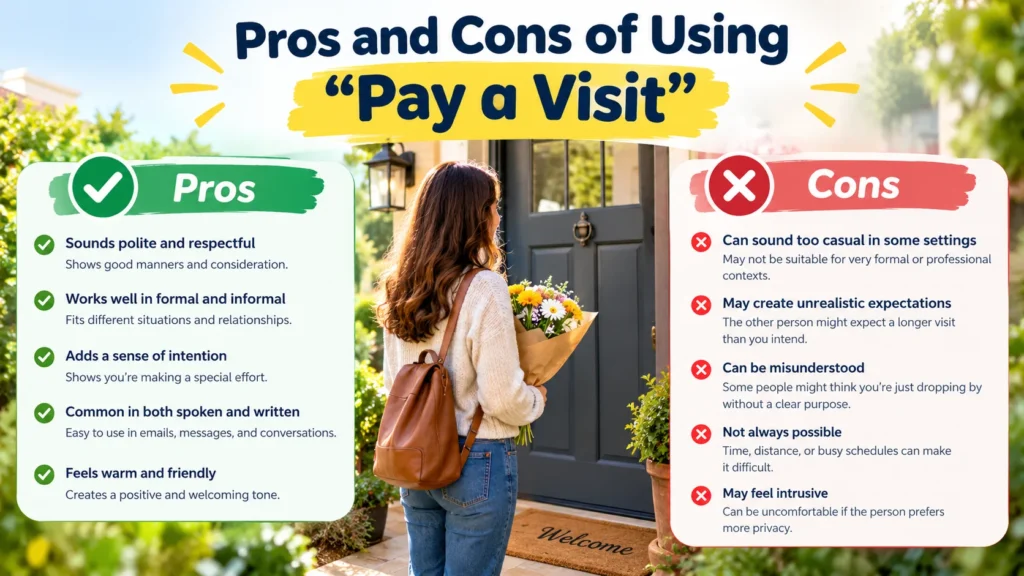
Every expression has strengths and limitations. Understanding both helps you select language that suits the situation.
Advantages
1. Clear meaning
The phrase communicates the idea of going somewhere to see a person or place. Most English speakers understand it without additional explanation.
2. Broad applicability
It works for family visits, business trips to an office, visits to institutions, and trips to places of interest.
3. Polite tone
It can sound courteous without being excessively formal, making it useful in many professional and social situations.
4. Accessible English
The expression is familiar to many English learners and readers. It provides a straightforward way to discuss visits.
5. Flexible purpose
A visit can be social, professional, educational, supportive, or practical. The phrase accommodates all these purposes when the context is clear.
Potential drawbacks
1. It can sound less conversational
In everyday American English, “stop by” or “come over” may sound more natural between friends.
2. It does not explain the purpose
“I will pay a visit to the office” does not clarify whether the speaker intends to attend a meeting, deliver documents, or inspect the workplace.
3. It may sound overly deliberate
A casual visit can seem more formal than necessary when described as paying a visit.
4. It can create ambiguity
The expression does not tell the reader whether the visit is planned, spontaneous, brief, or lengthy.
5. Repetition can weaken writing
Repeated use can make a paragraph sound formulaic. Varying the vocabulary improves readability when the alternatives accurately reflect the action.
The expression remains useful when you want a general, courteous description. When precision or a particular emotional tone matters, a more specific alternative may be better.
Real-Life Examples of “Pay a Visit” by Context
These examples demonstrate how the phrase works in ordinary communication.
1. Email to a colleague
Subject: Visiting the New Office
“Hi Sarah,
I’ll be in your area on Thursday and would like to pay a visit to the new office. If you’re available, I’d love to see the updated workspace and catch up on the project.
Best,
Daniel”
Why it works: The phrase communicates a planned visit, while the rest of the email explains its purpose and keeps the tone friendly.
2. Workplace meeting
“Our operations manager will pay a visit to the distribution center next week to review the updated procedures.”
Why it works: It conveys a deliberate workplace visit without suggesting an informal social gathering.
3. Presentation
“As part of our community outreach program, the team will pay a visit to three local schools this month.”
Why it works: The phrase suits a planned activity being described to an audience.
4. Conversation with a friend
“I haven’t seen Maya in ages. I think I’ll pay a visit this weekend if she’s free.”
Why it works: The speaker communicates an intention while acknowledging that the visit depends on Maya’s availability.
5. Family conversation
“Dad, we should pay a visit to Aunt Linda. She mentioned that she hasn’t seen everyone together in months.”
Why it works: The expression presents the visit as a considerate social gesture.
6. Travel writing
“If you’re exploring the old town, pay a visit to the local history museum. It has a fascinating collection of photographs from the early twentieth century.”
Why it works: The phrase gives readers a polite recommendation.
7. Social media
“Finally paid a visit to the little café everyone keeps recommending. The coffee was excellent, and the staff was lovely.”
Why it works: The wording is understandable and natural in a casual post, although “finally visited” would be shorter.
8. Customer communication
“Our representative would be happy to pay a visit to your premises to discuss the installation requirements.”
Why it works: It presents an in-person visit as a professional service and makes the purpose reasonably clear.
9. Supportive message
“I heard that you’ve been having a difficult week. I’d love to pay a visit sometime, if you’d appreciate some company.”
Why it works: The speaker offers support without assuming that the recipient wants company.
10. School assignment
“During our history project, we paid a visit to a nearby heritage site to learn about the region’s past.”
Why it works: The expression describes an educational outing in clear, conventional English.
“
Psychological Reason People Prefer “Pay a Visit”
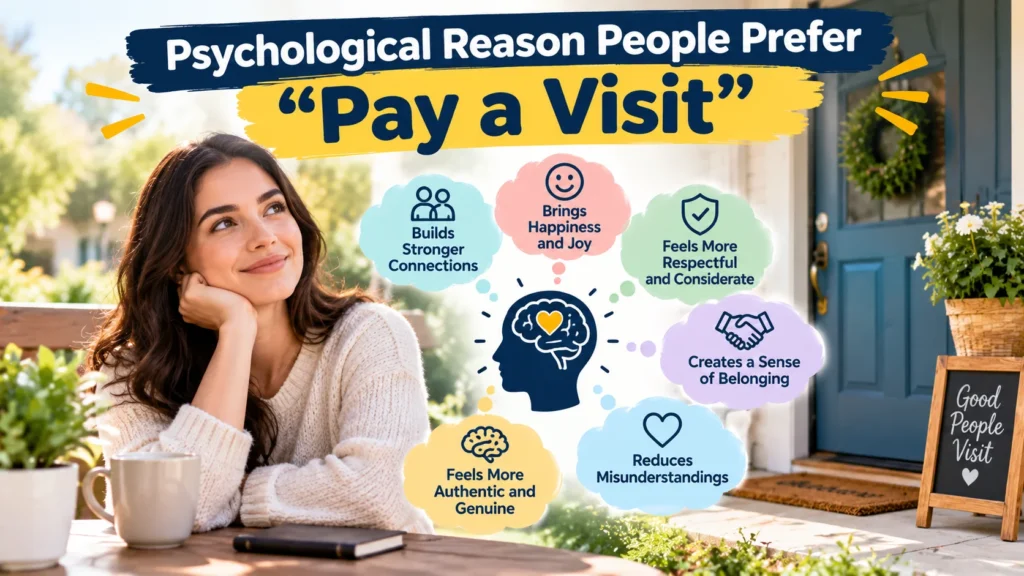
People often choose familiar expressions because they make communication easier. “Pay a visit” offers a convenient way to describe an action without explaining every detail.
Cognitive load reduction
A familiar phrase helps readers understand the general intention quickly. Instead of describing every step involved in going to see someone, a speaker can simply say, “I’ll pay a visit.”
This efficiency is particularly helpful in everyday conversations, travel descriptions, and general business writing.
However, if the purpose matters, the phrase should be followed by a short explanation.
Trust and authority signals
In some settings, “pay a visit” sounds considered and courteous. A professional might use it to communicate a planned visit without making the message sound abrupt.
For example:
“Our team would like to pay a visit to your premises next week.”
The wording is polite, but trust depends on more than word choice. Clear scheduling, honest intentions, and respect for the recipient’s time are equally important.
The attention economy
Modern communication often rewards concise messages. People read notifications quickly and may overlook long explanations.
A short phrase can communicate the basic idea, but clarity matters more than brevity alone. “I’ll stop by at 2 p.m. to collect the documents” is more useful than “I’ll pay a visit” when timing and purpose are important.
Modern communication habits
Texting, workplace messaging, and video calls have changed how people arrange visits. A person might write “Can I drop by?” before arriving or use “visit in person” to distinguish an office visit from an online meeting.
The preference for one expression over another often reflects the relationship, the platform, and the level of planning involved.
US vs. UK Usage of “Pay a Visit”
“Pay a visit” is understood in both American and British English. There is no strict rule that makes the expression exclusive to either variety.
The differences are more noticeable in the alternatives speakers commonly choose and the degree of formality they prefer.
| Expression | American English | British English |
| Pay a visit | Understood; can sound deliberate or slightly formal. | Understood; can sound polite or slightly formal. |
| Stop by | Common in everyday conversation. | Also used, although preferences vary by speaker and region. |
| Drop in | Common for an informal visit. | Common for an informal or spontaneous visit. |
| Pop in | Understood and used, particularly in informal conversation. | A familiar, natural choice for a brief visit. |
| Pop round | Less typical than “stop by” in many American contexts. | A familiar informal expression, especially in British English. |
| Swing by | Common in casual American conversation. | Understood and used, but regional and personal preferences vary. |
Popularity and tone
Both American and British speakers use “pay a visit,” especially when describing planned or purposeful visits. Its precise frequency varies by context, age, region, and type of writing.
American speakers may naturally choose “stop by” or “swing by” in casual conversation. British speakers may choose “pop in” or “pop round” in comparable situations.
These are tendencies, not fixed rules. A British professional may use “stop by,” and an American speaker may say “pop in.”
Regional preferences in practice
For an international audience, “visit” is often the simplest option. “Pay a visit” is also widely understood, while regional idioms may require more attention from English learners.
If your goal is natural everyday English, match the phrase to the audience rather than trying to follow a rigid US-versus-UK rule.
“Pay a Visit” in Digital & Modern Communication
The expression remains useful online because digital communication frequently involves arranging, describing, or recommending in-person visits.
Emails
In professional emails, the phrase can convey courtesy.
Example:
“Would it be possible to pay a visit to your office next week to discuss the proposal?”
If you want a more direct and natural version, write:
“I’d like to visit your office next week to discuss the proposal. Would Tuesday work for you?”
The second version is specific and gives the recipient a clear question to answer.
Slack and WhatsApp
Short messages usually benefit from simpler alternatives.
- “Can I stop by your desk after lunch?”
- “I’ll pop in around 3 if that works.”
- “Would it be okay if I came over this evening?”
“Pay a visit” is still understandable, but it may sound overly formal in a quick exchange between colleagues or friends.
Social media
In a social media post, the phrase can describe visiting a place, discovering a local business, or reconnecting with someone.
Example:
“We finally paid a visit to the community garden this weekend. It’s amazing how much the volunteers have accomplished.”
For a more casual post, “Finally visited the community garden” is shorter and equally clear.
AI-generated summaries
AI-generated summaries often use general phrases such as “visited the location” or “made an in-person visit.” These may be appropriate when summarizing a report, but the best wording depends on the original context.
For example:
- Original: “The manager stopped by for ten minutes to check the new display.”
- Accurate summary: “The manager briefly visited to review the new display.”
A summary should preserve important details, including duration, purpose, and whether the visit was planned. Replacing every expression with “pay a visit” would make the writing repetitive and sometimes less precise.
Go and See
Meaning: To travel to a person or place to see them or find out something directly.
Why This Phrase Works: It is simple, direct, and easy for English learners to understand.
Real-World Usage Insight: The expression often sounds more conversational than “pay a visit.” It can also suggest a practical reason for going, such as checking a problem personally.
Best Use: Everyday conversations, family visits, and straightforward advice.
Avoid When: You need a polished, formal description of a scheduled professional visit.
Tone: Plain, natural, and conversational.
US vs UK Usage: Widely used in both varieties of English.
Example (Email / Message / Meeting): “You should go and see the new office before deciding which team you’d like to join.”
Spend Some Time With
Meaning: To be with someone for a period of time, usually to socialize, offer support, or build a relationship.
Why This Phrase Works: It focuses on the relationship and shared experience rather than the act of arriving at a location.
Real-World Usage Insight: This is especially effective when the emotional purpose of a visit matters more than the location itself.
Best Use: Family relationships, friendships, caregiving, and supportive personal communication.
Avoid When: You need to communicate a short professional visit, an inspection, or a quick collection.
Tone: Warm, personal, and considerate.
US vs UK Usage: Natural in both American and British English.
Example (Email / Message / Meeting): “I’d like to spend some time with Dad this weekend, so I’ll visit him on Saturday afternoon.”
Conduct a Site Visit
Meaning: To visit a location for a professional purpose, such as inspection, evaluation, research, or project planning.
Why This Phrase Works: It makes the purpose of the visit more explicit than a general phrase such as “pay a visit.”
Real-World Usage Insight: The expression is useful in construction, property, engineering, research, facilities management, and other settings where the location must be examined in person.
Best Use: Project planning, inspections, operational reviews, property assessments, and formal reports.
Avoid When: You are talking casually about seeing a friend or visiting a family member.
Tone: Technical, professional, and precise.
US vs UK Usage: Common in professional English in both the United States and the United Kingdom.
Example (Email / Message / Meeting): “We’ll conduct a site visit on Wednesday to confirm the measurements before ordering the equipment.”
Comparison Table of 10 Best Alternatives
The best alternative to “pay a visit” depends on your purpose, audience, and preferred tone. Use this table to compare ten practical options and choose the expression that fits your situation.
| Phrase | Meaning | Best Use | Worst Use | Tone | US vs UK Usage |
| Visit | Go to see someone or somewhere. | General communication | When you need to emphasize spontaneity | Neutral | Common in both |
| Stop by | Make a brief visit. | Casual workplace or social visits | Formal inspections | Friendly | Common in both |
| Drop in | Visit informally, sometimes without planning. | Friends and familiar places | Strictly scheduled appointments | Casual | Common in both |
| Call on | Visit for a purpose. | Formal or traditional contexts | Relaxed conversations with close friends | Formal or traditional | Understood in both |
| Come over | Come to the speaker’s location. | Home invitations | Official reports | Warm and casual | Common in both |
| Swing by | Make a quick stop. | Errands and informal visits | Formal announcements | Casual | Especially familiar in the US |
| Pop in | Make a short, informal visit. | Quick visits and local errands | Formal business correspondence | Friendly | Familiar in both, especially UK |
| Pop over | Visit a nearby place informally. | Friends and neighbors | Formal or distant business visits | Relaxed | Familiar in both, especially UK |
| Meet with | Get together for discussion. | Business appointments | Visits without a meeting | Professional | Common in both |
| Check in on | See how someone is doing. | Support and follow-up | Routine visits without a checking purpose | Caring | Common in both |
Conclusion
“Pay a visit” is a useful English expression for describing a deliberate trip to see a person or place. Its meaning is straightforward, and its slightly formal, polite tone makes it suitable for many social, professional, and educational situations. However, the best alternative depends on what you want to communicate.
Choose “visit” for neutral, everyday English, “stop by” for a brief and friendly visit, and “meet with” when a planned discussion is the main purpose. If you want to express concern for someone, “check in on” or “spend some time with” may communicate your intention more clearly.
Remember that context matters as much as vocabulary. A phrase that sounds professional in an email may feel stiff in a message to a close friend. Similarly, a casual expression may be unsuitable for an official report.
By understanding these distinctions, you can choose alternatives that sound natural, respect your audience, and communicate your intentions clearly. The goal is not to replace “pay a visit” every time, but to use it when it expresses exactly what you mean.
FAQs
What does “pay a visit” mean?
“Pay a visit” means to go somewhere to see a person, place, or organization. It can describe social visits, professional appointments, educational outings, and official visits. The expression is polite and slightly formal, although it is also used in ordinary conversation.
What is another word for “pay a visit”?
Common alternatives include “visit,” “stop by,” “drop in,” “call on,” “come over,” and “swing by.” The best choice depends on the situation. “Visit” is neutral, “stop by” is casual, and “call on” can sound more formal or traditional.
Is “pay a visit” formal or informal?
“Pay a visit” is generally neutral to slightly formal. It works in professional emails, reports, and conversations about family or friends. In casual messages, expressions such as “stop by” and “pop over” may sound more natural.
Is “pay a visit” grammatically correct?
Yes, “pay a visit” is grammatically correct. The common construction is “pay a visit to someone or somewhere,” as in “We paid a visit to our neighbors.” You can also say, “Our neighbors paid us a visit.”
What is the difference between “pay a visit” and “visit”?
Both expressions describe going to see someone or somewhere. However, “visit” is more direct and versatile, while “pay a visit” can sound slightly more deliberate or formal. For example, “I’ll visit the office” is concise, whereas “I’ll pay a visit to the office” emphasizes the act of visiting.
Can I use “pay a visit” in a professional email?
Yes. The expression is appropriate when discussing a planned visit to an office, client, business, or worksite. For greater clarity, include the purpose and timing. For example, “I’d like to pay a visit to your office next Tuesday to discuss the proposal.”
Is “stop by” the same as “pay a visit”?
The expressions are similar, but “stop by” usually suggests a brief, informal visit. “Pay a visit” can describe both social and professional visits and may sound more deliberate. Use “stop by” for casual interactions and “pay a visit” when a more measured tone is appropriate.
What is a polite way to say “I want to visit you”?
You could say, “I’d love to come and see you,” “Would it be convenient if I visited?” or “I’d like to stop by if you’re available.” These alternatives express your intention while allowing the other person to consider their schedule.
Is “pay a visit” common in American and British English?
Yes. Both American and British speakers understand and use “pay a visit.” However, informal preferences may differ. Americans may often say “stop by” or “swing by,” while British speakers may use “pop in” or “pop round.” These are general tendencies rather than strict rules.
How do I use “pay a visit” in a sentence?
Use it to describe going to see someone or somewhere. For example, “We plan to pay a visit to the local museum this weekend.” You can also use it professionally: “The manager will pay a visit to the new branch on Monday.”