
Imagine you are sending an important email to your team about a deadline change, a new company policy, or an upcoming meeting. You might begin with “Please be advised that the deadline has been moved to Friday.” The message is clear, but the wording can sound formal, distant, or even slightly stern, depending on the situation.
“Please be advised” means “please be informed” or “please take notice of this information.” It is commonly used to communicate announcements, updates, instructions, warnings, and important changes in professional writing.
Although the phrase remains common in business emails, customer service messages, official notices, and workplace communication, it is not always the most natural choice. Modern professional communication often favors simpler alternatives, such as “Please note,” “Just a heads-up,” or “I wanted to let you know.”
Choosing the right expression matters because wording affects how readers interpret your message. A direct, neutral alternative can make information easier to understand, while a more formal phrase may be appropriate when documenting an important decision or communicating an official requirement.
This guide explores 20 alternatives to “please be advised,” including their meanings, tones, real-life examples, regional differences, and best-use scenarios. You will learn how to communicate information clearly, maintain professionalism, and choose wording that fits your audience without sounding unnecessarily stiff.
What Does “Please Be Advised” Mean?
“Please be advised” means please be informed of or take notice of the information that follows. The expression is commonly used in professional emails, business correspondence, official announcements, customer service communications, and formal notices to communicate changes, requirements, reminders, or important facts. Depending on the context, it can sound neutral, authoritative, cautionary, or overly formal.
Origin & History of “Please Be Advised”
The expression “please be advised” developed from established English words used in formal communication. Understanding its history helps explain why it remains common in official notices and why it can sometimes sound old-fashioned in everyday conversation.
The origins of “advise” and “advised”
The verb advise entered English through Old French aviser, associated with considering, reflecting on, or giving counsel. Its deeper roots are connected to the Latin visere, meaning to examine or look at carefully.
Over time, advise developed several related meanings. It could mean to offer a recommendation, consult someone, or inform another person about something. The expression “be advised” uses the informing sense rather than necessarily asking someone to follow advice.
The word please adds a conventional element of politeness. However, adding “please” does not automatically make a statement warm or friendly. The rest of the sentence, the relationship between the speakers, and the importance of the information all affect how it is received.
How the phrase became associated with formal communication
As administrative writing, business correspondence, and official notices became standardized, expressions such as “please be advised” offered a concise way to introduce information that readers were expected to notice.
The construction is especially useful when the writer needs to communicate a change, condition, deadline, or instruction without writing a long introduction. For example:
- “Please be advised that the office will close at 3 p.m.”
- “Please be advised that your application is still under review.”
- “Please be advised that additional documentation is required.”
In these examples, the expression signals that the following information deserves attention.
How its meaning evolved in modern English
The phrase has not lost its basic meaning, but its tone has become more noticeable as communication styles have changed. Traditional business correspondence often uses formal introductions, whereas contemporary workplace messages tend to favor direct, conversational wording.
Today, “please be advised” can still be appropriate in official correspondence, compliance notices, and situations where careful documentation matters. In an ordinary email to a colleague, however, “Please note that the meeting starts at 10 a.m.” or “The meeting has been moved to 10 a.m.” may sound more natural.
The important distinction is between informing someone and advising them what to do. In “please be advised,” the intended meaning is usually to inform, not to give personal advice.
Synonyms & Alternatives by Tone
The best alternative depends on what you want the reader to understand and how you want the message to feel. Some expressions emphasize neutral information, while others communicate urgency, reassurance, or an informal reminder.
Professional & Neutral Alternatives
- Please note
- Please be informed
- Kindly note
- For your information
- Please take note
- We would like to inform you
- Please be aware
- This is to inform you
Polite & Supportive Alternatives
- I wanted to let you know
- Just to keep you informed
- We would like to make you aware
- I would like to bring to your attention
- Please keep in mind
- I thought you should know
Encouraging & Reassuring Alternatives
- Just so you know
- To keep you updated
- For your awareness
- I wanted to give you an update
- Please know that
- Rest assured that
Casual, Playful & Idiomatic Alternatives
- Just a heads-up
- A quick reminder
- Just letting you know
- FYI
- Keep in mind
- Here’s an update
These categories are flexible rather than absolute. For instance, “please be aware” can sound like a warning, while “just so you know” can sound reassuring or dismissive depending on the surrounding message.
When Should You Use “Please Be Advised”?
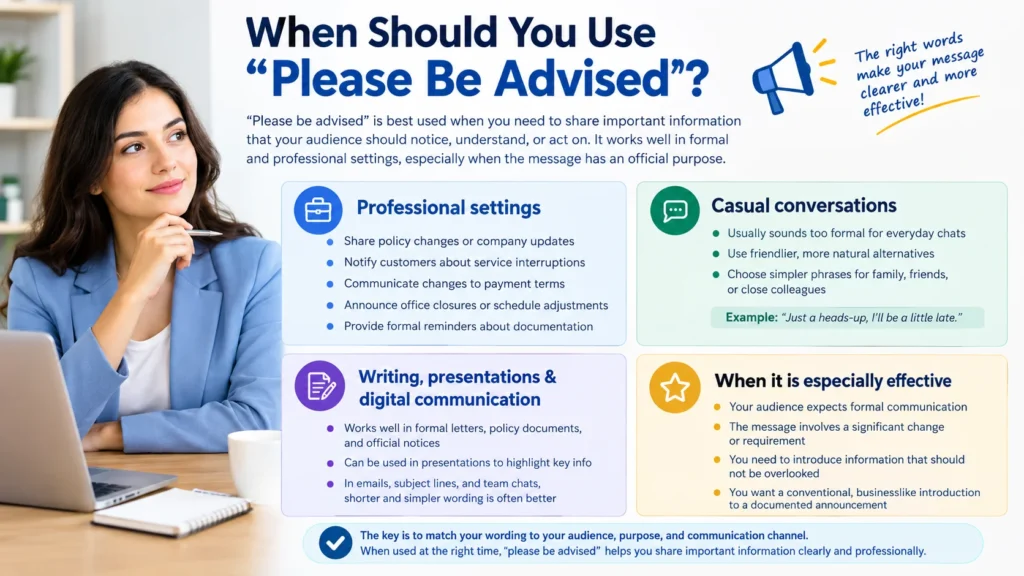
“Please be advised” is most effective when you need to communicate information that readers should notice, understand, or act on. It is particularly useful when the message has an official purpose or needs a clear written record.
Professional settings
Use the phrase when communicating formal updates, policy changes, procedural requirements, or important business information.
Examples include:
- Informing employees about revised workplace policies.
- Notifying customers about service interruptions.
- Communicating changes to payment terms.
- Announcing office closures or schedule adjustments.
- Providing formal reminders about documentation requirements.
For example: “Please be advised that all expense reports must be submitted by November 5.”
This wording makes the deadline noticeable. However, “Please note that all expense reports are due by November 5” communicates the same information with a more neutral tone.
Casual conversations
In everyday conversation, “please be advised” usually sounds unnecessarily formal. Friends, family members, and close colleagues generally prefer more natural expressions.
Instead of saying, “Please be advised that I will arrive late,” try:
- “Just a heads-up, I might be a little late.”
- “I wanted to let you know that I’m running behind.”
- “I’ll be there about 15 minutes late.”
These alternatives sound more conversational while communicating the same essential information.
Writing, presentations, and digital communication
The phrase can work in formal letters, policy documents, customer notifications, and presentations where an announcement needs to stand out. In email subject lines, short introductions, and team chats, simpler wording is often more effective.
For example:
- Formal notice: “Please be advised that the application deadline has changed.”
- Workplace email: “Please note that the application deadline has changed.”
- Team chat: “Quick update: the application deadline has changed.”
- Presentation: “Important update: the application deadline is now Friday.”
When it is especially effective
Choose “please be advised” when:
- The audience expects formal communication.
- The message concerns a significant change or requirement.
- You need to introduce information that readers should not overlook.
- The wording fits the established style of an official notice.
- You want a conventional, businesslike introduction to a documented announcement.
The phrase works best when the information that follows is specific and useful. Formal wording cannot compensate for an unclear message.
When Should You Avoid “Please Be Advised”?
Although the expression is grammatically correct, there are situations where another phrase communicates your intention more effectively.
Overly formal situations
Avoid it in friendly conversations, informal team messages, or routine updates that do not require an official tone.
Instead of “Please be advised that I have uploaded the file,” write “I’ve uploaded the file for you.” The second version is shorter, more direct, and less distant.
Legal, academic, or sensitive contexts
In legal or regulatory communication, wording should reflect the actual requirements and consequences. “Please be advised” does not, by itself, establish that a notification satisfies a legal obligation. Follow the applicable rules and use precise language.
In academic writing, the phrase may also feel unnecessarily bureaucratic. A direct statement usually works better than announcing that the reader is about to receive information.
For sensitive conversations, such as communicating a delay, rejection, or disappointing decision, a more considerate opening can reduce unnecessary tension.
For example, “I wanted to let you know that we need another day to complete your order” generally sounds more considerate than “Please be advised that your order has been delayed.”
Situations where nuance may be lost
The phrase can introduce information without explaining whether the reader needs to take action. If a message involves a deadline, responsibility, or required response, state the next step explicitly.
Instead of:
“Please be advised that your documents are incomplete.”
Try:
“Two documents are still missing from your application: proof of address and your signed form. Please upload both by Friday.”
The revised message explains the problem and tells the reader what to do.
Is “Please Be Advised” Professional, Polite, or Casual?
“Please be advised” is generally formal and professional, but its perceived politeness depends on context. It is not inherently rude, yet it can sound distant or authoritative when used in routine communication.
| Feature | Typical interpretation |
| Formality | High |
| Professionalism | Appropriate in official and business communication |
| Politeness | Conventionally polite, but not necessarily warm |
| Directness | Moderate to high |
| Emotional warmth | Usually low to moderate |
| Authority | Can sound official or directive |
| Casualness | Low |
How readers may interpret it
A customer receiving “Please be advised that your subscription will renew tomorrow” may interpret it as a routine formal notification.
An employee receiving “Please be advised that this mistake must not happen again” may perceive criticism or a warning, even if the writer intends only to be direct.
A colleague receiving the same opening before a minor update might wonder why the message sounds so official.
The surrounding words determine much of the emotional impact. A neutral announcement, a stern warning, and a supportive update can all begin with the same phrase but create different impressions.
Pros and Cons of Using “Please Be Advised”
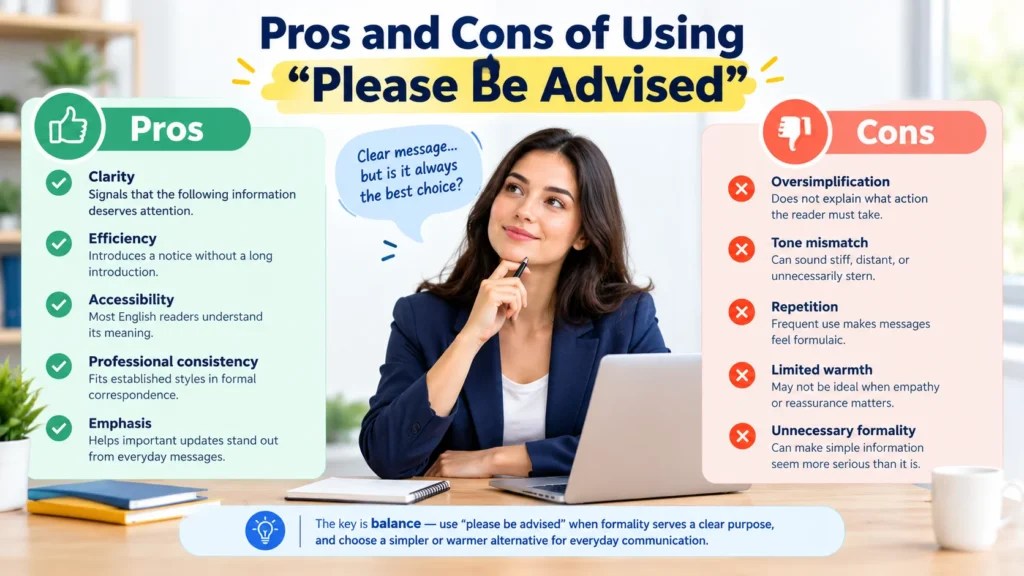
The expression has practical advantages, but it is not suitable for every audience or communication channel.
Advantages
- Clarity: It signals that the following information deserves attention.
- Efficiency: It introduces a notice without requiring a lengthy opening.
- Accessibility: Most fluent English readers understand its intended meaning.
- Professional consistency: It fits established styles used in some formal correspondence.
- Emphasis: It can help distinguish important updates from ordinary conversation.
Potential drawbacks
- Oversimplification: It does not explain what action the reader must take.
- Tone mismatch: It can sound stiff, distant, or unnecessarily stern.
- Repetition: Frequent use makes messages feel formulaic.
- Limited warmth: It may not be ideal when empathy or reassurance matters.
- Unnecessary formality: It can make simple information seem more serious than it is.
How to balance the advantages and disadvantages
Use the phrase when formality serves a clear purpose. For everyday messages, prefer a direct statement or a softer alternative.
Compare these examples:
- Formal: “Please be advised that the building will be closed on Monday.”
- Neutral: “Please note that the building will be closed on Monday.”
- Conversational: “Just a heads-up: the building will be closed on Monday.”
All three communicate the same fact. The best choice depends on the audience, the communication channel, and the level of formality required.
Real-Life Examples of “Please Be Advised” by Context
The following examples demonstrate how the expression works in common communication settings and how small wording changes can improve the tone.
Formal example:
“Please be advised that the revised contract is available in the shared folder. Kindly review the updated payment terms before Thursday’s meeting.”
More natural alternative:
“The revised contract is now in the shared folder. Please review the updated payment terms before Thursday’s meeting.”
The second version removes unnecessary introductory wording while preserving the request.
Meetings
A project manager might say:
“Please be advised that the client has moved the presentation to Wednesday morning.”
This is understandable but formal for spoken conversation. A more natural version would be:
“Just a quick update: the client has moved the presentation to Wednesday morning.”
The revised version communicates the change without making the announcement sound like an official warning.
Presentations
A presenter explaining new procedures might say:
“Please be advised that the reporting process will change starting next month.”
For a live presentation, a clearer alternative is:
“Starting next month, we’ll use a new reporting process. I’ll explain the changes and show you where to submit your reports.”
This approach gives the audience useful context rather than merely announcing a change.
Customer service
“Please be advised that your refund may take five to seven business days to appear in your account.”
This is suitable for a formal customer notification. A warmer version is:
“Your refund should appear in your account within five to seven business days. Please contact us if it hasn’t arrived by then.”
The alternative provides both the expected timeframe and a practical next step.
Social media
An organization might publish:
“Please be advised that our office will be closed this Friday.”
For a social media audience, the following is often more approachable:
“Quick update: our office will be closed this Friday. We’ll be back on Monday!”
The second version is friendly, concise, and suited to a public-facing announcement.
Workplace messaging
In Slack or Microsoft Teams, a colleague might write:
“Please be advised that the shared spreadsheet has been updated.”
A more natural version is:
“Quick update: I’ve added the latest figures to the shared spreadsheet.”
The second message explains what changed and sounds less bureaucratic.
Conclusion
“Please be advised” is a useful expression for communicating important information in formal emails, business correspondence, official announcements, and professional notices. It tells readers to pay attention to the information that follows, but its tone can sometimes feel distant, overly formal, or unnecessarily authoritative.
Choosing the right alternative depends on your audience, purpose, and communication style. “Please note” is a strong choice for neutral professional messages, while “I wanted to let you know” sounds more personal and considerate. For quick workplace updates, “Just a heads-up” offers a friendly, conversational alternative. When communicating deadlines, requirements, or policy changes, direct wording helps readers understand exactly what they need to know or do.
There is no single phrase that works best in every situation. Effective communication means balancing clarity, professionalism, and approachability. By understanding the meaning and tone of these 20 alternatives, you can make your emails, messages, presentations, and announcements more natural and effective. Ultimately, the best alternative to “please be advised” is the one that communicates your message clearly while matching the needs of your audience.
FAQs
1. What does “please be advised” mean?
“Please be advised” means “please be informed” or “please take notice of the following information.” It is commonly used in business emails, official notices, customer service messages, and workplace announcements. The phrase signals that the information deserves attention, particularly when communicating deadlines, policy changes, requirements, or important updates.
2. Is “please be advised” professional?
Yes, “please be advised” is generally considered professional because it communicates information in a formal, businesslike manner. It is suitable for official announcements, policy updates, and formal correspondence. However, it may sound unnecessarily stiff in everyday workplace communication. For routine messages, “please note” or a direct statement often feels more natural.
3. Is “please be advised” rude or impolite?
No, “please be advised” is not inherently rude or impolite. However, it can sound stern, distant, or authoritative depending on the context. For example, using it before a warning may make the message feel more serious. If you want a warmer tone, consider “I wanted to let you know” or “Just a quick update.”
4. What is the best alternative to “please be advised”?
“Please note” is one of the best general alternatives to “please be advised.” It communicates important information clearly while sounding professional and neutral. Other options include “please be aware,” “for your information,” and “I wanted to let you know.” Choose an alternative based on the formality of your message and your relationship with the reader.
5. Can I use “please be advised” in an email?
Yes, you can use “please be advised” in formal emails, especially when announcing policy changes, deadlines, service interruptions, or procedural requirements. For example, “Please be advised that the office will be closed on Friday.” In everyday emails to colleagues, “Please note” or “Just a quick update” may sound more approachable and conversational.
6. What is a polite way to say “please be advised”?
Polite alternatives include “I wanted to let you know,” “Please note,” “Just to keep you informed,” and “We would like to inform you.” These expressions can communicate important information without sounding unnecessarily formal. For sensitive situations, briefly explaining the circumstances and providing a helpful next step can make your message more considerate.
7. Is “please be advised” formal or informal?
“Please be advised” is a formal expression, commonly associated with business correspondence, official notices, and administrative communication. It is less common in casual conversations, personal messages, and informal workplace chats. For informal situations, expressions such as “Just a heads-up,” “Just letting you know,” and “Quick update” usually sound more natural.
8. What is the difference between “please be advised” and “please note”?
Both expressions introduce information that deserves attention, but their tone can differ. “Please be advised” generally sounds more formal and authoritative, whereas “please note” is usually more neutral and concise. Both can work in professional communication, but “please note” is often the better choice for routine emails and workplace updates.
9. Is “please be advised” commonly used in the US and UK?
“Please be advised” is understood in both American and British English. It appears in formal correspondence, administrative notices, and professional communication in both countries. Perceptions depend more on context and organizational style than on a strict regional distinction. In either variety, simpler alternatives such as “please note” and “just to let you know” can sound more natural.
10. How can I use “please be advised” without sounding too formal?
Use “please be advised” when the situation genuinely calls for formal communication, and avoid repeating it in every email or announcement. For everyday updates, consider a direct opening such as “The meeting has moved to Thursday” or “Just a heads-up: the deadline is Friday.” Clear wording and an appropriate tone make your message more effective.