
Imagine going through a difficult week when nothing seems to work out. You have deadlines to meet, personal responsibilities to manage, and unexpected problems that leave you feeling exhausted. A friend sends you a simple message: “This too shall pass.” Although those words cannot solve every problem, they may remind you that your current situation does not have to define your future.
“This too shall pass” is a popular expression that reminds people that difficult experiences, emotions, and circumstances can change with time. It encourages patience, hope, and perspective during uncertain periods. The phrase can also apply to happy experiences, reminding us that enjoyable moments are temporary and worth appreciating.
In modern communication, this expression appears in personal conversations, professional discussions, motivational writing, social media captions, and supportive messages. However, it is not always the best choice for every situation. Sometimes, a person needs practical advice rather than reassurance, while others may appreciate a gentler expression such as “Take it one day at a time” or “You will get through this.”
What Does “This Too Shall Pass” Mean?
“This too shall pass” means that a current situation, emotion, or experience will eventually change rather than remain exactly as it is forever. The expression is commonly used to offer comfort during stressful periods, disappointment, uncertainty, or personal hardship. It encourages people to remain patient and recognize that present circumstances do not necessarily determine their future.
Origin & History of “This Too Shall Pass”

The expression “this too shall pass” is associated with traditional wisdom about the temporary nature of human experiences. Its central idea is that happiness, sadness, success, disappointment, and other circumstances change over time. Although the saying is often connected with ancient stories, its precise historical origin is uncertain.
Historical Background
One popular story describes a ruler who asks a wise person for a statement that will make him feel humble during prosperous times and hopeful during difficult ones. The answer is remembered as a message that reminds him that his current circumstances will not last forever.
Different versions of this story appear in popular retellings, sometimes involving Persian traditions or King Solomon. However, these accounts should not be treated as definitive proof that one particular person invented the exact English expression.
The broader principle appears in many philosophical and cultural traditions. People have long reflected on the changing nature of life, the importance of patience, and the need to maintain perspective when circumstances become difficult.
How the Phrase Developed in English
The expression became familiar through literature, proverb collections, speeches, and popular discussions of wisdom and resilience. Its simple structure makes it easy to remember and apply to different situations.
The word “shall” gives the phrase a traditional and slightly formal sound. In contemporary English, people may choose simpler alternatives such as “Things will get better” or “This is only temporary.” Nevertheless, the original expression remains recognizable because it communicates a broad message in just a few words.
Why the Expression Remains Relevant
Today, “this too shall pass” is commonly used in personal reflections, motivational articles, wellness discussions, and online conversations. It can help someone gain perspective when a problem feels overwhelming.
Its meaning is not limited to negative experiences. People may also use it during happy periods to remember that circumstances change and that important moments deserve appreciation.
The phrase is especially useful when someone needs a reminder to be patient. However, it should not be interpreted as a promise that every problem will end positively. Its central message is that circumstances can change, not that every outcome is guaranteed to improve.
Synonyms & Alternatives by Tone
Choosing the right alternative depends on your audience, intention, and communication setting. Some expressions focus on hope, while others encourage patience, emotional support, or practical action.
Professional & Neutral Alternatives
- This situation is temporary.
- Things will improve with time.
- The current circumstances will change.
- This is a passing difficulty.
- The situation will not last forever.
Polite & Supportive Alternatives
- Take things one day at a time.
- You do not have to face everything at once.
- Give yourself time to work through this.
- I hope things become easier soon.
- You are allowed to take a break.
Encouraging & Reassuring Alternatives
- Things will get better.
- Better days are ahead.
- You will get through this.
- Keep going; this moment will not define you.
- Every difficult season eventually changes.
Casual, Playful & Idiomatic Alternatives
- Hang in there.
- It won’t last forever.
- This is just a rough patch.
- Tomorrow is another day.
- This will be a distant memory someday.
When Should You Use “This Too Shall Pass”?
“This too shall pass” is useful when you want to offer reassurance, encourage patience, or remind someone that a difficult experience may change with time. The expression works best when the listener needs perspective rather than a detailed explanation or immediate solution.
In Professional Settings
In the workplace, the phrase may help reassure a colleague who is dealing with a demanding project, a difficult deadline, or a disappointing result. It can communicate that one challenging period does not define an entire career or team’s performance.
For example, imagine that your colleague has spent several weeks correcting problems with a product launch. They feel discouraged because the team has encountered repeated setbacks.
You might say, “I know this launch has been more difficult than expected. This too shall pass, and we can focus on resolving the remaining issues together.”
This response offers encouragement while emphasizing cooperation. However, in a formal report or client email, a more specific statement may be preferable.
For example: “The current disruption is temporary, and our team is working to resolve the remaining issues.”
The second version is more appropriate when readers need clear information rather than emotional reassurance.
In Casual Conversations
The expression works naturally when talking to friends, relatives, or people you know well. It can help someone feel less overwhelmed without requiring them to explain every detail of their situation.
For example, a friend might tell you that they did not get a job they really wanted. Instead of immediately giving advice, you could acknowledge their disappointment and say, “I know how much that opportunity meant to you. This too shall pass, and there will be other opportunities when you’re ready.”
The important point is to avoid making the phrase sound like a command to stop feeling upset. Acknowledge the person’s emotions before offering reassurance.
In Writing and Presentations
Writers often use the expression in reflective essays, personal development articles, motivational speeches, and discussions about resilience.
It can introduce an idea about patience or help conclude a passage about handling setbacks. For example, a presentation about career development might explain that professional growth includes unsuccessful applications, changing priorities, and unexpected challenges.
The phrase can reinforce the idea that a disappointing experience does not necessarily determine future opportunities.
However, if your presentation discusses measurable business problems, include relevant information and practical recommendations rather than relying on a proverb alone.
In Text Messages and Digital Communication
Short expressions can be useful in WhatsApp messages, private chats, and social media conversations because they communicate support quickly.
For example:
“I know this week has been exhausting. You don’t have to figure everything out tonight. This too shall pass, and I’m here if you need to talk.”
This message is more thoughtful than using the expression by itself because it recognizes the person’s difficulty and offers continued support.
When the Phrase Is Especially Effective
Use the expression when someone is dealing with a temporary setback, adjusting to change, or struggling with uncertainty. It can also be useful when you want to remind yourself that one disappointing day does not determine your entire future.
The phrase is most effective when reassurance is combined with empathy, realistic expectations, and a willingness to listen.
Is “This Too Shall Pass” Professional, Polite, or Casual?
“This too shall pass” is generally polite, reflective, and moderately informal. It can fit supportive workplace conversations and personal messages, but its suitability depends on the relationship between the speaker and listener.
Tone and Formality
The expression sounds thoughtful because it is a familiar proverb. It can communicate patience and perspective without requiring a long explanation.
In casual conversation, it often feels natural. In a formal workplace setting, it may sound vague unless it is paired with a specific explanation or recommendation.
Emotional Subtext
The phrase often communicates the idea that the listener’s current feelings do not have to last forever. However, it can also sound like an instruction to stop worrying if the speaker does not acknowledge the difficulty first.
For example, telling an exhausted colleague “This too shall pass” may feel encouraging when accompanied by an offer to share the workload. Saying the same thing while ignoring their concerns may feel dismissive.
Audience Perception
Different people respond to reassurance differently. Some appreciate familiar sayings because they make difficult experiences feel more manageable. Others prefer direct language and specific solutions.
If you are uncertain about the listener’s preferences, acknowledge their situation first and choose wording that suits the conversation.
| Context | Suitability | Reason |
| Conversation with a friend | High | Familiar and reassuring |
| Personal text message | High | Brief and supportive |
| Informal team discussion | Moderate to high | Can encourage perspective |
| Formal client email | Moderate to low | May lack precision |
| Academic writing | Low | Requires factual, specific language |
| Urgent problem-solving | Low on its own | Practical action is more important |
Pros and Cons of Using “This Too Shall Pass”
The expression offers several communication benefits, but it also has limitations. Understanding both sides helps you decide whether it is appropriate for a particular situation.
Advantages
- Clarity: Communicates the idea that circumstances can change.
- Efficiency: Expresses reassurance in a few memorable words.
- Accessibility: Has a familiar meaning for many English speakers.
- Emotional reassurance: Can help someone gain perspective during a stressful period.
- Memorability: Its traditional structure makes it easy to remember.
- Versatility: Can be used in conversations, writing, and motivational content.
Potential Drawbacks
- Oversimplification: Serious problems may require more than a general reminder.
- Tone mismatch: The phrase can sound insensitive if used without empathy.
- Repetition: Overuse can make it feel automatic or impersonal.
- Uncertain outcomes: The expression does not guarantee that a situation will improve.
- Limited practical guidance: It does not explain what someone should do next.
- Cultural differences: People may interpret familiar sayings differently.
The best approach is to use the phrase when it genuinely fits the conversation. If the person needs action, provide a practical next step. If they need emotional support, listen before offering advice.
Real-Life Examples of “This Too Shall Pass” by Context
Here are realistic examples of how the expression can be used in different situations.
Email Example
Subject: Checking In
Hi Maya,
I know the past few days have been frustrating, especially with the project changes and the unexpected deadline. Try not to judge your progress by one difficult week. This too shall pass, and we can review the remaining tasks together tomorrow.
Take care,
Jordan
This email works because the reassurance is supported by an offer of practical help.
Meeting Example
A project manager might say:
“We’ve had a difficult launch, and I know everyone has been working hard to fix the problems. This too shall pass, but let’s also identify what went wrong and make the next release more manageable.”
The phrase encourages the team while maintaining attention on responsibility and improvement.
Conversation Example
A friend says, “I studied for weeks, and I still didn’t get the result I wanted.”
You respond, “I’m sorry. I know how much effort you put into it. This too shall pass, and when you’re ready, we can figure out what to try next.”
This response recognizes the disappointment and allows the friend to decide when they want to discuss solutions.
Social Media Example
“Some weeks are heavier than others. Take a breath, give yourself some grace, and remember that this too shall pass. You don’t need to have everything figured out today.”
This caption offers encouragement without suggesting that everyone should recover from difficult experiences at the same speed.
Workplace Chat Example
“Today was a lot, wasn’t it? Get some rest tonight. This too shall pass, and we’ll tackle the remaining issues tomorrow.”
This short message feels supportive because it recognizes the stressful day and points toward a manageable next step.
“This Too Shall Pass” vs. Similar Expressions
Several expressions communicate hope or patience, but they differ in meaning, tone, and practical use.
| Phrase | Meaning Difference | Tone Difference | Best Use Scenario |
| Things will get better | Predicts improvement rather than simply change | Hopeful and direct | Encouraging someone after disappointment |
| This is only temporary | Emphasizes that a condition will not last indefinitely | Neutral and practical | Workplace updates |
| Take it one day at a time | Focuses on manageable present actions | Gentle and supportive | Stressful transitions |
| Hang in there | Encourages persistence | Casual and friendly | Everyday challenges |
| Better days are ahead | Emphasizes future possibilities | Inspirational | Motivational messages |
| Every cloud has a silver lining | Suggests a positive aspect may emerge from difficulty | Optimistic and idiomatic | Reflecting on setbacks |
The best alternative depends on whether you want to emphasize change, improvement, patience, or action. Choose language that accurately reflects what you can offer instead of making promises about an uncertain future.
Common Mistakes & Misuse of “This Too Shall Pass”
Overusing the Phrase
Repeating the same expression every time someone encounters a problem can make it feel impersonal.
Better approach: Acknowledge the specific difficulty. For example, “That sounds exhausting. What part has been hardest for you?”
Using It in the Wrong Context
A person facing an urgent problem may need immediate assistance rather than a general reminder about time.
Better approach: Determine whether the person needs emotional support, practical help, or accurate information.
Making Contradictory Statements
Saying “This too shall pass, but nothing will ever improve” creates confusion because the two statements communicate conflicting ideas.
Better approach: Keep your message consistent and acknowledge uncertainty when necessary.
Treating It as a Guaranteed Promise
The expression suggests that circumstances change, not that every outcome becomes positive.
Better approach: Use “Things may feel different with time” if you want to offer a realistic perspective without promising improvement.
Ignoring Cultural and Personal Differences
Not everyone finds proverbs comforting. Some people prefer straightforward language, while others appreciate reflective expressions.
Better approach: Pay attention to the listener’s preferences and respond to their actual needs.
US vs UK Usage of “This Too Shall Pass”
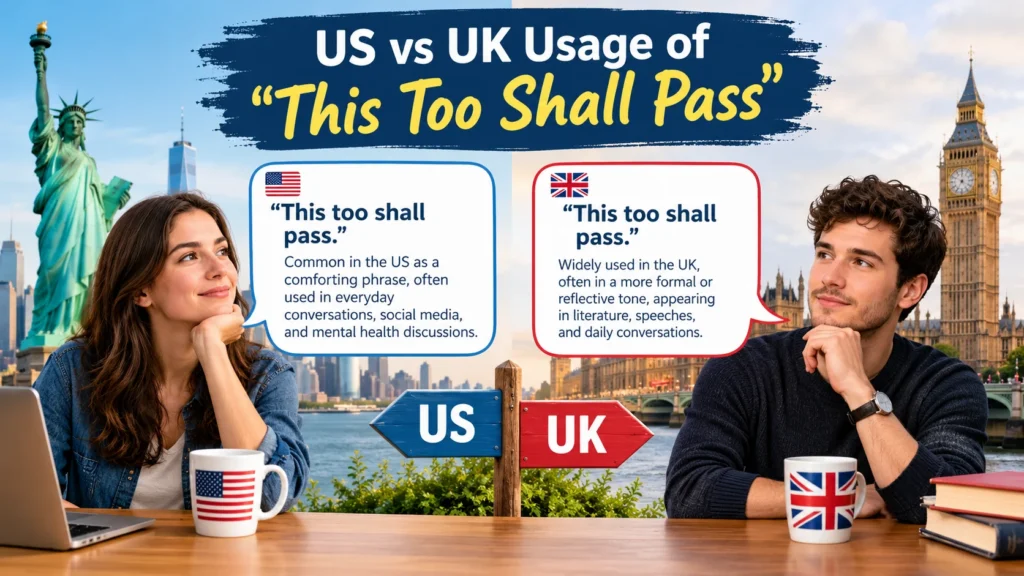
“This too shall pass” is understood in both American and British English. It is a traditional expression rather than a phrase belonging exclusively to one country.
Popularity
In the United States, the phrase appears in motivational writing, personal development content, social media captions, and everyday conversations.
In the United Kingdom, it is similarly recognizable in reflective writing and discussions about patience or changing circumstances.
There is no strong reason to treat the expression as exclusively American or British. Its popularity varies by individual, age group, and context.
Tone Perception
The expression may sound motivational in one conversation and reflective in another. Some speakers prefer direct alternatives such as “Things will get better,” while others appreciate the traditional quality of the original phrase.
These differences depend more on the individual and situation than on nationality.
Regional Preferences
For an international audience, simple alternatives such as “This situation is temporary” may be easier to interpret in formal communication.
In personal conversations, “Hang in there” and “Take it one day at a time” are also widely understood in both countries.
“
Linguistic & Communication Insight
Emotional Weight and Subtext
The literal meaning of “this too shall pass” is that the present situation will change. Its emotional subtext often suggests that the listener does not have to assume that their current feelings will last forever.
This can be reassuring because it encourages a broader perspective. However, the same phrase may sound dismissive if it is offered before acknowledging someone’s pain.
The difference often comes down to timing: recognize the person’s experience before offering reassurance.
Direct vs. Indirect Phrasing
“This too shall pass” offers a general perspective without naming a specific solution.
Compare these alternatives:
- “This too shall pass.” Emphasizes change over time.
- “This situation is temporary.” Communicates the idea neutrally.
- “Things will get better.” Expresses a more direct expectation of improvement.
- “Let’s work through this together.” Emphasizes cooperation.
- “Take it one day at a time.” Encourages manageable steps.
None is universally better. Choose according to whether the listener needs emotional reassurance, practical action, or a realistic explanation.
Professional Communication Perspective
In the workplace, the expression can acknowledge a difficult period without making the conversation unnecessarily dramatic. However, teams dealing with missed deadlines, service interruptions, or customer complaints need specific information as well.
For example, “This too shall pass” may help a team maintain perspective, but “The issue is affecting today’s release, and we are testing a fix” communicates actionable information.
Effective professional communication combines an appropriate tone with honest, specific details.
Why Experienced Communicators Choose Alternatives
Communicators often choose different expressions to control how their message is interpreted.
- To reduce defensiveness: “Let’s take this one step at a time.”
- To show empathy: “I know this is difficult.”
- To preserve accuracy: “The situation may improve with time.”
- To encourage action: “Let’s focus on what we can change today.”
- To maintain professionalism: “The current circumstances are temporary.”
These alternatives help speakers align their intentions with what the listener needs to understand.
Social Signaling
Word choice can signal warmth, patience, confidence, or authority. A familiar proverb may make someone sound reflective, while a specific explanation may make them sound prepared and accountable.
Neither style automatically builds trust. Trust is more likely when the words match the situation and the speaker’s actions.
Tone and Context Guidance
Before using the phrase, consider whether the person needs reassurance, practical assistance, or both. Think about whether the expression might minimize their experience and whether a more specific statement would communicate your intention more clearly.
If the situation is painful, begin with acknowledgment. If it requires action, provide a next step. If the person needs a reminder to remain patient, “this too shall pass” may be appropriate.
Conclusion: Choosing the Right Alternative to “This Too Shall Pass”
“This too shall pass” remains a meaningful expression because it reminds people that difficult experiences and changing circumstances do not necessarily define their future. It can offer perspective during stressful periods and encourage patience when the next step is unclear.
However, the best alternative depends on the situation. “Things will get better” emphasizes hope, “Take it one day at a time” encourages patience, and “This situation is temporary” provides a more neutral, professional tone. Meanwhile, “Let’s take it step by step” combines reassurance with practical action.
When communicating with friends, colleagues, or a wider audience, consider the listener’s feelings and the seriousness of the situation. A familiar proverb can be comforting, but it should not replace empathy, factual information, or meaningful assistance.
Ultimately, effective communication is about choosing words that match the moment and express your intentions honestly. Sometimes a few reassuring words are enough; at other times, the most helpful response is to listen, acknowledge the difficulty, and offer support.
FAQs About “This Too Shall Pass”
What does “this too shall pass” mean in simple words?
“This too shall pass” means that the situation you are experiencing now will eventually change. People often use it to remind themselves or others that difficult feelings, stressful periods, and disappointing experiences are not necessarily permanent. It encourages patience and perspective without guaranteeing a particular outcome.
What is another way to say “this too shall pass”?
Common alternatives include “Things will get better,” “This is only temporary,” “Take it one day at a time,” “Hang in there,” and “You will get through this.” Choose an expression based on whether you want to emphasize hope, patience, practical action, or emotional reassurance.
Is “this too shall pass” a positive phrase?
Yes, it is generally a reassuring and reflective expression. It encourages people to view their current circumstances as changeable rather than permanent. However, it should be used sensitively, especially when someone is experiencing serious pain or uncertainty.
Is “this too shall pass” professional?
It can be appropriate in supportive workplace conversations, especially between colleagues who communicate informally. However, it is usually less suitable for formal reports, client updates, and official documents. Alternatives such as “The current situation is temporary” may communicate the message more precisely.
Is “this too shall pass” a proverb?
Yes, it is commonly treated as a proverb or traditional saying. It expresses the idea that circumstances change and that neither hardship nor happiness remains constant forever. Although it is associated with several historical traditions and popular stories, its precise origin is uncertain.
How do you use “this too shall pass” in a sentence?
You can use the expression when reassuring someone during a difficult period. For example: “I know the job search has been exhausting, but this too shall pass, and you will have other opportunities to explore.” It can also appear in reflective writing and motivational speeches.
What is the difference between “this too shall pass” and “things will get better”?
“This too shall pass” emphasizes that a current situation will change, without necessarily predicting whether the result will be positive. “Things will get better” expresses a more direct expectation of improvement. The first is reflective, while the second is straightforward and hopeful.
Can “this too shall pass” sound insensitive?
Yes, especially when used before acknowledging someone’s feelings or when the person needs practical assistance. A listener may interpret it as minimizing their experience. A more empathetic response is to recognize the difficulty first and offer genuine support.
Is “this too shall pass” used in American and British English?
Yes, the expression is understood in both American and British English. Its meaning remains essentially the same across the two varieties. Speakers in either country may choose alternatives such as “Hang in there,” “Things will get better,” or “Take it one day at a time.”
What is the best alternative to “this too shall pass” for a text message?
“Take it one day at a time” is a good choice when someone feels overwhelmed, while “You will get through this” offers direct encouragement. For a more personal message, acknowledge what the person is experiencing and offer specific support.