
Imagine you are in a team meeting, and everyone agrees that a project is going well. However, you know the deadline is unrealistic, the budget is tight, and the team needs to make a difficult decision. Instead of pretending everything is fine, you might say, “Let me level with you. We need another week to finish this properly.”
The phrase “let me level with you” is a conversational way to introduce an honest, direct, and sometimes uncomfortable statement. It signals that the speaker wants to speak openly rather than soften the truth or avoid an important issue.
In modern communication, honesty matters in workplace discussions, personal relationships, emails, and online conversations. However, the words you choose can influence how your message is received. While this expression can build trust, it may also sound serious or confrontational in the wrong context.
What Does “Let Me Level With You” Mean?
“Let me level with you” means let me speak honestly and directly with you about something, especially when the truth may be difficult, unexpected, or uncomfortable. The phrase introduces an open conversation in which the speaker wants to clarify facts, express a genuine opinion, or address a concern without unnecessary politeness or misleading reassurance. It is commonly used in personal conversations, workplace discussions, negotiations, and situations requiring trust.
Origin & History of “Let Me Level With You”
The expression comes from the broader English use of level to describe equality, fairness, or an even position. The verb level has historically referred to making something flat or aligning things. Over time, the word also developed figurative meanings associated with treating people equally and communicating without deception.
The expression “level with someone” came to mean speaking frankly or dealing honestly with another person. The wording suggests that the speaker is removing an imbalance in information or expectations so both people can understand the situation more clearly.
Although it is difficult to identify one definitive moment when the exact phrase originated, its modern conversational use developed within informal English, particularly in contexts where straightforwardness and personal credibility matter.
Today, “let me level with you” is familiar in American English and appears in workplace conversations, interviews, television dialogue, podcasts, online videos, and everyday discussions. It can introduce anything from constructive feedback to a difficult personal admission.
Its central meaning has remained consistent: the speaker is asking for space to communicate frankly, often before revealing something important.
Synonyms & Alternatives by Tone
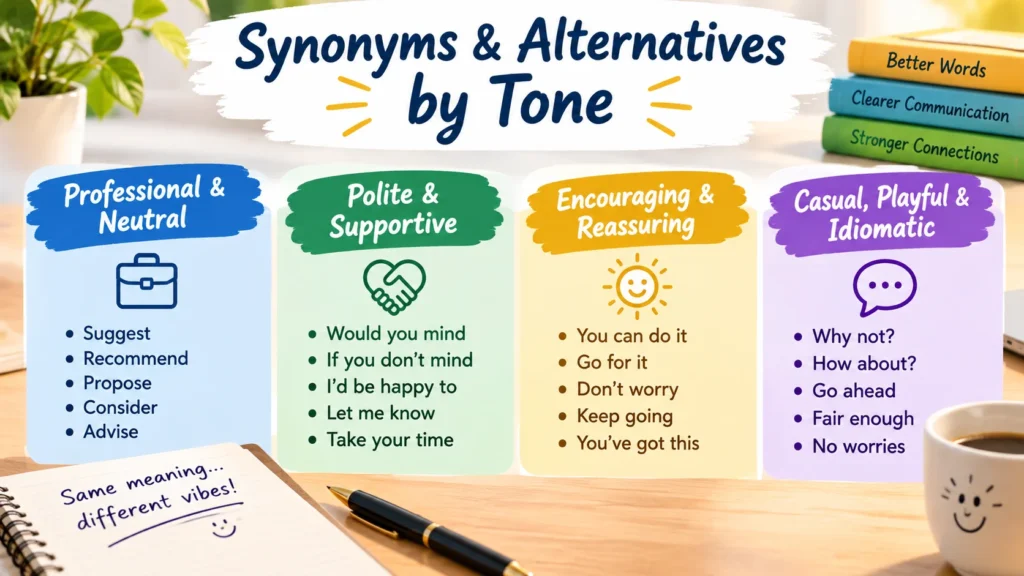
There are many ways to communicate the honesty behind “let me level with you.” The best alternative depends on whether you want to sound professional, supportive, encouraging, or casual.
Professional & Neutral Alternatives
- Let me be straightforward with you.
- I want to be transparent with you.
- To be clear with you.
- Let me explain the situation honestly.
- I want to be candid with you.
- Here’s the reality of the situation.
- Let me give you an honest assessment.
- I want to clarify something.
- To give you the full picture.
- Let me speak frankly.
Polite & Supportive Alternatives
- I want to be honest with you.
- Can I share my honest perspective?
- I want to be open with you.
- Let me explain where I’m coming from.
- I want to be upfront about something.
- I think it’s important to tell you this.
- I hope you don’t mind me being honest.
- I’d like to share something with you openly.
Encouraging & Reassuring Alternatives
- Let’s look at this realistically.
- I believe we can work through this honestly.
- Let me put things into perspective.
- I want us to understand each other clearly.
- Here’s what I think we can do.
- Let’s focus on what we know.
- I want to give you an honest but constructive view.
- We can talk openly about this.
Casual, Playful & Idiomatic Alternatives
- Let’s be real.
- Real talk.
- Honestly, though.
- Between you and me.
- Here’s the deal.
- I’ll shoot straight with you.
- No sugarcoating it.
- Let’s call it like it is.
- To be totally honest.
- Here’s the truth.
Is “Let Me Level With You” Professional, Polite, or Casual?
“Let me level with you” is primarily informal to conversational in tone, although it can be appropriate in professional environments. Its suitability depends on the relationship between the speakers, the seriousness of the subject, and the culture of the organization.
| Factor | Explanation |
| Formality | Informal to moderately professional |
| Politeness | Generally acceptable when delivered respectfully |
| Directness | High; it prepares the listener for frank information |
| Emotional subtext | May suggest seriousness, concern, or an important admission |
| Workplace suitability | Appropriate for familiar teams and candid discussions |
| Audience perception | Can sound trustworthy, reassuring, blunt, or confrontational depending on context |
How Different Audiences May Interpret It
- Colleagues: They may interpret it as an invitation to discuss a problem openly.
- Managers: They may appreciate its directness when discussing risks or expectations, although more formal wording can be preferable.
- Clients: They may value transparency but could interpret the phrase as a warning that something has gone wrong.
- Friends: They may hear it as a sign that you are about to share a genuine opinion.
- Online audiences: They may expect a strong opinion, a confession, or an unfiltered explanation.
The phrase is not inherently rude. Its impact depends on what follows and how it is delivered. A calm explanation can make it constructive; a sarcastic delivery can make the same words sound dismissive.
Pros and Cons of Using “Let Me Level With You”
Understanding the advantages and disadvantages helps you decide whether the phrase will improve your message or create unnecessary tension.
Advantages
- Clarity: It signals that the speaker intends to address the issue directly.
- Efficiency: It prepares the listener for the main point without a lengthy introduction.
- Accessibility: It uses familiar, everyday English that most fluent speakers understand.
- Trust: It can communicate a willingness to acknowledge difficult facts.
- Expectation management: It helps introduce realistic timelines, limitations, or concerns.
- Conversation control: It provides a natural transition from small talk or general discussion to a serious topic.
Potential Drawbacks
- Oversimplification: A complicated issue may require explanation and context rather than a blunt statement.
- Tone mismatch: The phrase can sound overly casual in formal correspondence or intimidating in a sensitive conversation.
- Repetition: Frequent use can make the speaker sound predictable or unnecessarily dramatic.
- Negative expectations: Listeners may assume bad news is coming, even when the message is neutral.
- Perceived superiority: If delivered aggressively, it can imply that the speaker knows the truth while everyone else is mistaken.
Best practice: Use the expression selectively and support it with accurate information, respectful language, and a clear purpose.
Which Expression Should You Choose?
Choose “let me level with you” when you want to prepare someone for an honest discussion. Use “I want to be transparent” when professional trust and openness matter most. Choose “to be honest with you” for a more neutral personal tone, and “let’s be real” when the conversation is informal and conversational.
Linguistic & Communication Insight
Understanding “let me level with you” requires more than knowing its dictionary meaning. The phrase also performs a social function: it signals how the listener should interpret the statement that follows.
Emotional Weight and Subtext
The expression carries an implied contrast between ordinary conversation and a more candid exchange. By saying “let me level with you,” the speaker suggests that the next statement may be more direct than what has been said previously.
Listeners may infer that the speaker is about to reveal bad news, challenge an assumption, or share an opinion that others have avoided expressing.
That inference is not always accurate. The phrase can introduce a reassuring truth or a practical recommendation as well. Nevertheless, it creates an expectation of seriousness, which is why it should be used deliberately.
Direct vs. Indirect Phrasing
Direct language makes the speaker’s intention clear, but it can also increase the emotional intensity of a message.
Compare these examples:
- Direct: “Let me level with you. We cannot deliver the full project by Friday.”
- Neutral: “We need to revise the project timeline because the current deadline is not realistic.”
- Collaborative: “I think we should review the timeline together so we can agree on a realistic delivery date.”
All three communicate a similar concern, but they create different interpersonal expectations.
The direct version emphasizes candor. The neutral version focuses on the problem. The collaborative version invites shared responsibility.
Effective communication is not simply about saying the truth directly; it is about making the truth understandable and useful to the listener.
Professional Communication Perspective
In professional settings, the expression can be useful when employees need to discuss project limitations, managers need to address expectations, or teams need to acknowledge a problem before it becomes more serious.
However, workplace hierarchy matters. A manager using the phrase with an employee may sound decisive, while an employee using it with a senior executive may sound assertive or unusually informal. Neither interpretation is inevitable, but both are possible.
When discussing sensitive performance issues, focus on observable behavior and specific outcomes.
For example, “Let me level with you: the last two reports arrived after the deadline, and we need to agree on a more reliable process” is more constructive than “Let me level with you: you’re unreliable.”
The first statement identifies a pattern and creates an opportunity for improvement. The second makes a broad judgment about a person’s character.
Pragmatic Reasons for Choosing Alternatives
Experienced communicators adjust their wording to manage the relationship as well as the information being communicated.
- To reduce defensiveness: “Can I share my perspective?” invites a response rather than announcing a verdict.
- To signal transparency: “I want to be transparent about the risks” emphasizes openness and accountability.
- To maintain authority: “Let me be clear about the expectations” communicates a firm boundary.
- To encourage collaboration: “Let’s look at the situation together” frames the issue as a shared problem.
- To communicate uncertainty: “Based on what we know so far” avoids presenting an incomplete assessment as absolute truth.
These alternatives are not interchangeable in every context. Each places a different emphasis on honesty, certainty, authority, or cooperation.
Social Signaling
Language choices influence how people perceive the speaker. Someone who regularly communicates difficult information accurately and respectfully may be viewed as dependable. Someone who repeatedly announces that they are being honest but offers exaggerated or unsupported opinions may lose credibility.
The expression therefore works best when the speaker’s behavior supports its implied promise of candor.
Trust is strengthened when you acknowledge inconvenient facts, distinguish opinions from evidence, listen to other perspectives, and remain willing to correct mistakes.
Tone and Context Guidance
Before using “let me level with you,” consider three questions:
- What is my intention? Are you sharing important information, offering constructive feedback, or simply emphasizing an opinion?
- How might the listener interpret the opening? Could it sound like a warning when you actually intend to reassure them?
- What should happen next? Can you follow the statement with evidence, an explanation, or a practical next step?
If the phrase helps prepare someone for an important conversation, it may be appropriate. If it creates unnecessary tension, a more neutral alternative is likely to work better.
The strongest communicators do not rely on bluntness to demonstrate honesty. They combine clarity, accuracy, empathy, and appropriate directness.
To Be Honest With You
Meaning: To introduce a sincere opinion, admission, or explanation.
Why This Phrase Works: It sounds personal and familiar, making honesty feel like part of an ordinary conversation rather than a formal declaration.
Real-World Usage Insight: The expression can introduce a positive or negative opinion, but excessive use may make listeners question why sincerity needs to be announced repeatedly.
Best Use: Everyday conversations, personal advice, informal messages, and friendly workplace discussions.
Avoid When: Writing a formal report that requires evidence rather than a personal judgment.
Tone: Conversational, sincere, and flexible.
US vs UK Usage: Widely understood in both American and British English.
Example (Email / Message / Meeting): “To be honest with you, I think we should test the new layout with a few customers before we spend money redesigning the whole site.”
Let Me Speak Frankly

Meaning: To communicate an opinion or concern openly, without avoiding an uncomfortable point.
Why This Phrase Works: It clearly signals candor and prepares the listener for a direct statement.
Real-World Usage Insight: The phrase can sound more serious or formal than “let me level with you,” particularly when discussing disagreements or difficult decisions.
Best Use: Serious discussions, negotiations, management conversations, and candid feedback.
Avoid When: The conversation requires a particularly warm or reassuring introduction.
Tone: Frank, serious, and assertive.
US vs UK Usage: Understood in both varieties; the degree of formality depends on the situation.
Example (Email / Message / Meeting): “Let me speak frankly: the current proposal does not explain how we will support customers after launch.”
I Want to Be Upfront About Something
Meaning: To share important information openly, especially when it might affect another person’s expectations.
Why This Phrase Works: It prepares the listener for information that should not be hidden or delayed.
Real-World Usage Insight: This expression is useful when you want to prevent misunderstandings before committing.
Best Use: Job interviews, personal conversations, project planning, and negotiations.
Avoid When: The information is routine and does not need a special introduction.
Tone: Honest, conversational, and considerate.
US vs UK Usage: Natural in both American and British English.
Example (Email / Message / Meeting): “I want to be upfront about something: I can help with the first draft, but I won’t have time to manage the entire campaign.”
Let’s Be Real
Meaning: To acknowledge the practical truth about a situation rather than rely on unrealistic expectations.
Why This Phrase Works: It creates an informal sense of shared understanding and encourages people to consider the situation realistically.
Real-World Usage Insight: The expression is especially common in casual discussions and opinion-driven online content, where a relaxed but confident tone feels natural.
Best Use: Conversations with friends, informal team chats, and social media posts.
Avoid When: Addressing a formal audience or discussing a highly sensitive matter that requires careful wording.
Tone: Casual, emphatic, and relatable.
US vs UK Usage: Understood in both varieties, though its frequency can vary by social group and context.
Example (Email / Message / Meeting): “Let’s be real: if we keep adding features every week, we’re never going to finish this website.”
Here’s the Reality of the Situation
Meaning: To explain the actual circumstances, including constraints or facts that may have been overlooked.
Why This Phrase Works: It directs attention toward the conditions that shape a decision instead of focusing on assumptions.
Real-World Usage Insight: This wording can help reset expectations when a discussion has become overly optimistic or disconnected from available resources.
Best Use: Business planning, budgeting, project reviews, and strategic discussions.
Avoid When: You lack enough information to describe the situation accurately, or the wording could sound dismissive.
Tone: Firm, factual, and explanatory.
US vs UK Usage: Suitable in both American and British English.
Example (Email / Message / Meeting): “Here’s the reality of the situation: we have funding for one more hire this quarter, so we need to decide which role is most important.”
Comparison Table of 10 Best Alternatives
The following table compares ten useful alternatives to “let me level with you.” It highlights their meanings, suitable situations, potential drawbacks, and regional usage to help you select the right expression for your audience.
| Phrase | Meaning | Best Use | Worst Use | Tone | US vs UK Usage |
| Let me be straightforward with you | Communicate directly and clearly | Professional feedback and decisions | Highly delicate conversations without a gentle introduction | Direct, professional | Natural in both |
| I want to be transparent with you | Explain information openly | Client updates and business communication | Casual remarks that need no special framing | Professional, reassuring | Natural in both |
| To be honest with you | Share a sincere opinion | Everyday conversations and personal advice | Formal factual reports | Conversational, sincere | Common in both |
| Let me speak frankly | Address an issue without evasion | Serious discussions and negotiations | Situations requiring extra warmth | Firm, candid | Understood in both |
| I want to be upfront about something | Disclose relevant information openly | Expectations and commitments | Routine updates | Honest, considerate | Natural in both |
| Let’s be real | Acknowledge practical reality | Informal discussions and social media | Formal business correspondence | Casual, emphatic | Understood in both |
| Here’s the reality of the situation | Explain the actual circumstances | Planning and risk assessment | Situations where facts remain uncertain | Firm, factual | Natural in both |
| I want to share my honest perspective | Offer a sincere personal view | Collaboration and constructive feedback | Communicating mandatory rules | Respectful, thoughtful | Natural in both |
| I’ll be straight with you | Promise a direct explanation | Informal workplace and personal conversations | Highly formal correspondence | Confident, conversational | Commonly understood in both |
| To give you the full picture | Provide relevant context | Reports, explanations, and decisions | Situations where no additional context is available | Neutral, informative | Natural in both |
Conclusion
“Let me level with you” is a useful English expression for introducing an honest, direct conversation. It helps speakers address difficult realities, clarify expectations, offer sincere opinions, and discuss problems without unnecessary evasion. Its conversational tone makes it suitable for personal discussions, workplace meetings, and informal digital communication.
However, the best alternative depends on your audience and purpose. “I want to be transparent with you” works well in professional settings, while “to be honest with you” sounds natural in everyday conversation. “Let me be straightforward with you” emphasizes clarity, and “let’s look at this realistically” encourages practical problem-solving.
Remember that honesty does not require harshness. A direct statement supported by facts, respect, and a constructive next step is more effective than blunt language alone. By choosing your words carefully, you can communicate difficult information clearly while protecting trust and maintaining positive relationships.
Ultimately, effective communication means knowing not only what to say but also how your words may affect the person hearing them.
FAQs
What does “let me level with you” mean?
“Let me level with you” means that someone wants to speak honestly and directly about a situation. It often introduces an important fact, personal opinion, or difficult truth. The phrase is conversational and commonly used when a speaker wants to establish candor, correct expectations, or address an issue openly.
Is “let me level with you” professional?
Yes, it can be professional in informal workplace conversations, team meetings, and discussions about project expectations. However, it is less formal than expressions such as “I want to be transparent” or “let me clarify the situation.” Choose wording that matches your audience, workplace culture, and the seriousness of the subject.
Is “let me level with you” rude?
No, the phrase is not inherently rude. It can communicate honesty and concern when delivered respectfully. However, it may sound confrontational if followed by an insult, an accusation, or an unnecessarily harsh opinion. The words that follow, along with the speaker’s delivery and relationship with the listener, largely determine how the expression is received.
What is the best synonym for “let me level with you”?
The best synonym depends on the context. “To be honest with you” works well in everyday conversations, while “I want to be transparent with you” suits professional communication. “Let me be straightforward with you” is useful when you need to communicate expectations clearly and directly.
Can I use “let me level with you” in an email?
Yes, particularly in informal workplace emails to colleagues with whom you have an established working relationship. It can introduce a difficult update or realistic assessment. For formal client communication, consider “I want to be transparent about the current situation” because it sounds more measured and emphasizes openness.
What is a more polite way to say “let me level with you”?
Polite alternatives include “I want to share my perspective,” “Can I be honest with you?” and “I want to be upfront about something.” These expressions can soften the introduction while preserving sincerity. For sensitive conversations, explain your concern respectfully and avoid presenting your personal opinion as an unquestionable fact.
What is the difference between “let me level with you” and “to be honest with you”?
“Let me level with you” often prepares the listener for a direct or potentially uncomfortable discussion. “To be honest with you” more generally introduces a sincere opinion, admission, or personal response. Both communicate candor, but the first can create a stronger expectation that an important truth or difficult point is coming.
Is “let me level with you” more American or British?
The expression is understood in both American and British English. It has a familiar conversational quality in American usage, but British speakers can use it naturally as well. Regional preferences vary by individual and context, so it is better to choose based on the desired tone than to treat the phrase as exclusive to one variety.
What are casual alternatives to “let me level with you”?
Casual alternatives include “let’s be real,” “here’s the deal,” “I’ll be straight with you,” and “no sugarcoating it.” These expressions work well in informal conversations, friendly advice, and social media posts. Some sound more blunt than others, so consider whether you want to communicate warmth, confidence, or an especially direct opinion.
When should I avoid saying “let me level with you”?
Avoid the expression when its conversational tone conflicts with a formal document, when it creates unnecessary anxiety, or when you need highly precise language for a sensitive issue. It is also best avoided as an introduction to insulting or unsupported claims. A neutral, evidence-based statement is often more effective in these circumstances.